Where to Hang a Mirror in a Small Bedroom: 6 Rules

A mirror is the fastest way to make a small bedroom feel bigger, but only if you hang it in the right spot. Put it in the wrong place and it just doubles your clutter, throws glare across the bed, or startles you awake at 2 a.m.
Search this question and you will find advice that contradicts itself. Some pages say always hang a mirror opposite the window; others say never do it. Both can be right, because the correct answer depends on your light, your layout, and what the mirror will actually reflect. This guide cuts through the noise with six placement rules that work in real small bedrooms, including exact hanging heights and renter-friendly options.
On this page
- The rule everything else hangs on
- Window light: where to hang for glow, not glare
- Exact hanging heights that work
- One big mirror beats several small ones
- Should a mirror face your bed?
- Renter-friendly options that need no drilling
The rule everything else hangs on
A mirror does not create space, it repeats whatever sits across from it. Before you hammer a single nail, stand where your pillow will be and look at the wall you are considering. Whatever you see there is what you will get twice.
If the reflection shows your window and a tidy wall, you get light and depth. If it shows an overflowing laundry chair or the closet doors you never close, fix that sightline first or pick another wall. Call it the pillow check: every placement rule below assumes the reflection is worth doubling.
This one habit resolves most mirror debates online. It is also why a mirror above a dresser often beats one hung randomly on an empty wall: the dresser wall usually faces something intentional.
Window light: where to hang for glow, not glare
You have probably seen two pieces of advice: “hang it opposite the window” and “never hang it opposite the window.” Both are half right.
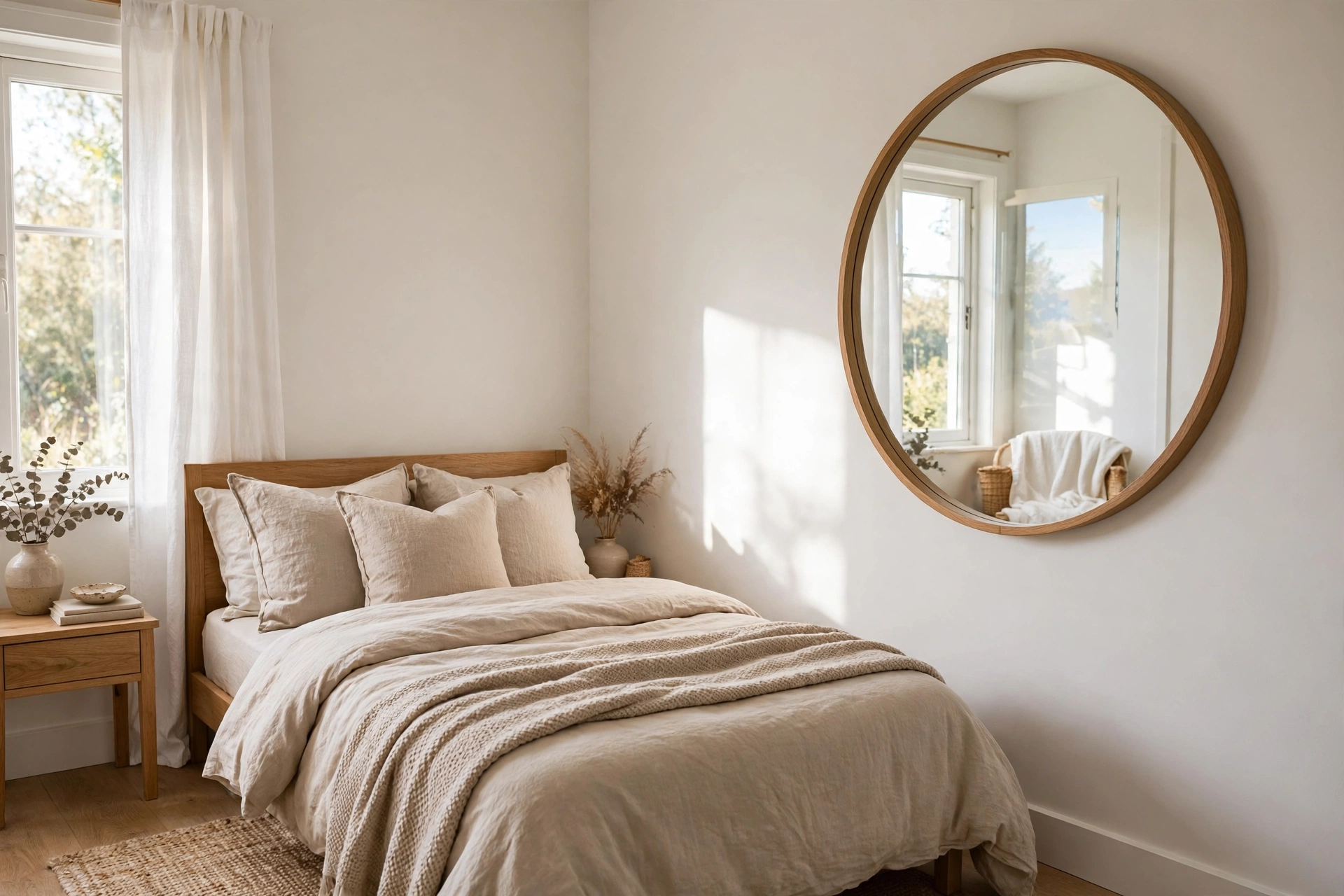
If your window gets direct sun, hang the mirror on a wall perpendicular to the window, beside it or on the adjacent wall, rather than directly across from it. A mirror opposite a sunlit window acts like a second window aimed straight at you, throwing harsh glare onto the bed in the morning and evening. Hung at a right angle, the mirror still bounces brightness deep into the room, just without the spotlight effect.
If your window only gets indirect or north-facing light, the opposite wall is fine and often the best spot, since soft light will not create glare. This is the classic “make a dark room brighter” move: a large mirror across from a gently lit window spreads that light across the whole room. Sheer curtains for a small bedroom soften direct light further, which gives you more freedom in placement.
Exact hanging heights that work
Mirror hanging heights are not guesswork. Use these numbers:
- Standalone mirror on an empty wall: hang it so the center of the mirror sits 57 to 60 inches from the floor. That puts the middle at average eye level, which is the height mirrors look natural.
- Mirror over a nightstand or dresser: leave 5 to 8 inches of wall space between the top of the furniture and the bottom edge of the mirror. Closer than that and the mirror crowds the lamp and books; higher and the two pieces stop looking like a pair.
- Full-length mirror: to see your whole body, the mirror needs to be at least half your height. A 6-foot person needs a minimum of 36 inches of mirror. The standard home size of 60 inches tall by 20 inches wide works for almost everyone. Hang it so the top edge is at least 6 inches above your head, or lean it (more on that below).

One big mirror beats several small ones
Gallery walls of tiny mirrors look busy in a small bedroom and barely add any sense of space. One large mirror does far more for depth because the reflection reads as one continuous surface, which your eye interprets as another opening in the room.
Size the mirror to the furniture below it. The mirror should be about two-thirds to three-quarters as wide as the piece beneath it. So above a 40-inch dresser, aim for a mirror roughly 26 to 30 inches wide. A mirror wider than the furniture below it looks top-heavy and throws the proportions off.
Frame choice matters too. A thin, minimalist frame lets the reflective surface do the work. A heavy ornate frame steals wall space visually, which is the opposite of what you want in a small room. If you are building out your bedroom look, our small bedroom ideas guide has more ways to keep a compact room feeling open.
Should a mirror face your bed?
This is the placement question people argue about most. Put aside the folklore: the practical complaint is real. Many people wake up, catch their own moving reflection in dim light, and feel a jolt. If that happens to you even once, it is a genuine sleep-quality issue, not superstition.
The practical fixes, in order of effort:
- Angle it. Tilt or shift the mirror a few degrees so it reflects a window or wall instead of the bed, while still reading as a design piece.
- Move it to the adjacent wall. A mirror on the wall beside the bed reflects the room’s depth from your peripheral vision, which still makes the room feel bigger without the night-time surprise.
- Cover or lean it. If a mirror must face the bed, a leaning full-length mirror can be angled away, and some people drape a throw over it at night. Do whatever lets you sleep well.
If you like the idea of a mirror near the bed, grounding it with a rug helps the whole arrangement feel intentional. See our bedroom rug placement guide for sizing that pairs well with mirrors and nightstands.
Renter-friendly options that need no drilling
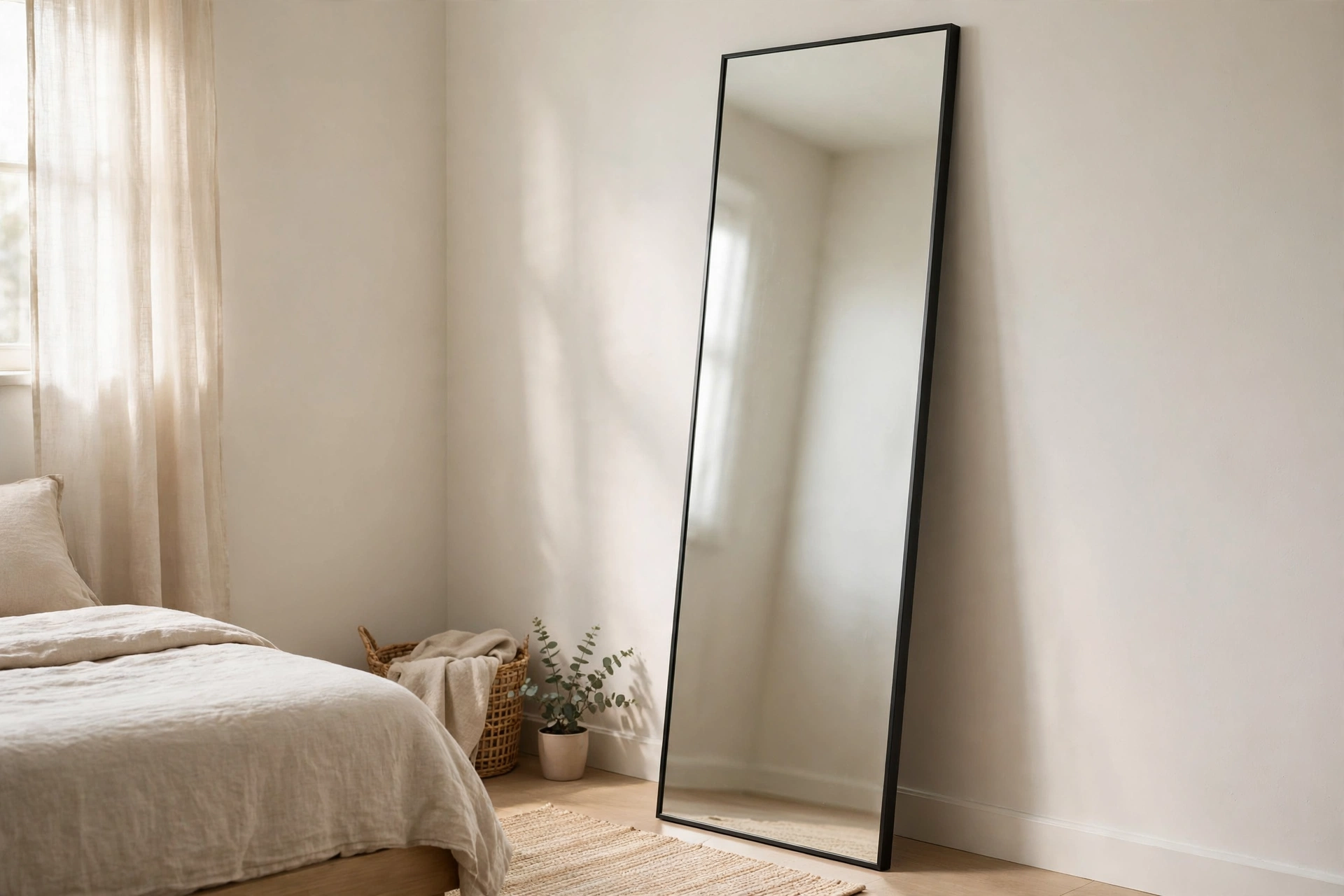
No drill, no problem. A leaning full-length mirror is the best renter move for a small bedroom. It adds the most reflective surface of any option, it fills an awkward corner, and it takes zero holes.
Lean it with a slight upward tilt so it catches the room rather than the ceiling, and always secure it with a furniture anti-tip kit. A tall mirror can weigh 30 to 40 pounds, and that is a genuine falling hazard, especially with kids or pets around. The kits cost a few dollars and install with adhesive pads or a single small screw.
For smaller mirrors, adhesive picture-hanging strips rated for the mirror’s weight work on most smooth walls, and a decorative easel or plate stand can display a small round mirror on a dresser with no wall contact at all.
Frequently asked questions
Which wall is best for a mirror in a small bedroom?
The wall beside or perpendicular to the window is the safest all-rounder: it bounces light deep into the room without the harsh glare that a mirror placed directly opposite a sunlit window can throw. If your window only gets soft indirect light, the wall opposite the window works well too. Always do the pillow check first: stand at your pillow and make sure the mirror reflects something worth doubling, like light or a tidy wall, not clutter.
How high should a mirror hang above a nightstand?
Leave 5 to 8 inches of wall space between the top of the nightstand and the bottom edge of the mirror. This keeps the mirror visually connected to the furniture below it without crowding lamps, books, or a plant on the nightstand. For a mirror on an empty wall, center it 57 to 60 inches from the floor instead.
Is it bad for a mirror to face your bed?
There is no rule against it, but there is a practical reason to think twice: catching your own moving reflection in dim light can startle you awake, and that is a real sleep-quality complaint. If it bothers you, angle the mirror so it reflects a window or wall, move it to the wall beside the bed, or use a leaning mirror you can tilt away from the bed.
Is one big mirror or several small mirrors better for a small bedroom?
One big mirror wins. A single large reflection reads as a continuous surface that your eye interprets as another opening in the room, which adds real depth. Several small mirrors reflect fragmented pieces and can look busy on the wall. Aim for one mirror about two-thirds to three-quarters as wide as the furniture beneath it.
How can I hang a mirror without drilling in a rental?
Lean a full-length mirror against the wall with a slight upward tilt and secure it with a furniture anti-tip kit, since a tall mirror can weigh 30 to 40 pounds. For smaller mirrors, use adhesive hanging strips rated for the mirror’s weight on smooth walls. You can also display a small round mirror on a dresser with a decorative easel or plate stand.