Bedroom Rug Placement: What Works Under and Beside the Bed
Bedroom rug placement works best when the rug reaches the floor you use as you get into and out of bed. Start with that spot, then decide whether one large rug, two runners or a single bedside rug fits the room. Centering a rug on the empty floor can miss the place where you actually want it.
The label on the bed is not enough to choose a rug size. Measure the outside of the frame, decide which way the rug will face and check its position from the headboard toward the foot. A rug can extend generously on both sides while leaving only a short strip beyond the footboard.
On this page
- Start where you step out of bed
- Work out the exposed rug on each side
- Use runners for narrow or one-sided layouts
- Resolve nightstands and storage access
- Test the placement before moving the bed
Start Bedroom Rug Placement Where You Step Out of Bed
Sit on the side of the bed and notice where both feet land. Then stand and take your normal first steps. Repeat on the other side if someone uses it. These positions give you a more useful starting point than an empty-room photograph.
Choose the floor area you want to cover:
- Both sides and the foot: test one rug beneath part of the bed.
- Bed and bedside furniture together: measure the whole furniture group for a larger rug.
- Only the narrow bedside strips: test separate runners.
- One accessible side: place a single rug where that person steps.
Ruggable’s bedroom guide uses 18–24 inches of exposed rug beside and beyond the bed as a design starting point. That is roughly 46–61 cm. Treat it as a border to test, not a required walkway width or a guarantee that a particular rug fits your room.
If the bed’s position is still changing, settle it first. Our small bedroom ideas cover the wider layout decisions; the rug can follow once you know where the bed and daily routes will stay.
Work Out the Exposed Rug on Each Side
Record the frame’s full width and length, including projecting upholstered sides or a footboard. Next, write the rug dimensions in the same unit and identify which edge runs across the bed. Turning a rectangular rug changes both the side border and the coverage at the foot.
For a rug centered across the frame, calculate the exposed width on each side as:
(Rug width across the bed − outside bed-frame width) ÷ 2
A 6 × 9 ft rug can have enough side coverage but little at the foot
Consider an illustrative bed frame measuring 64 inches wide by 84 inches long. These are example frame dimensions, not a standard mattress size. Position a 6 × 9 ft rug with its 9 ft edge across the bed. The rug is 108 inches across and 72 inches from its top edge to its bottom edge.
The side border is (108 − 64) ÷ 2 = 22 inches on each side. Now place the rug’s top edge 24 inches down from the head end of the frame. Its bottom edge reaches 24 + 72 = 96 inches from that same starting point. The bed ends at 84 inches, leaving 12 inches beyond the foot.
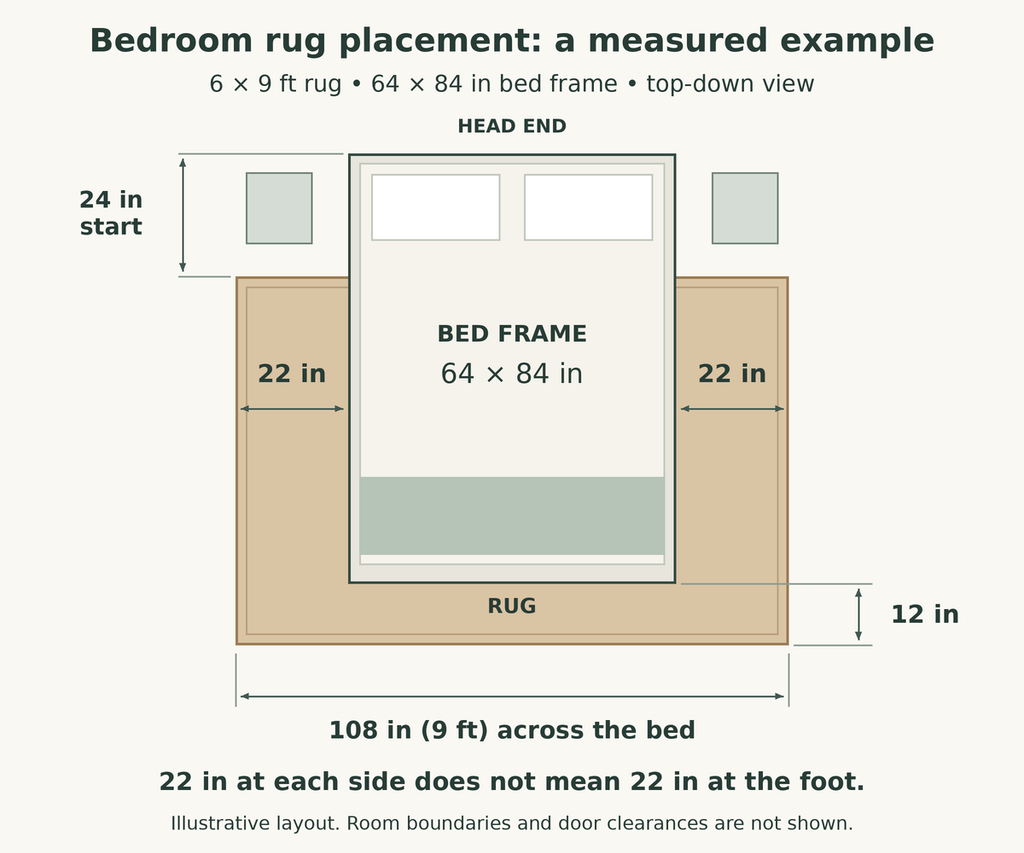
Illustrative layout: with the rug starting 24 inches from the head end, side exposure is 22 inches but foot exposure is only 12 inches. Room clearances are not shown.Moving this rug farther toward the foot increases the strip beyond the bed, but also moves its upper edge away from where you may step out. In this example, shifting it down another 12 inches would produce 24 inches of rug at the foot while changing the start position from 24 to 36 inches. Test your foot position before making that trade.
Compare another size without changing the assumptions
| Rug orientation | Exposed on each side | Exposed at the foot |
|---|---|---|
| 6 × 9 ft: 108 in across, 72 in along | 22 in | 12 in |
| 8 × 10 ft: 120 in across, 96 in along | 28 in | 36 in |
Both rows use the same 64 × 84 inch frame, with the rug starting 24 inches from its head end. The larger option adds coverage, but also reaches farther toward walls, doors and furniture. Neither size is a recommendation until you check the available floor. The product’s actual measurements may also differ from its nominal size.
Use Runners for Narrow or One-Sided Layouts
Separate runners let you cover the bedside floor without putting most of a large rug beneath the frame. Measure each open strip independently. A wardrobe on one side may leave a different usable area from the other, even when the bed looks centered on the wall.
Start each runner where it catches your feet, rather than automatically aligning its top with the headboard. Look at the short ends too: a runner may fit beside the mattress but extend into the room’s entrance. If two matching runners cannot both fit, it is reasonable to use one where it serves the room best.
Lorena Canals’ placement guide includes a single bedside rug for a bed against a wall. In that arrangement, judge the rug from the open side. There is little practical benefit in forcing equal rug exposure on an inaccessible side just to imitate a centered-bed layout.
A rug entirely beyond the foot serves a different job. It may suit a dressing spot or a bench, but it will not provide a soft landing beside the pillows. Identify which activity you are covering before buying that smaller size.
Resolve Nightstands and Storage Access
When the rug starts below the bedside tables, check that the tables remain stable on the floor. If the larger layout puts them on the rug, include their outermost legs in the measurements. Avoid ending the rug where it leaves a small table rocking across two surface heights.
Check the bed’s supports as well. A partial-under-bed layout may put some feet on the rug and others on the floor. Consider the combined rug and pad thickness, follow the bed’s setup instructions and confirm that the frame and central supports remain properly supported. A thick rug should not create a new problem with an otherwise stable bed.
Pull out under-bed drawers and rolling boxes through their full travel. Note where their wheels or lower edges cross the rug. A rug that clears the drawer when empty may still bunch as a loaded storage box rolls back. Test the storage you use rather than relying only on a tape outline.
Finally, consider removal. If cleaning the rug means moving a heavy frame every time, separate bedside rugs may be easier to manage. Check the specific care instructions and, for a machine-washable product, the required machine capacity before treating washability as a practical benefit.
Test the Placement Before Moving the Bed
Use small pieces of paper or tape approved for your flooring to mark the proposed edges; test adhesive in an inconspicuous spot first. Keep the frame where it belongs while checking the exposed borders. An outline checks size, but it cannot reproduce pile height, grip or the way a rug bends under a drawer.
- First step: do both feet land within the proposed rug rather than on its edge?
- Getting dressed: can the wardrobe and drawers open without catching the rug and pad?
- Walking through: do the door swing, vents and daily route stay usable?
- Daily upkeep: can you clean the exposed surface and remove the rug when its care instructions require it?
Use a pad or backing compatible with both the rug and your flooring where required. Check that the installed rug lies flat without sliding or curled edges. Get suitable help to move a heavy bed; do not try to force a rug beneath loaded furniture by pulling it from one side.
Keep the successful measurements: the rug’s orientation, its distance from the head end and the exposed borders. Those details tell you more than the rug size alone, and they make it easier to compare another product without starting the layout again.