Where to Put a Microwave in a Small Kitchen (6 Spots)
A countertop microwave eats 18 to 24 inches of counter width and 15 to 20 inches of depth. In a small kitchen, that is often the difference between cooking comfortably and chopping dinner on a cutting board balanced over the sink. If your counter is already full, the microwave is the first thing that should move.
The good news: a microwave is the easiest appliance to relocate. It asks for only three things: an outlet, airflow around it, and a safe height for lifting hot food. Below are the exact rules that decide the spot, the six best places ranked from most to least renter-friendly, and a quick decision tree for galley, L-shape, and studio kitchens.
On this page
- The rules that pick the spot
- The 6 best spots, ranked for renters
- Decision tree by kitchen layout
- 5 safety mistakes to avoid
The rules that pick the spot
Four rules decide every placement below. Get these right and the spot almost picks itself.
- Height: keep the cavity floor between 24 and 48 inches off the floor. The absolute ceiling is 54 inches to the floor of the microwave cavity. Above that, lifting a bowl of hot soup down to your face becomes a burn risk. This is why “on top of the fridge” only works when the fridge is low and you are tall enough. Too low is a problem too: a microwave sitting near the floor forces awkward bending with hot food.
- Airflow: 3 inches on both sides, 3 inches above, 1 to 2 inches behind. You will find two competing clearance rules online, 2 to 3 inches all around versus the numbers above, and both exist because vent placement varies by model. Some microwaves vent through the sides, some through the back, some through the top. Always read the manual first. When the manual is unavailable, use the default above: it covers every vent layout. One exception: if you know the unit is rear-venting, the behind clearance matters less, but never skip the sides and top. Keep the front edge flush with or slightly proud of the cabinet face so heat escapes forward instead of into the woodwork.
- Landing zone: 15 to 18 inches of clear counter beside or below the opening. Hot food needs somewhere to land the second the door opens. A spot that is perfect for the microwave but forces you to carry a bubbling bowl across the kitchen is the wrong spot. Measure this before you commit to a placement, not after.
- Power: a dedicated 20-amp, 120-volt circuit, no extension cord. Most countertop microwaves draw 1,000 to 1,600 watts, which is a lot for a shared circuit. Never run one on an extension cord or a light-duty power strip; the cord can overheat even when everything seems fine. A short, heavy-duty appliance cord rated for the wattage is the only acceptable substitute, and a wall outlet on its own circuit is better.
One more thing before you move anything: if the real problem is that your whole kitchen is short on storage, our guide to small kitchen storage ideas may free enough counter space that the microwave never has to move at all.
The 6 best spots, ranked for renters
Ranked from least to most demanding of your landlord.
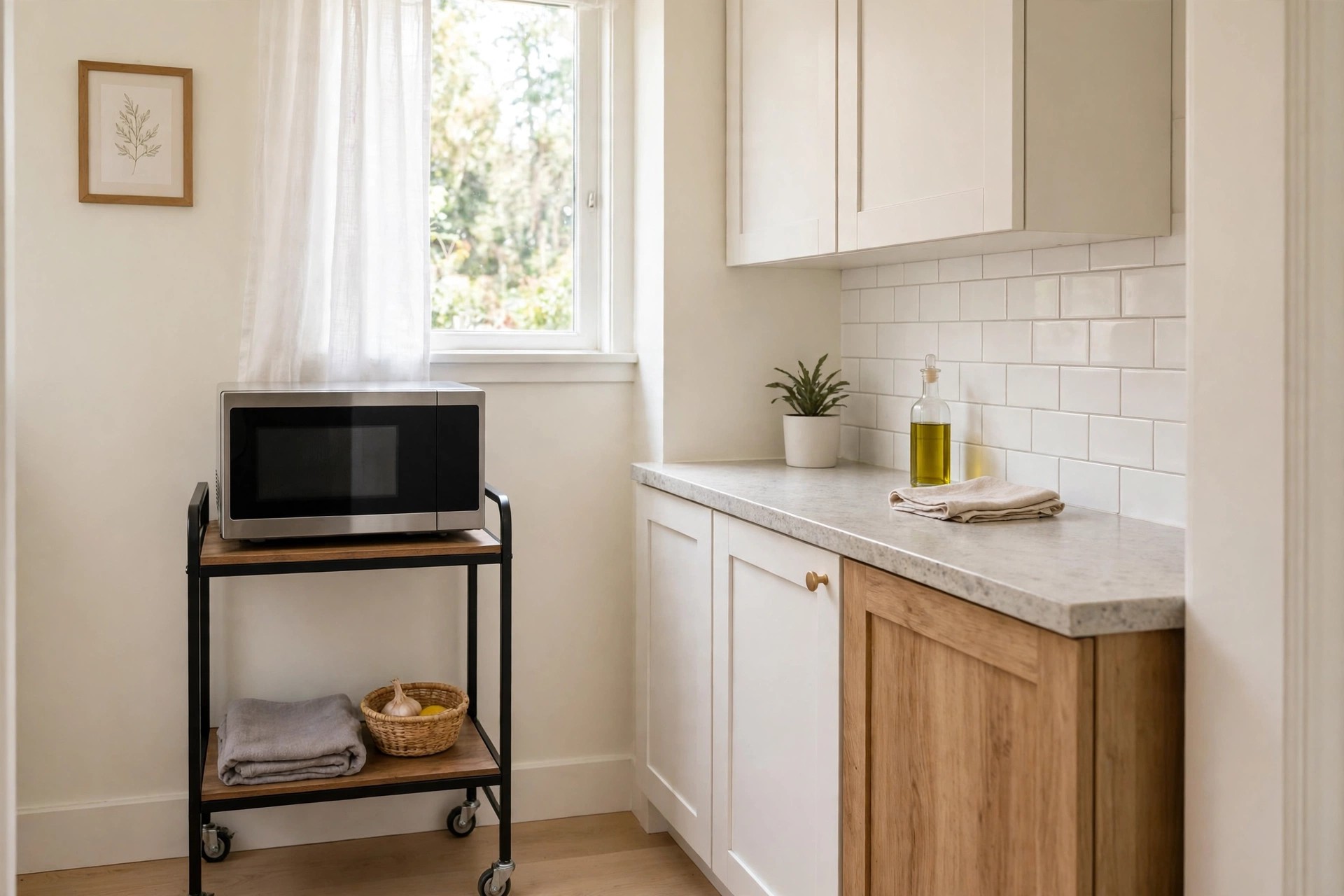
- A rolling microwave cart or stand. The most renter-friendly option: no holes, no brackets, no landlord conversation. A basic cart costs little, holds the microwave at a comfortable 30 to 40 inches off the floor, and adds a bonus shelf underneath for storage or a landing zone. Roll it against a wall or into a corner when you need the floor back. The only trade-off is floor space, and in most kitchens a 20-inch cart fits where nothing else could.
- A sturdy floating shelf on the wall. Frees the counter entirely and puts the microwave at a perfect height. The catch: the shelf must be rated for 30+ lb, a loaded microwave weighs roughly 25 to 40 lb, and it must be anchored into studs, not held by drywall anchors alone. If your lease allows small anchors, this is the best-looking permanent option.
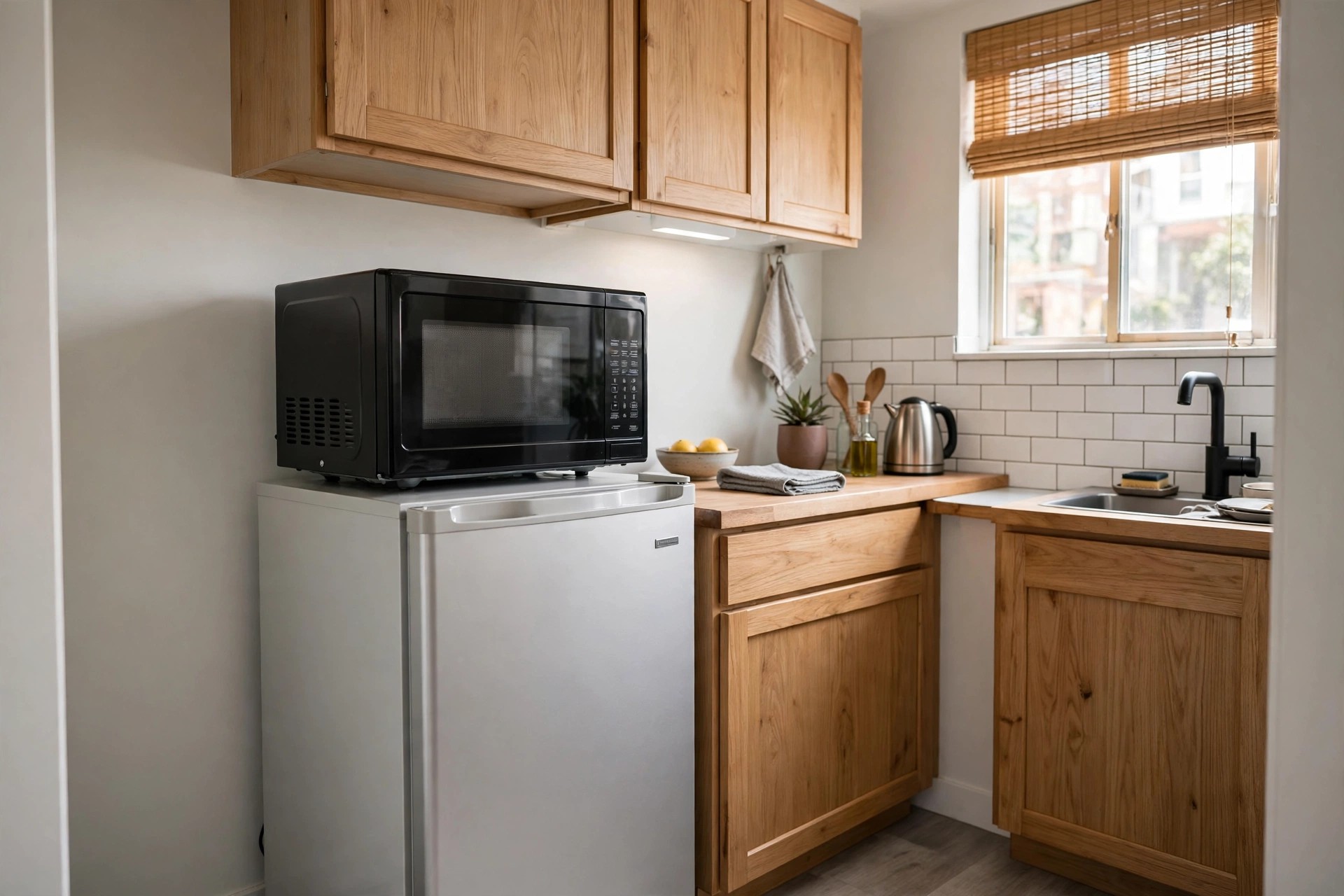
- On top of the fridge. Free, instant, zero installation. It works only if three conditions are met: the fridge top is stable and reachable, the cavity floor lands at or below 54 inches, and the sides and back keep their ventilation clearance. Skip it if you are short or the fridge is tall: reaching up with hot food is exactly how spills happen.
- Over the range. This means a true over-the-range microwave, never a countertop model perched above the stove. These units need 13 to 18 inches of clearance above the cooktop and are engineered so the top of the unit lands around 66 inches off the floor. If your stove layout and wiring allow it, this clears the counter completely. The trade-off: it usually needs an electrician and landlord approval, so renters rank it lower.
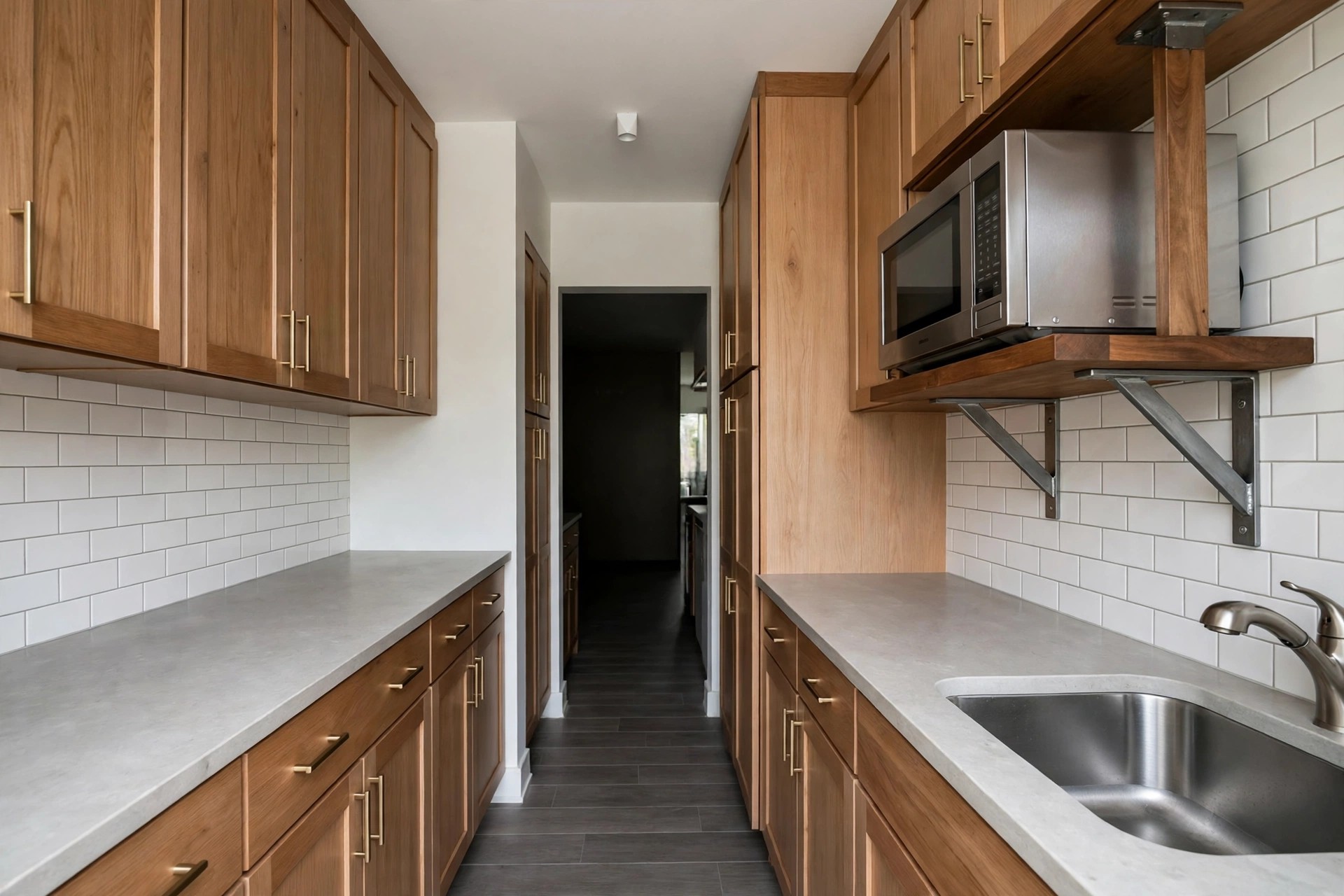
- An under-cabinet mount with brackets. A countertop microwave hung beneath a wall cabinet saves the counter and keeps a great height. It requires drilling into the cabinet bottom and a model rated for bracket mounting. Good if your lease allows it, a non-starter if it does not.
- Inside a cabinet with the door removed. Tucking the microwave into a base or wall cabinet hides it completely. Two non-negotiables: honor the full ventilation clearances from rule 2, and remove the door (or swap it for an open frame), because cooking inside a closed cabinet traps heat. Compact models of 0.7 to 1.1 cubic feet fit niches and corners best. If you buy a trim kit to make it look built-in, it must be model-specific; a generic kit blocks vents.
Decision tree by kitchen layout
Pick your layout and take the recommended shortcut.
Galley kitchen (two parallel walls): put the microwave on the wall opposite your main prep counter, ideally on a shelf or a rolling cart near the fridge end. This keeps the walkway clear and puts hot food near your landing zone. Our guide on where to put small appliances in a small kitchen covers how to zone a galley so appliances stop fighting over the same outlet.
L-shape kitchen: the inside corner of the L is usually dead space. Park a rolling cart in or beside that corner, or mount a shelf on the shorter leg. Keep the microwave within one step of the main counter, not across the room: the landing zone rule applies to walking distance too.
Studio or kitchenette: you have one wall, maybe two. On top of the fridge is the classic move if the 54-inch height check passes. Otherwise, a slim rolling cart parked at the end of the counter doubles as extra prep space. For squeezing storage out of the same footprint, see small kitchen without a pantry.
5 safety mistakes to avoid
- Pushing it flush against the wall or into a tight cubby. Blocked vents are the fastest way to overheat a microwave and the most common cause of that burning smell. Honor the clearance rule even when the spot looks perfect.
- Mounting it too high. Above 54 inches to the cavity floor, every hot bowl becomes a spill waiting to happen. If the only high spot available breaks this rule, pick a different option.
- Running it on an extension cord. A 1,000+ watt appliance on a thin cord is a fire risk. Plug directly into the wall on a dedicated circuit.
- Trusting a shelf that is not rated for the load. A microwave weighs 25 to 40 lb loaded. Shelves must be rated for 30+ lb and anchored into studs. Drywall anchors alone are a collapse waiting to happen.
- Skipping the landing zone. No 15 to 18 inches of clear space beside or below the opening means hot food travels across the kitchen in your hands. Rearrange so the landing zone comes with the spot.
Frequently asked questions
Can a microwave go inside a cabinet?
Yes, as long as the full ventilation clearances are honored: 3 inches on both sides, 3 inches above, and 1 to 2 inches behind when the manual is unavailable. Remove the cabinet door or replace it with an open frame, because cooking inside a closed cabinet traps heat. Compact models of 0.7 to 1.1 cubic feet fit best, and any trim kit must be made for your exact model.
How much clearance does a microwave need around it?
The safe default is 3 inches on both sides, 3 inches above, and 1 to 2 inches behind. Clearance rules vary online because vent placement varies by model: some vent through the sides, some through the back, some through the top. Always follow your manual first and use this default only when the manual is unavailable.
What is the best place for a microwave in a rental?
A rolling microwave cart or stand. It needs no drilling, no brackets, and no landlord approval, it holds the microwave at a comfortable 30 to 40 inches off the floor, and the shelf underneath doubles as a landing zone. If your lease allows small anchors, a sturdy wall shelf rated for 30+ lb anchored into studs is the next best option.
Can I put a microwave above the stove?
Only an over-the-range microwave designed for that job, never a countertop model. Over-the-range units need 13 to 18 inches of clearance above the cooktop and are engineered so the top of the unit lands around 66 inches off the floor. Most installations need an electrician and landlord approval, so renters should treat this as a last resort.