Duvet vs Comforter: Which Fits Your Laundry Routine?
The duvet vs comforter decision comes down to which bedding routine you prefer. A duvet system lets you remove the cover for washing or a change of color, but you have to put it back around the insert. A finished comforter avoids that assembly step, while its filled layer needs its own practical cleaning plan. Neither name tells you, by itself, how warm the bedding will feel.
If your current bedding is comfortable and manageable, you may not need to replace it. Start with the task you want to improve: washing a bulky item, wrestling with a cover, keeping the bed neatly covered, or storing seasonal layers.
On this page
- Compare the two setups
- Choose for your actual laundry routine
- Check warmth and fit separately
- Decide whether to keep, adapt or replace
Duvet vs Comforter: Compare the Setup You Will Use
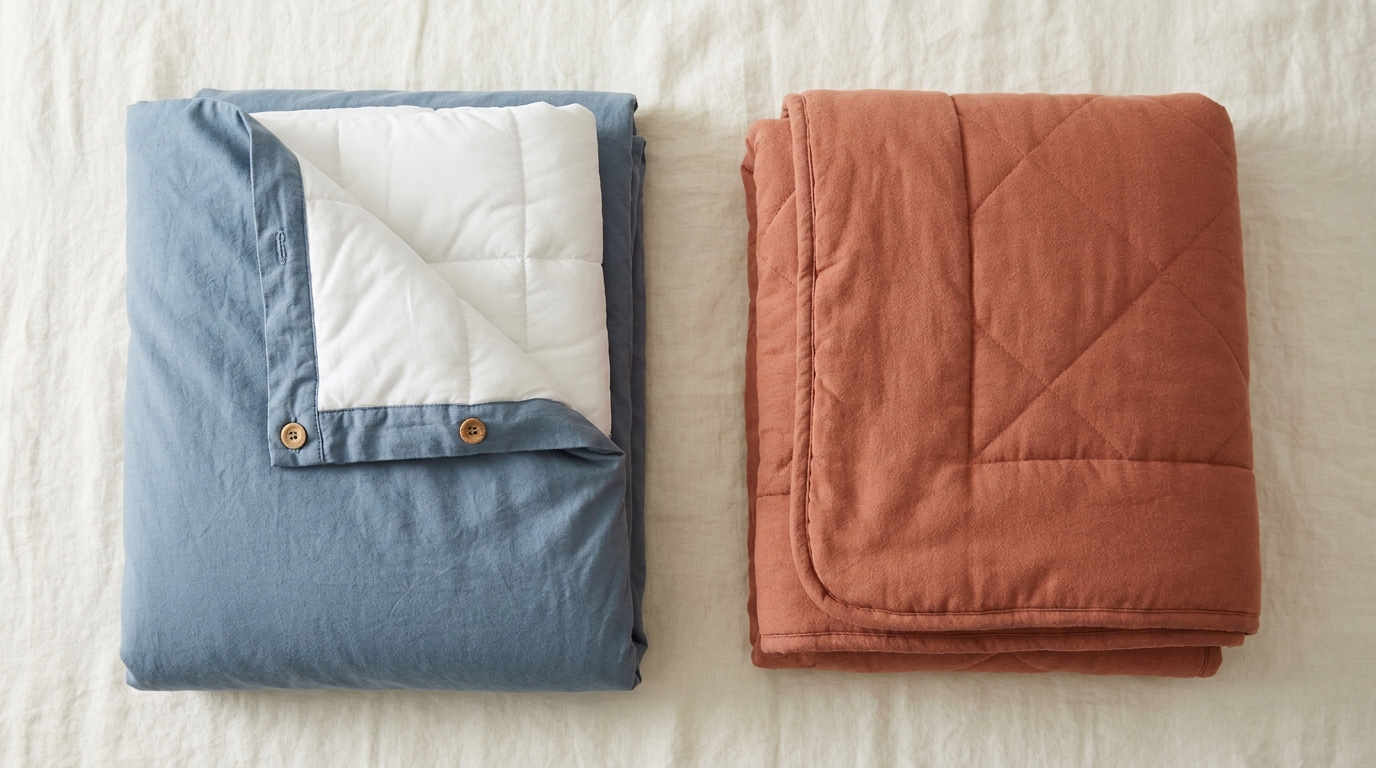
A duvet cover is an unfilled fabric envelope with an opening for a separate filled insert. A comforter usually means a finished filled bed covering that can be used without a removable cover. That is the basic distinction in The Company Store’s bedding guide.
| Decision | Duvet with a cover | Comforter used alone |
|---|---|---|
| Regular handling | Remove and refit a separate cover. | Straighten a single filled piece. |
| Changing the look | Replace or rotate the cover. | Change the visible filled piece or add a suitable cover. |
| Matching pieces | Check insert and cover compatibility. | Check the finished item against the bed. |
| Cleaning plan | Read the cover and insert labels separately. | Read the filled item’s label; check any additional cover separately. |
The terminology overlaps in real shops. For example, The Company Store’s Classic Down Alternative Comforter has corner loops and is described as suitable for use alone or inside a coordinating cover. Read the product’s features instead of rejecting it because the title says “comforter.”
Check what the package includes, too. A duvet-cover set may contain a cover and pillowcases or shams without any filled insert. A low price for that set is not directly comparable with the price of a complete filled bedding setup.
Choose for Your Actual Laundry Routine
Imagine stripping the bed on your usual laundry day. Where will each piece be washed, how will it dry, and what will go back on the bed that evening? This is a more useful comparison than calling one option easier for everyone.
When a removable cover helps
A cover gives you a separate outer layer to clean. You can remove it without putting the filled insert into the same load, provided the insert itself does not also need cleaning. The trade-off comes afterward: fitting the insert back into the corners and closing the cover.
Think about whether that task is comfortable for you. A wide opening and usable corner ties may make a cover more convenient, but inspect the actual design. Small buttons, a narrow opening or a heavy insert can make the job less appealing than it sounds in a product description.
If you already struggle to refit a cover, try changing the cover design or getting help with that task before buying a whole new bedding system. A spare cover can also let you remake the bed while the washed one dries, if you have room to store it.
When a finished comforter is simpler
A comforter can suit someone who wants to put one filled piece on the bed and straighten it without attaching an insert. That convenience matters if the cover-changing task is the part of laundry you dislike most.
Before choosing it, settle the bulky-wash question. Whirlpool’s comforter-washing guidance emphasizes checking the care label and using a machine with room for the item to move. Being able to push a comforter through the washer door does not establish that the machine can wash it properly.
Check the bedding label and your washer and dryer instructions together. If the item needs equipment you do not have, include the time and cost of using a suitable laundry service or laundromat. Do not choose a universal machine-capacity number from a bedding size alone; bulk and appliance requirements also matter.
Drying is part of the decision. Follow the item’s care directions, and make sure it is fully dry before using or storing it. A duvet insert will also need an appropriate cleaning and drying plan when required; having a removable cover does not make the filling permanently maintenance-free.
Two different households, two reasonable choices: Someone who has access to suitable machines and dislikes refitting covers may prefer a washable comforter. Someone who finds regular bulky loads inconvenient but is comfortable changing covers may prefer a duvet system, with a separate plan for cleaning the insert. These are decision examples, not product-test results.
Check Warmth and Fit Separately From the Name
Do not choose a duvet because you assume it is always warmer, or a comforter because you assume it will feel lighter. Look at the actual filling, construction and manufacturer’s warmth description. Consider the cover and any other layers you use as part of the complete bed.
IKEA’s duvet guide offers several warmth levels and asks shoppers to consider bedroom temperature, personal preference and other bedding. A warm insert in a warm room may be the wrong combination even if its removable cover suits your laundry routine.
Physical weight and warmth are separate preferences. You might like substantial bedding but become uncomfortable under a very insulating layer, or prefer warmth without much weight pressing down. Read those descriptions separately and use your existing bedding as a reference for what you want to change.
If you share the bed, compare both people’s preferences before buying one heavier layer. Different personal layers may be worth considering when you regularly disagree about warmth. You can keep a coordinated appearance without requiring both sleepers to use exactly the same setup.
For a duvet, check two kinds of fit
Cover-to-insert fit: Compare the listed width and length in inches or centimeters, not just the words “queen” or “king.” Check the manufacturer’s recommended pairing and the locations of ties and loops. An oversized cover can leave empty fabric at the edges; forcing a much larger insert into it can create bunching.
Bedding-to-bed fit: Check how far the finished bedding reaches down the mattress sides and at the foot. Mattress depth, a topper and a projecting frame all change the appearance. Use a covering you already own to identify where you want more or less coverage, then compare its measurements with the proposed purchase.
A comforter used alone skips the cover-to-insert match, but it still needs the bed-fit check. Extra width is not automatically useful if the edges trail on the floor or gather against furniture.
In a compact room, avoid solving a styling problem by buying several bulky layers you will need to store. Keep access around the bed usable for changing the sheets; our small bedroom ideas include planning that access and using storage you can actually reach.
Keep, Adapt or Replace Your Current Bedding
Keep it if the warmth, coverage and cleaning routine already work. A different bedding name will not improve a problem you do not have. You can change the room’s appearance with pillowcases or a modest throw you actually use.
Adapt it if the filled piece is comfortable but you want a removable outer layer. Check whether the manufacturer permits using it inside a cover, then match dimensions and attachments. If it already feels too warm, account for the added cover before treating this as the obvious solution.
Replace the part causing the problem when possible. A troublesome closure may call for a different cover, while inadequate coverage or an unsuitable warmth level may call for a different filled piece. Buying both again is not always necessary.
Compare complete costs before ordering: the filled item, any required cover, the spare cover you intend to buy, and cleaning arrangements. Check the return conditions, especially if you want to assess the weight or feel at home. A display photo cannot tell you whether a particular combination will suit your routine.
Finish with one sentence: “I want to make easier, and I am willing to.” That might be “wash the outer layer more conveniently, and refit a cover,” or “make the bed with fewer parts, and arrange bulky-item cleaning.” The better choice is the setup that solves your actual task at a warmth and size you like.