Where to Put a Washing Machine in a Small Apartment
A washing machine does not need a laundry room. It needs three things: a water supply, a drain, and enough clearance to open, load, and breathe. In a small apartment, the best spot is usually the one that already has two of those three. That is why the winning locations are almost always a closet near plumbing, a bathroom corner, or a kitchen run, not a spare corner of the living room.
Start by ruling out the romantic options. A machine in the middle of a room looks fine in a photo and feels wrong every laundry day, because hoses, vibration, and a full hamper have nowhere to hide. Pick a spot you can close, curtain, or stack, and your apartment will still feel like an apartment when laundry is running.
Start With Your Hookups, Not Your Floor Plan
There are only three kinds of apartment laundry setups, and your building decides which ones are open to you. A full hookup means a hot and cold water outlet, a drain standpipe, and a vented dryer outlet or a ventless dryer option. A partial setup means you have a sink and a standard outlet but no dedicated hookup. No setup means you have neither, and you are choosing between a portable machine and a shared laundry room.
Check four things before you fall in love with a spot. First, water: is there a faucet or supply valve within hose reach, usually 4 to 5 feet? Second, drain: can water run downhill to a sink, tub, floor drain, or standpipe without a hose crossing a walkway? Third, power: is there a grounded outlet on its own circuit, or at least one that is not already running a microwave and a kettle? Fourth, floor: is the floor level and solid? A machine on a springy floor will walk, shake, and annoy the neighbors below.
If you have a full hookup, use it, even if it is in an awkward closet. Moving plumbing to a prettier spot costs far more than a curtain or a folding screen ever will.
The Stacked Closet: Best for Most Apartments
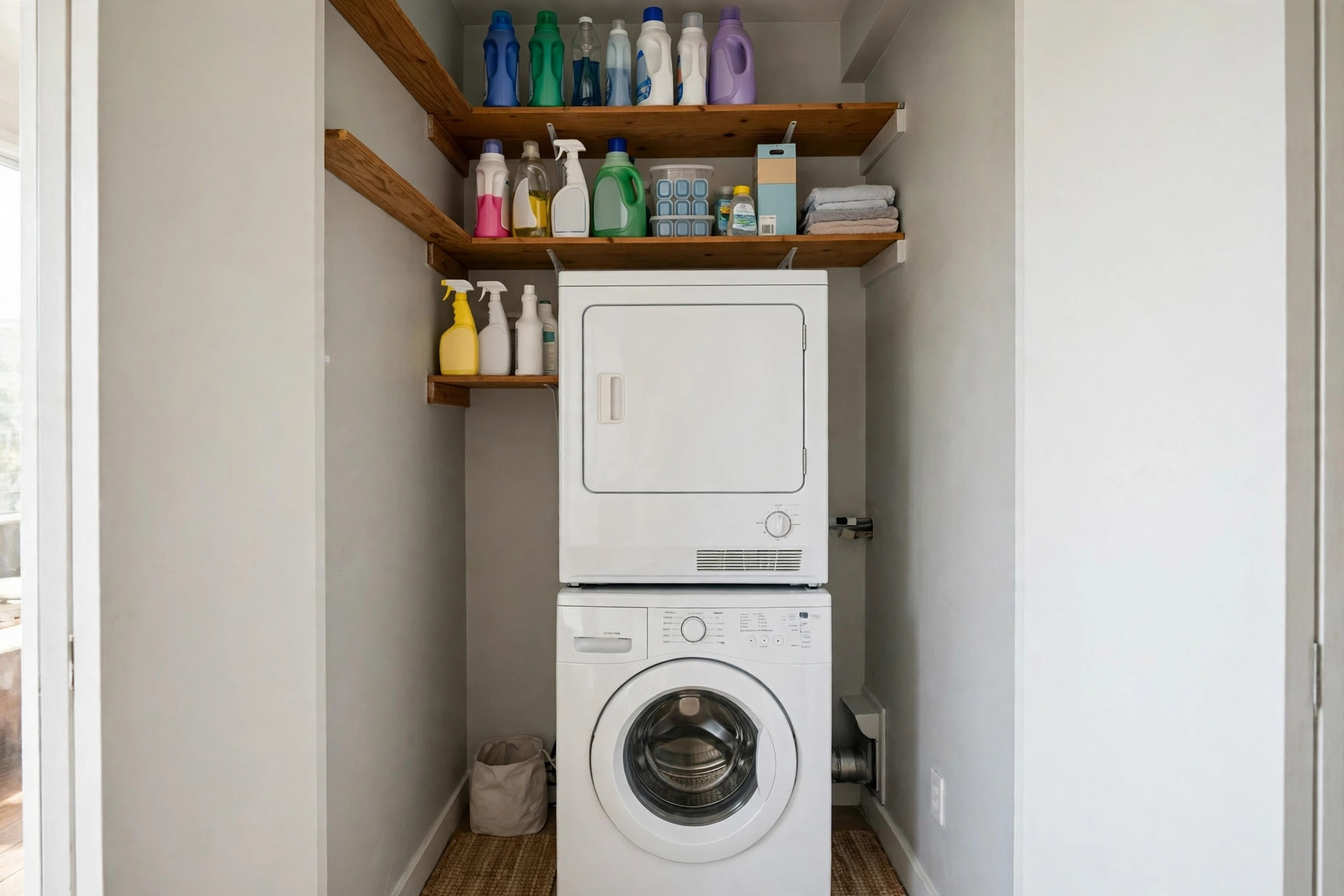
A stacked washer and dryer turns one machine footprint into a full laundry pair. A typical compact stack needs about 24 to 27 inches of width, 27 to 30 inches of depth, and 70 to 76 inches of height, plus room to open the doors and pull out the lint filter. Measure the closet, then measure the door the machines must pass through. Many stacks fit the closet and fail at the front door.
The stack works best in a hall closet, an entry closet, or a bedroom closet that shares a wall with a bathroom, because plumbing is close. Put a shelf above the stack for detergent, not on top of the dryer, where bottles fall and heat builds up. Leave at least 1 inch of side clearance and 4 to 6 inches behind for hoses, and keep the dryer vent path short and straight. A long, kinked vent is a fire risk and a drying-time problem.
Hide the stack with bifold doors, a curtain on a tension rod, or a sliding panel. Do not seal it airtight. Dryers need airflow, and a damp closet grows mold fast. If the closet has no vent, a ventless heat-pump dryer or a washer-only setup with a drying rack is the safer pair.
For the hamper that feeds the stack, keep it in the same zone. A slim basket beside the closet beats a basket in another room that you must carry across the apartment. See our guide on where to put a laundry basket in a small bedroom for a system that keeps dirty clothes out of sight between loads.
The Portable Sink Model: Best With No Hookups

A portable washer connects to a kitchen or bathroom sink faucet with an adapter, fills from the tap, and drains into the sink. Most compact models hold 0.9 to 1.7 cubic feet, roughly 6 to 11 pounds of laundry, which suits one or two people doing 2 to 4 small loads a week. It is not a family machine, and pretending otherwise is how clothes come out damp and the sink stays busy for an hour.
Store the machine where it can roll to the sink without crossing a rug or a threshold. A kitchen corner, a bathroom-adjacent closet, or the gap beside a cabinet works, as long as the path is short and the floor is hard. Put a small rubber mat under its parking spot to protect the floor and catch drips. When laundry is done, disconnect the hoses, coil them, and roll the machine back. The reset matters: a portable washer left connected turns your kitchen into a laundry room all week.
Check your faucet before you buy. Standard aerator faucets accept most adapters, but pull-out spray faucets often do not. Check the drain too. Gravity-drain models need the drain point lower than the machine, or a pump model that can push water up into the sink. If your sink drains slowly already, fix that first. A washer will only make it worse.
The Bathroom Corner: Best for Plumbing
The bathroom already has water, a drain, and a floor that can handle splashes, which makes it the most practical room for a compact washer. The best bathroom spot is the wall beside the sink or toilet where a 24-inch-wide machine can sit without blocking the door swing or the toilet clearance. You need about 30 inches of clear floor in front to load and service it, and you must keep the machine out of the direct shower spray zone.
Ventilation decides whether this works long term. A bathroom washer in a room with no fan will stay damp, and damp plus detergent residue smells. Run the fan during and after each load, wipe the door seal on a front loader, and leave the door ajar between loads. If the bathroom is tiny, a washer-only model plus a wall-mounted drying rack beats a bulky combo that crowds the room.
Storage in a small bathroom has to work harder once a machine moves in. Keep detergent on a high shelf or in a slim rolling cart that slides into the gap beside the machine, and keep towels somewhere dry, not draped over the washer. Our small bathroom storage ideas and our guide on where to store towels in a small bathroom both use the same rule: everyday items at arm height, backup stock up high.
The Kitchen Run: Best for Hiding It
A slim washer under a kitchen counter or at the end of a cabinet run is common in small apartments, and it hides well behind a cabinet-front panel. Standard counter height is about 36 inches, so check the machine height before you plan this. Many compact models fit, but a taller model will not, and cutting a counter to fit a washer is rarely worth it.
The kitchen spot wins on plumbing and loses on timing. Your sink is busy while the washer runs, because most compact models borrow the faucet or share the drain. Plan laundry around cooking, not during it. Keep a small landing zone beside the machine for the detergent and the hamper, so you are not carrying wet clothes across the kitchen.
Noise matters more in a kitchen than in a closet, because the room is open to the living space. Look for a machine rated near 60 decibels or lower for wash cycles, and run full loads rather than many small ones. A level machine on a solid floor vibrates less than a bigger, unbalanced one, so level it with a spirit level on delivery day, not after the first noisy spin.
The Measurements Checklist Before You Buy
Measure twice, in this order. Width of the spot, minus 1 inch of side clearance on each side. Depth, including the door swing and 4 to 6 inches behind for hoses. Height, including the lid if it is a top loader, because a top loader under a shelf cannot open. Doorway width along the delivery path, including turns and elevator doors. Floor space in front, at least 30 inches for loading and service.
Then measure the laundry itself. A compact washer that holds 6 pounds will need more loads than a 1.7 cubic foot model, and more loads mean more sink time for a portable model. Count your real weekly loads, not your ideal ones. One person in a small apartment usually runs 2 to 3 loads a week. Two people run 3 to 5. If your count is higher, a compact machine will feel small fast, and a shared laundry room may still be the honest answer.
Write the numbers on your phone before you shop. Models look smaller in a store than they do in a 24-inch closet, and a tape measure is cheaper than a return.
Renter Rules That Save Your Deposit
Ask your landlord in writing before you bring in a machine, even a portable one. Some leases ban washers because of leak risk, and a leak in an upper-floor apartment damages more than your own floor. Explain the setup in one sentence: the machine type, where it drains, and what leak protection you will use. A water-leak alarm under the machine costs little and reassures a landlord a lot.
Do not drill, move plumbing, or vent a dryer through a wall without permission. Use renter-safe options instead: a faucet adapter, a freestanding stack, a curtain instead of a door, a rolling cart instead of a built-in shelf. Keep the original faucet aerator so you can restore it on move-out day.
Get renter insurance if you do not have it, and photograph the setup on day one. If a hose ever fails, you want proof that the installation was careful, not improvised.
What to Skip in a Small Apartment
Skip a full-size side-by-side pair unless you have a true hookup room. It eats a wall and leaves no room for folding, sorting, or storage. Skip a vented dryer with no vent route. Venting into a room is not a workaround, it is a moisture problem. Skip a washer in a bedroom closet with no plumbing nearby. Running long hoses across a bedroom is a trip hazard and a leak path.
Skip the cheapest twin-tub if you want hands-free washing. Twin tubs are light and cheap, but you move clothes between tubs by hand, and that gets old by the third week. Buy the format that matches how much work you will actually do, not the lowest price.
The best spot is rarely the biggest empty corner. It is the smallest spot that already has water, a drain, and a door you can close. Find that spot, measure it honestly, and let the machine type follow the plumbing, not the other way around.
Can I put a washing machine in a small apartment bathroom?
Yes, if it fits without blocking the door or toilet clearance and the room has ventilation. Keep at least 30 inches of clear floor in front, keep it out of the shower spray zone, and run the fan during and after each load.
Do portable washing machines need a hookup?
No. Most portable models connect to a sink faucet with an adapter and drain into the sink. You still need a compatible faucet, a drain route, and a grounded outlet.
How much space does a stacked washer and dryer need?
A compact stack usually needs 24 to 27 inches of width, 27 to 30 inches of depth, and 70 to 76 inches of height, plus 1 inch of side clearance and 4 to 6 inches behind for hoses.
Can my landlord forbid a portable washing machine?
Yes, if the lease bans washers or the building rules do. Ask in writing first, explain the drain setup and leak protection, and keep the approval with your lease.
Is a washer dryer combo better for a small apartment?
A combo saves space because it is one machine, but drying takes longer and loads must be smaller for good drying. It suits one or two people best, and a washer plus a drying rack often dries faster for the same footprint.