How to Style Open Shelves Without Clutter
To style open shelves without clutter, start with what the shelves need to hold, arrange those items in a few clear groups, and leave enough room to remove and return things easily. Add decorative pieces only after the useful items have a place. You do not need to fill every gap or buy matching accessories to make the arrangement feel finished.
The right balance depends on the shelf. A bookcase can be mostly books, a kitchen shelf can hold everyday dishes, and a living room shelf might combine reading material with a few personal objects. The aim is an arrangement you enjoy looking at and can actually use, rather than one you must dismantle to reach a favorite mug.
Give Each Shelf a Clear Purpose
Look at what has collected on the shelf before moving it. Separate things you use, things you want to display, and things that landed there because they had nowhere else to go. A shelf holding books and one photograph has a clear role. A shelf holding books, receipts, charging cables, spare toiletries, and several unrelated ornaments needs some decisions before styling.
Choose a main purpose for each section. One shelf might hold current reading, while another stores a few games. It is fine to mix useful and decorative objects, but avoid asking every shelf to do every job. Clear roles make it easier to put things back after the initial tidy.
Move belongings that do not fit those roles to proper homes. Do not solve the problem by relocating the same loose pile to a nearby table. If the room needs a broader reset, our guide to refreshing your home with what you already own can help you rethink existing pieces.
Check the shelf itself while it is clear. Note its usable depth, height, condition, and load limit. Follow the furniture or shelving manufacturer’s installation and anchoring instructions. Styling should work within those limits, especially when you are arranging books, ceramics, or other heavy objects.
Place Useful Items Before Decorative Ones
Start with the items that genuinely need the space. Put regularly used objects where they are comfortable to reach. Leave room above a stack to lift the top item and beside a row to pull something out without knocking into a neighboring display.
For books, try a supported upright row before experimenting with stacks. Keep titles visible if that is how you find them. Turning every spine inward may create a uniform photograph, but it makes little sense if you regularly search for a particular book.
Horizontal stacks can provide variety when they hold books you rarely need or use together. Keep them short enough to manage, and avoid balancing a fragile object on a book you frequently remove. A practical arrangement should survive an ordinary evening of reading.
For dishes, group the pieces you use together and keep stacks manageable. Test lifting an item with the neighboring objects still in place. If you must move a vase before taking down a bowl every morning, the vase needs another position.
Style Open Shelves Without Clutter by Building Clear Groups
Think in groups rather than individual objects spread across the entire shelf. A row of books can form one group, a small bowl and framed picture another. Leave a visible separation between groups so they do not read as one continuous line of belongings.
There is no fixed number of objects that every shelf needs. Three small ornaments can still look scattered on a wide shelf, while a long row of books may look orderly. Judge the arrangement by its scale and how it works from the room, not by a rule about odd numbers.
Vary height where it helps the arrangement feel less flat. An upright frame beside a lower bowl may be enough. Keep the taller item from hiding something you need to see or reach, and use frames or objects with stable supports rather than relying on a precarious lean.
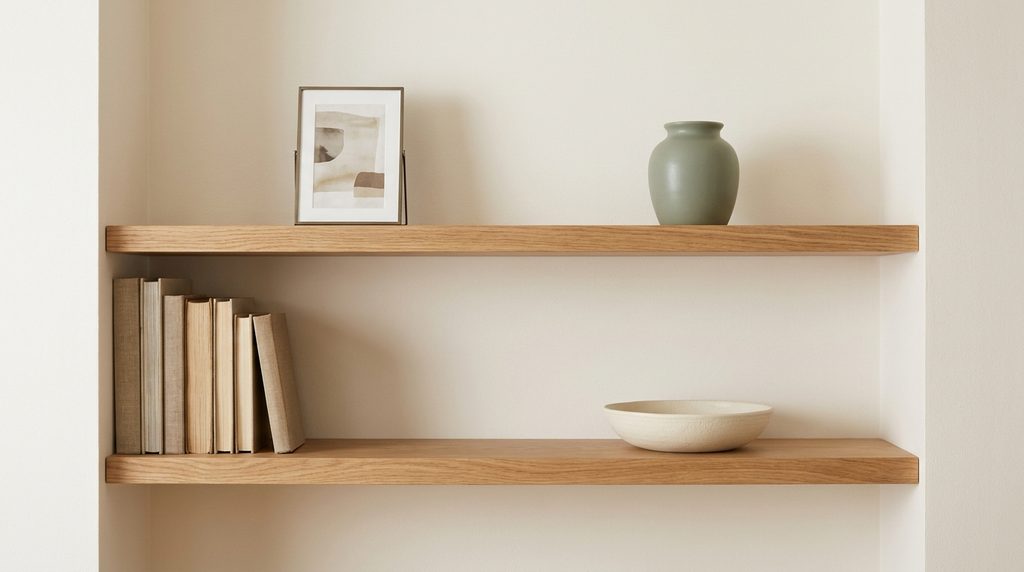
Repeat a few colors or materials already present in the room. Warm wood, cream ceramics, and a muted green object can connect different shelves without requiring everything to match. A colorful collection can also work when it is grouped deliberately instead of dispersed among many unrelated pieces.
Three Shelf Arrangements You Can Adapt
A living room shelf for books and one personal object
Place your current books together at one end, supported as needed. At the other end, display one object you enjoy: a small framed photograph, a handmade bowl, or a souvenir with a stable base. Leave the middle open enough that each part has a clear boundary.
On the shelf above or below, avoid copying the arrangement exactly if it makes the whole unit look rigid. You might use a shorter book row or a single larger object. The shelves can relate through color or material while holding different things. If the surrounding furniture also needs adjusting, explore our small living room ideas.
A kitchen shelf that earns its space
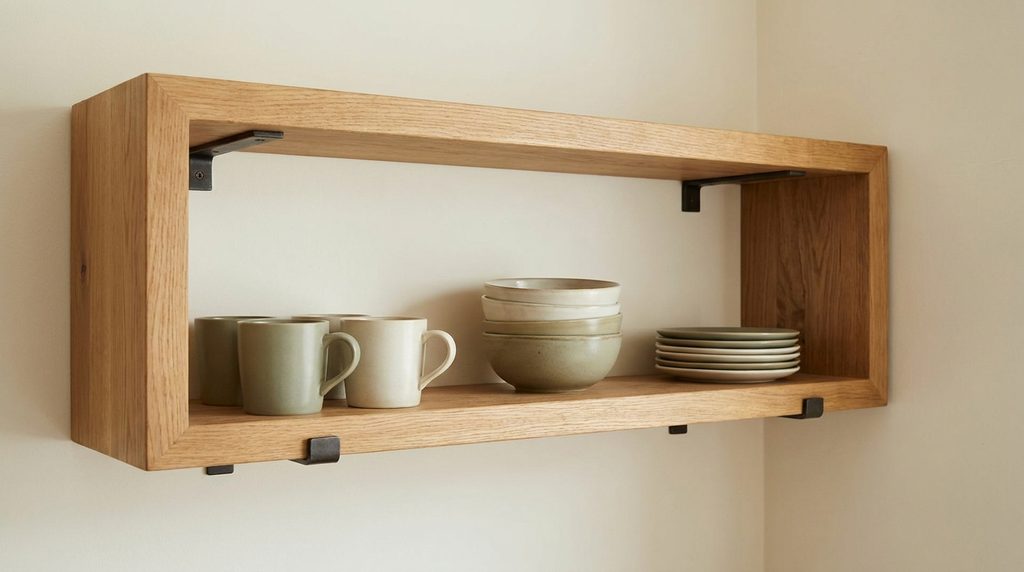
Begin with the everyday pieces you reach for: perhaps a few mugs, a manageable stack of bowls, and a small plate stack. Arrange them in distinct groups with enough space to grip handles and lift dishes. A useful kitchen shelf does not need an extra decorative layer.
Choose a location and arrangement that suit the room’s conditions and the items stored. Keep frequently used pieces easy to clean and follow shelf load limits. If the shelf collects dust or cooking residue faster than you want to maintain it, move some items into closed storage rather than adding more display pieces.
A shared shelf for books, games, and small accessories
Assign one section to books, another to games, and one accessible container to loose items that actually belong there. Fit the container around its contents rather than buying a basket first and searching for things to fill it.
Use the shelf with the whole household in mind. A game should come out without displacing a decorative arrangement, and returning it should be just as easy. If smaller users need access, choose an appropriate reachable position and secure the furniture according to its instructions.
Contain Small Items Without Hiding a Mixed Pile
A container can simplify the appearance of many small pieces, but only when its contents have a clear purpose. One box for game accessories is useful. A box of everything removed from the shelf becomes difficult to use and eventually overflows.
Choose a size that fits comfortably inside the shelf opening and can be lifted out without scraping the surface above. Check its weight when full. Handles can help, but they also need room, and a deep basket may conceal objects you would prefer to see at a glance.
Use a tray only when you want to move its contents together. If the tray adds another raised edge between you and a daily-use item, it may not improve the arrangement. An ordinary grouping on the shelf is sometimes the simpler choice.
Reserve closed containers for things that benefit from being kept together or out of view. Keep frequently searched-for items easy to identify. Labels can help a shared household, but a straightforward system with one purpose per container may need very little explanation.
Add Personal Details With Room Around Them
Choose a few objects because you like them, not because every shelf photograph seems to include a candle, plant, and vase. A family photograph or a ceramic piece from a trip can give the display character without creating a new shopping list.
Give those objects enough separation to be noticed. If a small photograph disappears behind a vase and several ornaments, remove some neighboring pieces before buying a larger frame. The problem may be competition around it rather than the object itself.
If you include a plant, choose a position suited to its needs and protect the shelf surface from water. Make it easy to remove for care. Avoid arranging books so tightly around it that watering becomes awkward or spills are difficult to notice.
Rotate a few decorative pieces when you want a change. Keep the rest in a defined storage place rather than squeezing every meaningful object into the current display. The shelf can show a small selection while the collection remains intact.

Check the Arrangement From Where You Use the Room
Step back to the doorway and then sit in the usual seat. A shelf can look balanced close up but appear crowded across the room. Notice which object attracts your attention first and whether anything feels lost behind another item.
Next, remove and return three things you use regularly. This checks the practical side of the display. If one action disrupts several objects, simplify that section. You should not need to carefully reconstruct the arrangement after taking out a book.
Finally, imagine cleaning the shelf. If every surface needs a long sequence of objects removed, ask whether all of them deserve their places. Leave enough accessible space to maintain the shelf without turning a quick tidy into a project.
Live with the arrangement before adding more. If loose items start collecting in an empty gap, decide whether they need a permanent home elsewhere. Empty space does not need to become storage by default; it can be part of what makes the shelf easy to use.
Common Questions
How much empty space should open shelves have?
There is no universal percentage. Leave enough room to see separate groups and remove items comfortably. A working bookcase may be quite full, while a display shelf may need more space around individual objects. Let its purpose guide the balance.
Should I arrange books by color?
You can if it helps you enjoy and use the collection. If you usually search by author or subject, that system may suit you better. Start with the way you find books, then adjust the visual arrangement around it.
What if my shelves still look cluttered after organizing?
Remove items that belong elsewhere, reduce overlapping objects, and combine small related pieces into one useful container. Check whether the shelf is doing too many jobs. A different basket will not solve a collection that exceeds the available space.