How to Decorate a Small Living Room for Christmas Without Losing Floor Space
Most small living room Christmas advice starts with the same mistake: it adds things. A tree here, a display there, a basket of ornaments by the door, until the room that was already tight becomes a room you have to shuffle through sideways for three weeks.
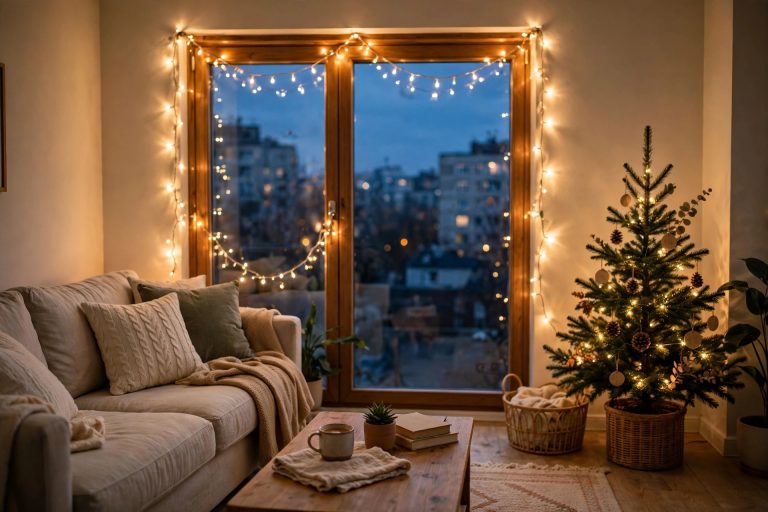
The better way to decorate a small living room is to add almost nothing to the floor at all. This guide follows one rule: zero new floor footprint. Every idea below goes on a wall, a window, a surface you already own, or in place of something already in the room. If an idea needs floor space, it does not make the list. That single rule keeps walkways clear, keeps the TV view open, and still leaves the room looking properly festive on the darkest evenings in December.
The Zero Floor Rule: Decorate Up, Not Out
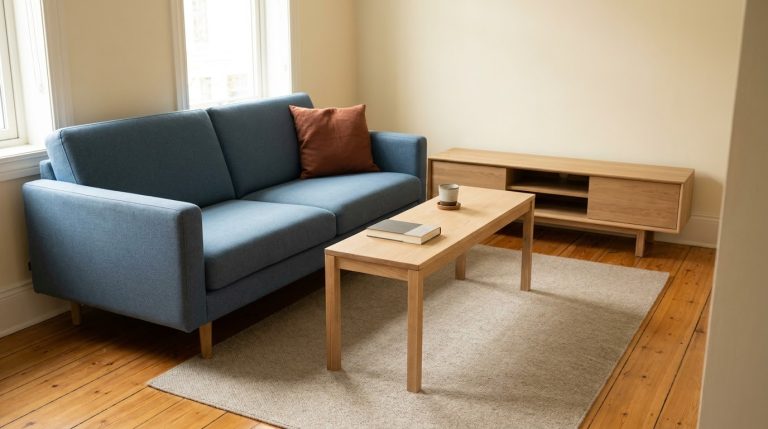
Before you open a single box, walk your room and name the three surfaces that are already doing a job: the wall behind the sofa, the window, and the coffee table or shelf you use every day. Those are your decorating surfaces. Everything else in the room, including the floor, stays exactly as it is. This is where most guides go wrong. They treat a small room like a large room with smaller decorations, so they scatter a little cheer on every surface and call it cozy. In a small room, scattered decor reads as clutter, because there is no empty space left to let your eye rest. One strong focal point plus two quiet supports looks far more festive than ten small touches spread everywhere. A useful test: after decorating, you should still be able to walk from the door to the sofa to the TV without stepping around anything new. If you cannot, something on the floor has to go back in its box. Our guide to small living room ideas makes the same point for everyday layouts, and it matters twice as much at Christmas, when guests, coats, and gift bags all need the same walkways.
Start With One Focal Wall
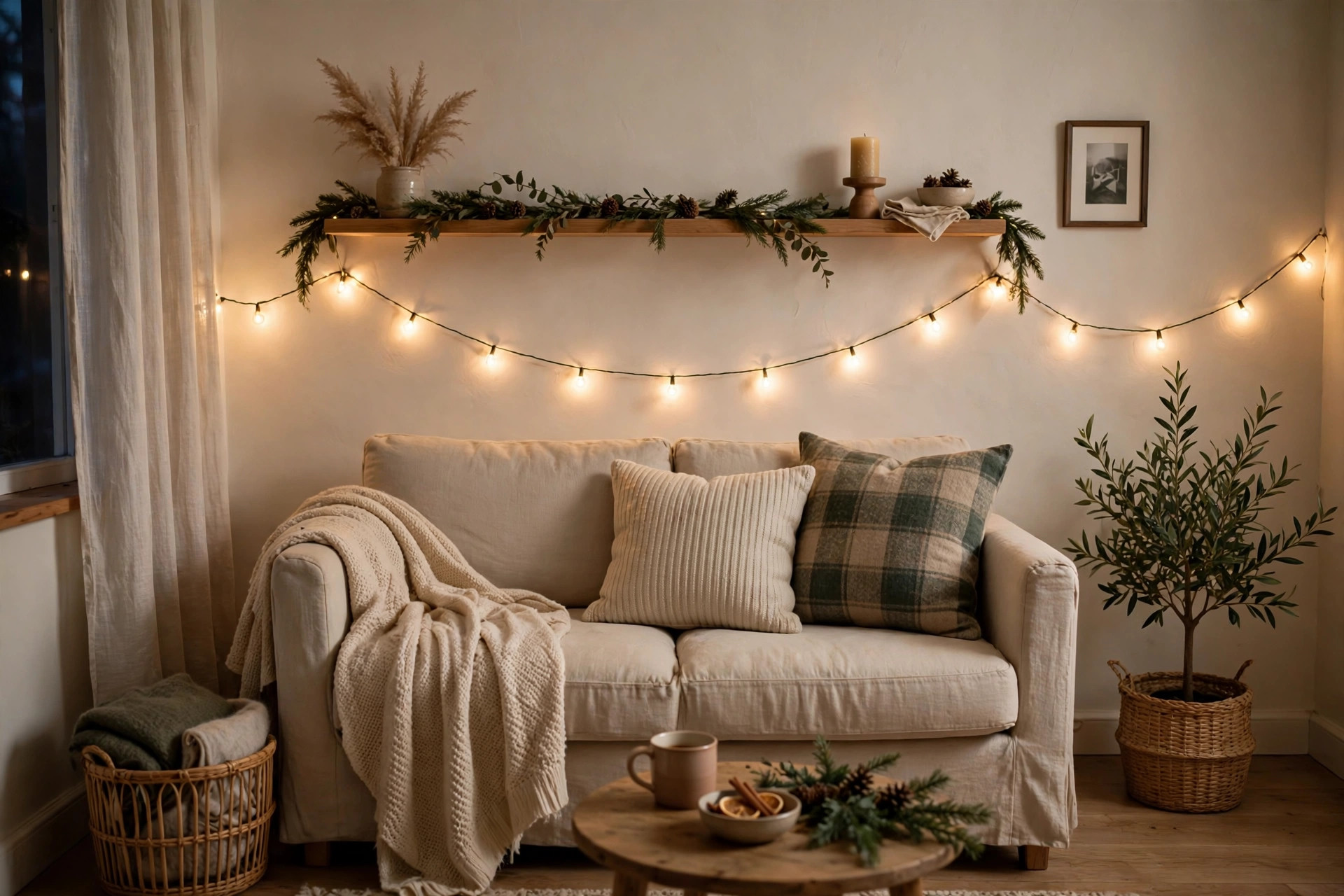
Pick one wall and make it the Christmas wall. In most small living rooms, that is the wall behind the sofa or the wall with the TV, because it is the wall you already look at. Decorate that wall and leave the other walls mostly alone. On that wall, choose one of these three moves, not all three. First, a garland along the top of the wall or along a picture rail, hung high so it draws the eye up and makes the ceiling feel taller. Second, a wreath on the wall, centered at eye level, which gives you a finished focal point in about two minutes. Third, a light shape, such as a simple zigzag or star outline made from one string of warm white lights, which reads as a tree or a star from across the room without taking any floor space at all. Keep the focal wall to one move because two focal moves on one wall compete with each other, and a wall with a garland plus a wreath plus lights stops looking decorated and starts looking busy. If you already have a tree in the room, the tree is your focal point, and the wall should stay quiet. Our guide to where to put a Christmas tree in a small living room helps you place that tree so it does not block a walkway, and the same placement logic applies here: the focal point should be seen from the sofa, not walked around.
Lights: Where They Earn Their Place
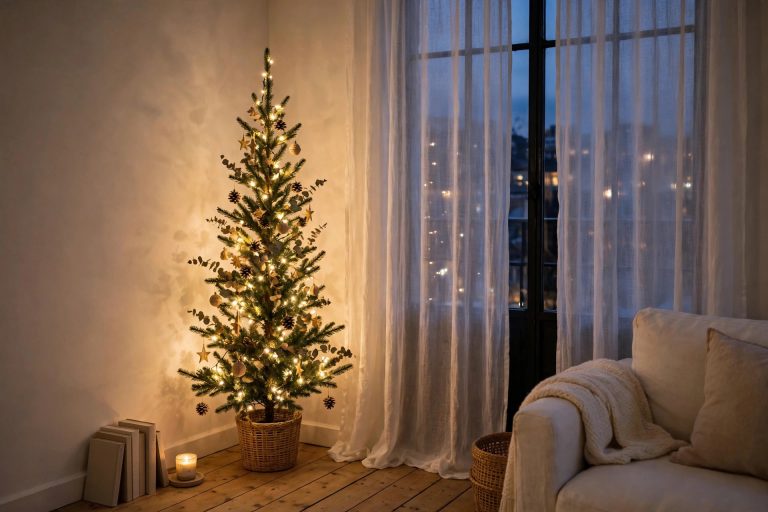
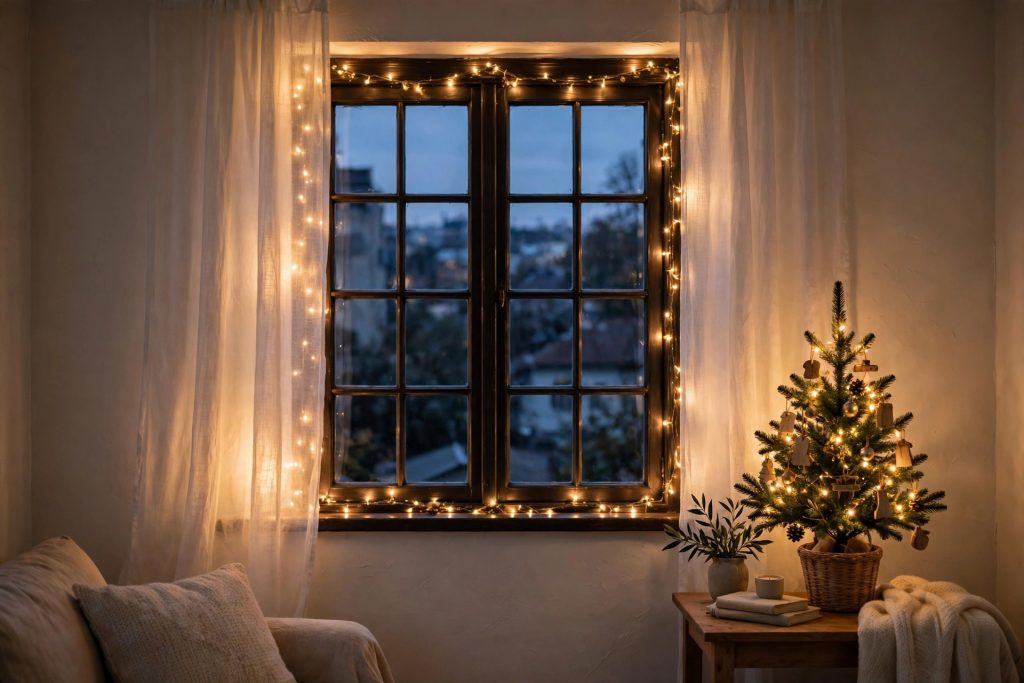
Lights do more work per inch than any other decoration in a small room, but only when they are placed where your eye already goes. Random strings around every edge of the room flatten the space and make it feel like a fairground. One or two deliberate runs make it feel warm. Put lights in these places, in this order of impact. First, behind sheer curtains, where the fabric softens the bulbs into a glowing wall of light. This single move can carry a whole room in the evening, and it uses no surface at all. Second, around one window frame, on the inside edge of the frame, not draped over the curtains, so the curtains still open and close. Third, along the top edge of a bookshelf or along the back of a sofa, tucked just out of sight so the glow appears without a visible string of bulbs. Use warm white lights, not multicolor, if you want the room to feel calm rather than busy. In a small room, one color story keeps everything tied together. Choose battery lights with a timer for the window and shelf runs if your outlets are scarce, and keep one plug-in string for the curtain wall, where a timer on the plug saves you remembering to switch it off. Count your strings before you buy: most small living rooms need two strings at most, one for the focal wall or window, and one for a shelf or curtain. A third string is usually the one that tips the room from festive into cluttered. Safety matters more in a tight room, because cords cross walkways faster. Never run a light cord across the floor to reach an outlet. If the only outlet is across a walkway, use a battery string for that spot instead, or move the light to the nearest outlet. Keep lights away from curtains that touch the bulbs, and switch lights off when you leave the house, even with a timer, if the room will be empty for days.
The Window: Your Best Free Display
The window is the most underused Christmas surface in a small home, and it is free. It already frames light, it is seen from inside and outside, and decorating it costs no floor space and no shelf space. Keep the window display low and simple so daylight still gets in. A string of lights around the inside of the frame, plus a small wreath hung from a suction hook or a removable hook at the top of the frame, is enough. On the sill, if you have one, place three small things at most: two candles in glass holders and one small pine branch, or three tiny bottle brush trees in a row. Anything taller than about 8 inches on the sill starts to block light and looks top heavy from outside. Do not hang anything heavy from a curtain rod, and do not drape garland over curtains. Garland on curtains pulls them down, blocks light, and makes the window look smaller, which is the opposite of what a small room needs. If your window has no sill, skip the sill display entirely. The lights and the wreath already do the job. This window approach pairs well with the floor lamp placement in our guide to where to put a floor lamp in a small living room, because a lamp near the window and lights on the window together create one warm corner in the evening, instead of two competing bright spots.
Swap, Do Not Stack: Textiles and Surfaces
The fastest way to make a small living room feel festive without adding anything is to swap what is already there. Swap, do not stack. Stacking a festive throw on top of your everyday throw, and festive cushion covers on top of your everyday cushions, doubles the bulk on the sofa. Swapping keeps the sofa exactly as full as it was. Swap two cushion covers for covers in your Christmas color story, deep green, warm red, or cream and gold, and swap one throw for a chunkier knit in the same story. Put the everyday covers in a bag ready for January. That is the whole textile change, and it takes about five minutes. Do the same on surfaces. On the coffee table, replace your everyday tray contents with a Christmas tray, not in addition to them. One tray, with a candle, a few pinecones, and a small sprig of greenery, is a complete centerpiece. Because it sits on a tray, you can lift the whole thing off the table when you need the table for a board game or a meal, and put it back in seconds. If your coffee table is small, the tray is even more important, because it stops the centerpiece from spreading across the whole table. Our small living room layout guide covers the same tray logic for everyday layouts, and at Christmas it is what keeps the table usable.
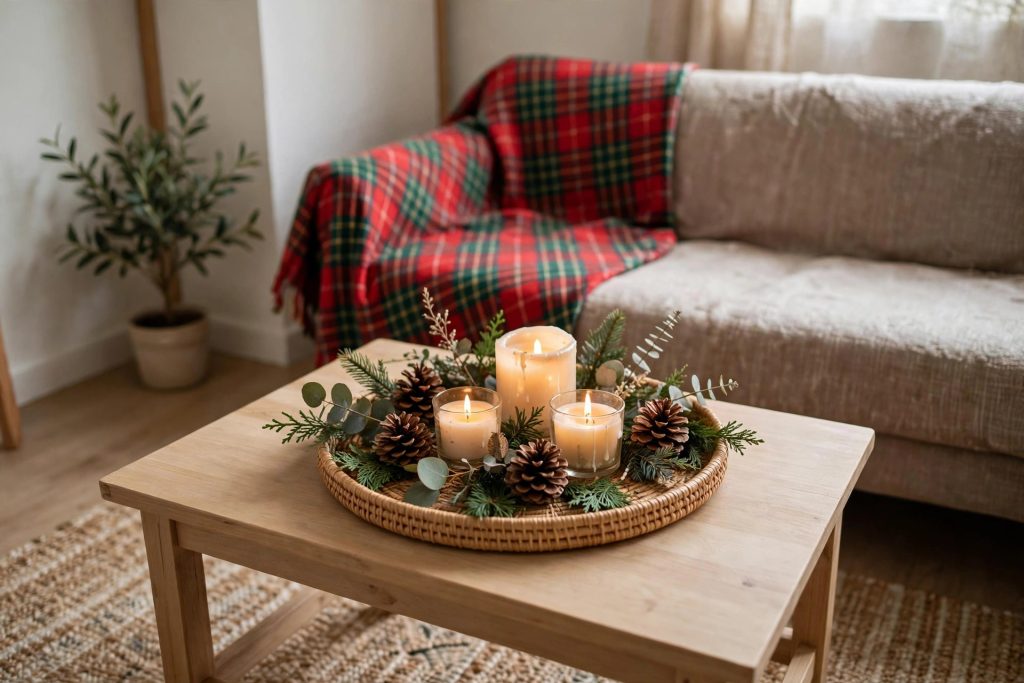
Small Displays That Still Read as Christmas
If you have no tree, or your tree is in another room, you still need one small thing that says Christmas at a glance. Pick one of these, not all of them. A tabletop tree, 2 to 3 feet tall, on a console, a bookshelf, or a side table you already own, gives you lights, ornaments, and a star on top with zero floor space. A wall tree, a triangle of garland or lights pinned to the wall above the sofa or above a console, gives you the tree shape on a wall that was empty. A shelf vignette, three small items on one shelf, such as a tiny tree, a candle, and a small framed card, gives you a festive moment you see every time you sit down. Each of these works because it is contained. It lives on one surface, inside one clear boundary, and it does not spill onto the next surface. The moment a display spills, a shelf vignette plus a tray plus a windowsill display plus a garland, the room stops reading as decorated and starts reading as full. Choose your one small display, place it where you see it from the sofa, and let the lights and textiles do the rest.
What to Skip in a Small Living Room
Skipping is a decorating decision, not a failure. In a small living room, skip these five things and the room will look better for it. First, skip a second tree. One tree, or one tree alternative, is enough. Second, skip floor baskets of ornaments, wrapped empty boxes, and oversized floor lanterns. They are the first things you trip over, and they eat the walkway you need most. Third, skip garland on every doorway. One doorway, the main living room doorway, is plenty. Fourth, skip tall centerpieces on the dining or coffee table. Anything above about 12 inches tall blocks conversation across the table. Fifth, skip loose ornaments on every shelf. Ornaments belong on the tree, on the wall tree, or in the tray. Loose ornaments on five shelves look like ornaments that have not been put away yet. If you love a piece that is on this skip list, keep it, but give something else back. A floor lantern can stay if the floor basket goes. A second garland can stay if the tall centerpiece goes. The rule is not about banning things you love. It is about keeping the total amount of new stuff in the room low enough that the room still works.
A 30 Minute Decor Plan
Here is the whole job, in order, in about 30 minutes. First, pick your focal wall and hang its one move, about 10 minutes. Second, put lights on the window frame and behind the sheer curtains, about 10 minutes. Third, swap two cushion covers and one throw, and set the coffee table tray, about 5 minutes. Fourth, place your one small display, a tabletop tree or a shelf vignette, about 5 minutes. Step back, sit on the sofa, and look at the room in the evening with the main light off and the Christmas lights on. If one spot looks busy, remove one thing from that spot, not from another spot. The room is done when it glows from the sofa and you can still walk to the kitchen without sidestepping anything. When the season ends, this zero floor approach pays off again. Because nothing new went on the floor, there is almost nothing to clear away, and the storage plan in our guide to where to store holiday decor in a small apartment fits in one or two small boxes. The lights come off the wall, the tray goes back to everyday use, the cushion covers swap back, and the room is itself again in under half an hour.
How do you decorate a small living room for Christmas without a tree?
Use one focal wall, lights on the window or behind sheer curtains, and one contained display such as a tabletop tree, a wall tree made from garland or lights, or a shelf vignette. You do not need a floor tree for the room to read as festive.
Where should Christmas lights go in a small living room?
Put them where your eye already goes: behind sheer curtains for a glowing wall, around one window frame on the inside edge, or along the top of a bookshelf. Two strings at most is usually enough, and warm white keeps the room calm.
How many decorations are too many in a small living room?
If you have to step around something new, or if every surface has a decoration on it, you have too many. One focal wall, one window treatment, swapped textiles, and one tray or small display is a complete plan for most small living rooms.
Can you hang Christmas decor in a rental without damage?
Yes. Use removable adhesive hooks, suction hooks for windows, and battery lights with timers. Avoid drilling, heavy garland on curtain rods, and anything that pulls curtains down or blocks a window from opening.
What Christmas decor should you skip in a small living room?
Skip a second tree, floor baskets and oversized floor lanterns, garland on every doorway, centerpieces taller than about 12 inches, and loose ornaments scattered across shelves. Each of these eats space or blocks sightlines in a small room.