Where to Put a TV in a Small Bedroom Without a Dresser
Skipping the dresser buys you real floor space in a small bedroom. The catch: the one piece of furniture that usually holds the TV is gone. Now you need a placement that does not eat the room you just saved.
There are six options that actually work, and they are not equal. A wall mount opposite the bed wins for most people, but it is the wrong call if your lease bans wall anchors or your bed sits against the only solid wall. Below, all six ranked with honest trade-offs, exact mounting heights for bed viewing, and screen-size math for short distances.
The Six Placements, Ranked
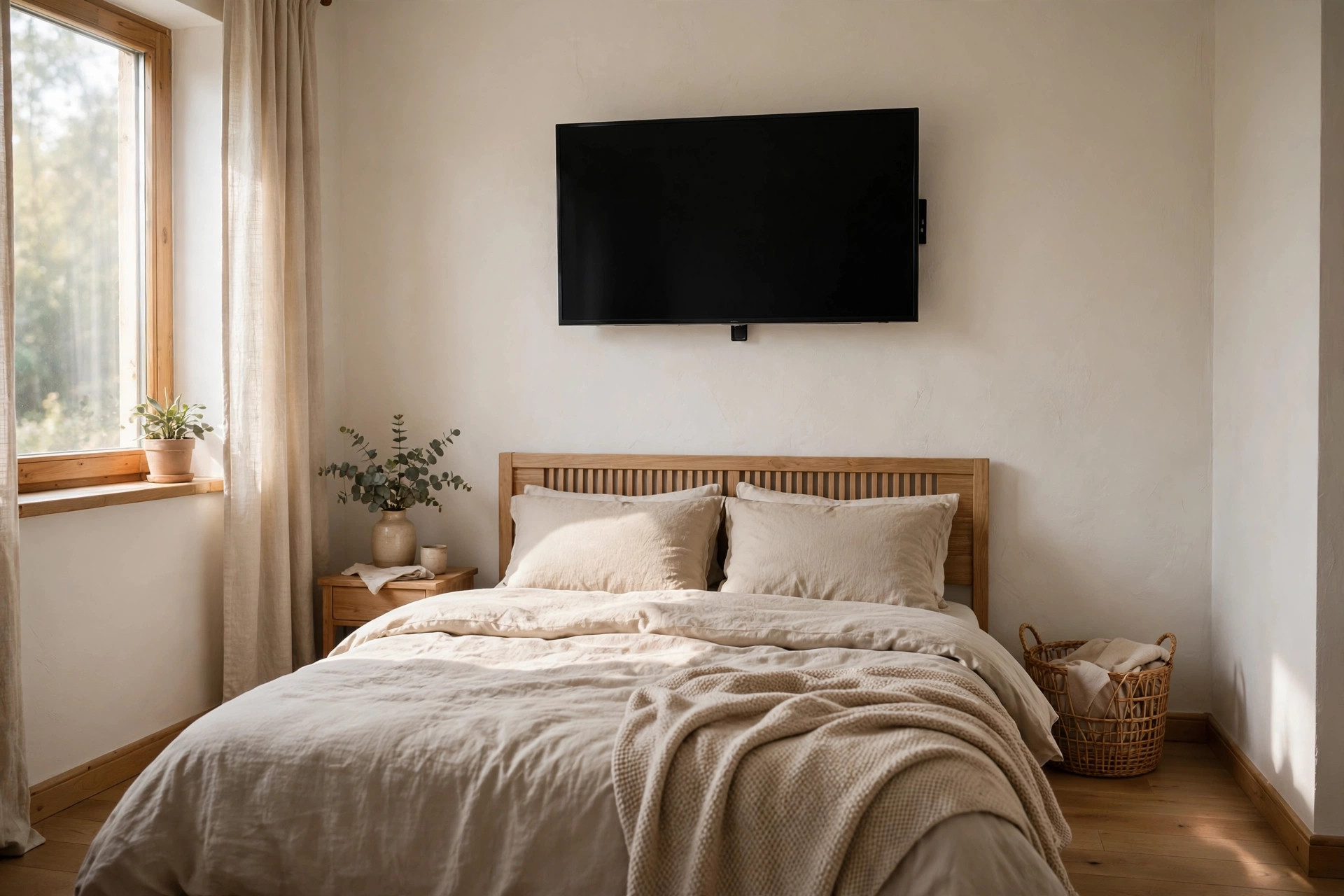
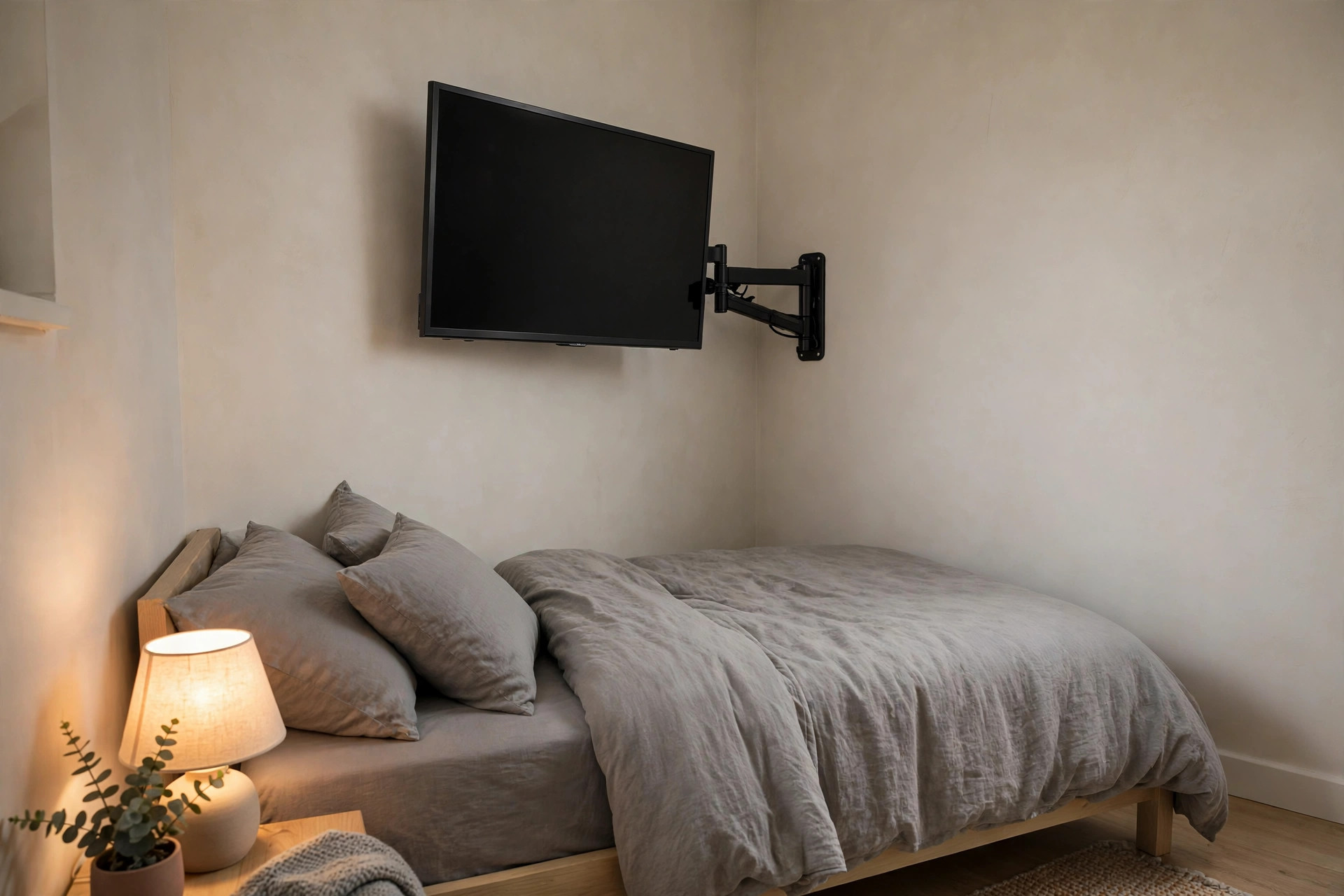
1. Wall mount opposite the bed. The default winner. The TV sits flat against the wall, takes up zero floor space, and faces your pillow square on. If the wall opposite your bed is uninterrupted, stop deliberating and do this.
2. Corner wall mount. When the opposite wall has a door, window, or closet break, mount in the corner on a full-motion arm. The arm pulls the screen square to the bed for viewing and folds flat when you are done. You lose a few degrees of viewing angle, but you keep the floor completely clear.
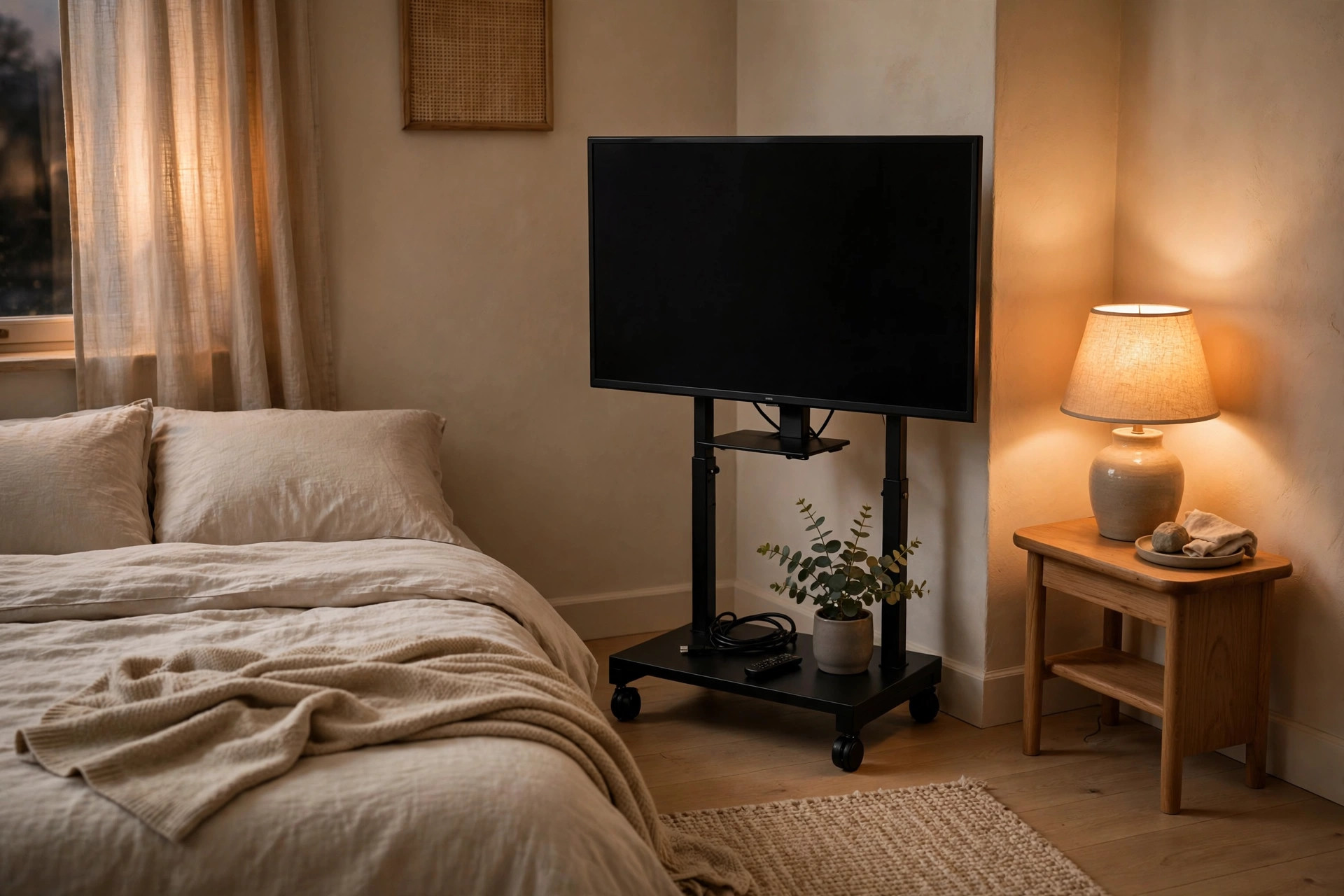
3. Rolling TV cart. A slim rolling stand with a vertical pole holds the TV at eye level and wheels wherever you want it: opposite the bed at night, tucked behind the door by day. The base footprint is roughly 24 by 18 inches, nothing touches your walls, and it is the best pick for renters or anyone who rearranges often.
4. Low bench at the foot of the bed. A narrow bench, 12 to 16 inches deep, doubles as seating and a TV stand. It costs you about 30 inches of walkway, so measure first: you need at least 24 inches of clearance past the bench for comfortable passage. Best when the bed faces open floor rather than a wall.
5. Closet-door or wardrobe-door mount. A strap-on mount turns a closet or wardrobe door into a TV stand. Use doors you open rarely, and keep the TV under 43 inches and under 30 pounds. Clever, but limited.
6. Leaning shelf. A tall leaning shelf can hold a 32-inch or smaller TV on one shelf with decor around it. It looks great and needs no drilling, but the screen usually sits higher than ideal for bed viewing, so treat it as a style pick, not an ergonomics pick.
Bottom line: if you can mount, mount. If you cannot drill, the rolling cart is the no-compromise alternative. The rest are situational fixes for awkward layouts. If your bedroom has no dresser at all, our guide to a small bedroom without a dresser covers where the storage goes instead.
The Right Mounting Height for Bed Viewing
Living room mounting advice does not translate here, because you watch lying down with your head on a pillow. The rule: the center of the screen should sit at your eye level in your normal viewing posture, slightly propped, not flat.
For most adults that means a screen center between 40 and 50 inches off the floor. Dial it in for your own bed. Lie down the way you actually watch TV and measure from the floor to your eyes. That number is your target for the screen’s center. Convert it: the center of a 43-inch TV sits about 10.5 inches above its bottom edge, so if your eye level is 44 inches, mount the bottom edge at about 33 to 34 inches. Write the number down before drilling, because patching a misplaced mount is tedious work.
Two common mistakes. Mounting at standing eye level (55 to 60 inches) forces your neck backward when reclined. Mounting high over a doorway to save wall space turns every movie night into a posture problem. Slightly low beats slightly high every time: tilting the screen down 5 degrees is easy and comfortable, craning upward is not.
Screen-Size Math for 5 to 8 Foot Rooms
Short viewing distances mean a smaller TV looks bigger than you expect. Measure from your pillow position to where the TV will sit. That is your viewing distance.
Practical guideline: divide your viewing distance in inches by 2 for your comfortable maximum screen size. Five feet (60 inches) supports up to 32 inches. Six feet (72 inches) supports 36 to 40 inches. Seven feet (84 inches) supports 40 to 43 inches. Eight feet (96 inches) supports 43 to 50 inches. Bigger than this in a small bedroom gives you eye strain and a screen you cannot take in without moving your head, not a theater feel.
For most small bedrooms, where the bed sits 6 to 8 feet from the opposite wall, a 43-inch TV is the sweet spot: big enough to read subtitles, small enough that the wall still feels like a wall. At 5 to 6 feet, go 32 inches. One more note: 4K matters more in small bedrooms than in living rooms, because you sit close enough to actually see the extra pixels on a 43-inch screen. For more ways to make a tight layout feel intentional, see these small bedroom ideas.
Renter-Friendly Options (No Drilling)
If your lease bans wall anchors, work through this ladder from most to least recommended.
Rolling TV cart. The top no-drill pick. Choose one with a locking base, adjustable pole height, and a VESA bracket that fits your TV. Run power and HDMI down the pole with Velcro ties and it looks built in. Budget 60 to 120 dollars; the wobbly 40-dollar versions are false economy.
Tension pole mounts. A floor-to-ceiling tension pole, the same principle as a shower rod but TV-rated, wedges between floor and ceiling and carries a bracket. No holes, no adhesive, holds up to about 55 inches on most models. It needs a solid ceiling, so press-test first: crumbly popcorn texture will not hold.
Closet-door strap mounts. Straps loop over the top and bottom of a door and tighten around a VESA plate. Best on sturdy doors you rarely open, with straps rated well above your TV’s actual weight.
Leaning shelves with adhesive anchors. A leaning shelf can carry a small TV, and the anti-tip anchor at the top can be a heavy-duty adhesive strip instead of a screw. Keep the TV at 32 inches or under. This is the least sturdy option, so do not let kids climb it.
Cable management deserves its own note, because a cart or pole-mounted TV with dangling cables ruins the clean look. Run cables in a paintable cord channel down to the outlet, mount a short power strip to the back of the cart pole or behind the TV, and use a single HDMI-ARC connection to your soundbar if you have one. Three managed cables beat ten hidden behind a dresser you do not own. The same cord-hiding logic works in the living room too, as covered in our small living room layout with a TV guide.
Frequently Asked Questions
What height should a TV be mounted in a bedroom?
The center of the screen should sit at your eye level when lying down, which is 40 to 50 inches off the floor for most beds. Measure your own eye level on your pillows and mount the screen center to match.
Can you put a TV in a bedroom without a dresser?
Yes. A wall mount opposite the bed is the most space-efficient option, and a rolling TV cart is the best no-drill alternative. Both keep the floor clear with no dresser involved.
What size TV is best for a small bedroom?
For a 6 to 8 foot viewing distance, a 43-inch TV is the sweet spot. At 5 to 6 feet, go with 32 inches. Divide your viewing distance in inches by 2 to find your comfortable maximum.
How can renters mount a TV without drilling?
Use a rolling TV cart, a floor-to-ceiling tension pole mount, or a closet-door strap mount. All three hold a TV securely with zero wall damage.
Is it bad to mount a bedroom TV too high?
Yes. Mounting at standing eye level forces your neck backward when you recline in bed. Slightly low is always more comfortable than slightly high, and a 5-degree downward tilt helps.