Where to Put Shoes in a Small Entryway (No Closet Needed)
A small entryway with no closet turns shoes into clutter fast. Without a closed door to hide them behind, every pair stays visible, and by Friday the floor looks like a shoe sale gone wrong. The fix is not a bigger rack. It is a simple system: decide how many pairs earn a spot by the door, then pick storage that fits your exact entry shape. Once both pieces are in place, a closetless entry stays tidy almost by itself.
Below is the framework I would follow in any small apartment: a capacity rule, options measured to the inch for narrow hallways, renter-friendly picks, and the wet-shoe and odor rules almost every guide skips.
On this page
- The capacity rule: only daily shoes live at the door
- Match the solution to your entry shape
- 5 shoe storage options with exact measurements
- Wet shoes and odor: the rules
The capacity rule: only daily shoes live at the door
Here is the single rule that matters more than any product: the entry holds daily-use shoes only, 2 to 3 pairs per person. Everything else rotates elsewhere. If you keep every pair by the door, no storage system on earth stays tidy.
Make it concrete:
- At the door: the shoes you wore this week. For most people that is 2 to 3 pairs each: work shoes, sneakers, and one weather pair.
- Rotated away: seasonal shoes, dress shoes, spares, and anything you have not touched in two weeks. Move these to under-bed bins, the top of a wardrobe, or a storage setup in the bedroom where they are easy to grab but out of the way.
- Rotate twice a year: when the season changes, swap the entry lineup. Snow boots leave in spring, summer sandals leave in fall. Put the swap on your calendar so it actually happens.
A two-adult household following this rule keeps 4 to 6 pairs by the door. That is a manageable number for every solution below. A family of four keeps 8 to 12, which means you need something with real capacity, like a tall narrow cabinet, not a single shelf.

Match the solution to your entry shape
The best answer depends on the shape of the space by your door. Walk it with a tape measure before you buy anything.
Narrow hallway
If your door opens straight into a hallway narrower than about 36 inches, depth is your enemy. A standard shoe rack sticks out 12 inches or more and turns the walkway into an obstacle course. Here, a slim tilt-out cabinet is the clear winner at roughly 6.75 inches deep. A low bench with a shoe shelf underneath works too if it stays under 12 inches deep. A narrow console table with baskets, if you already own one, can double as shoe storage: one basket per person, and nothing on the floor. (For more ways to use a console table in a tight entry, see how to style a small entryway without a console table.)
Wall by the door
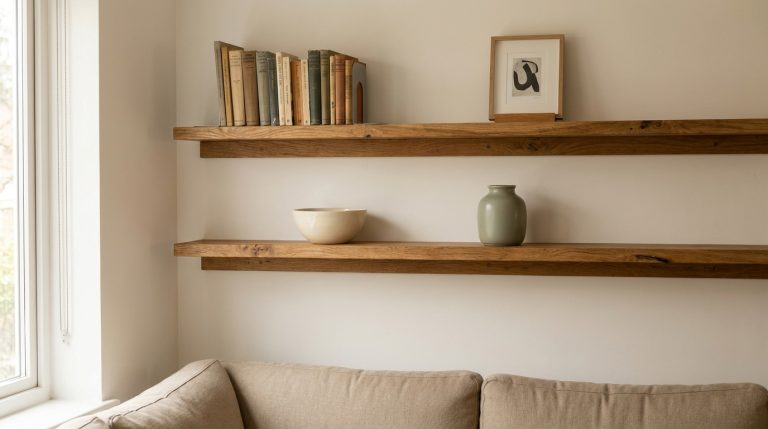
If you have a blank wall next to the door but no floor space to spare, go vertical. A floating shelf plus a row of wall hooks uses zero floor inches and still holds several pairs. A tall narrow cabinet, 20 inches wide or less, uses a sliver of floor space while holding 6 to 10 pairs, depending on the model.
Renter, no drilling allowed
No-drill means freestanding only. A leaning ladder shelf takes a narrow vertical footprint and holds shoes on its rungs. An over-the-door pocket organizer works on the entry door itself or a bedroom door nearby, just do not overload it past its weight rating or the pockets sag and tear. A rolling shoe cart tucks beside a sideboard or in a corner and wheels out when you need it.

5 shoe storage options with exact measurements
1. Slim tilt-out shoe cabinet
The standout pick for narrow entries. A unit like the IKEA Trones measures about 20 inches wide, 15 inches high, and only 6.75 inches deep, holding roughly one pair per compartment. That 6.75-inch depth is the number that matters: it lets the cabinet sit against the wall of a narrow hallway without blocking traffic, where a standard 12-inch-deep rack would be in the way. Wall-mount it or stack two or three units as household members grow. Honest trade-off: boots and chunky sneakers often do not fit the compartments, so plan a separate spot for those.
2. Wall shoe hooks
Simple peg hooks in a row, mounted about 12 inches above the floor, with one shoe per peg. Keep the lowest row at least 12 inches above the baseboard so shoes clear it. Hang pairs by their heels or straps. Heavier boots can rest upside down between two pegs. Honest trade-off: the shoes are fully visible, so this suits people who like a tidy, curated look. It holds fewer pairs than a cabinet, so it fits singles and couples better than families.
3. Low bench with shoe shelf
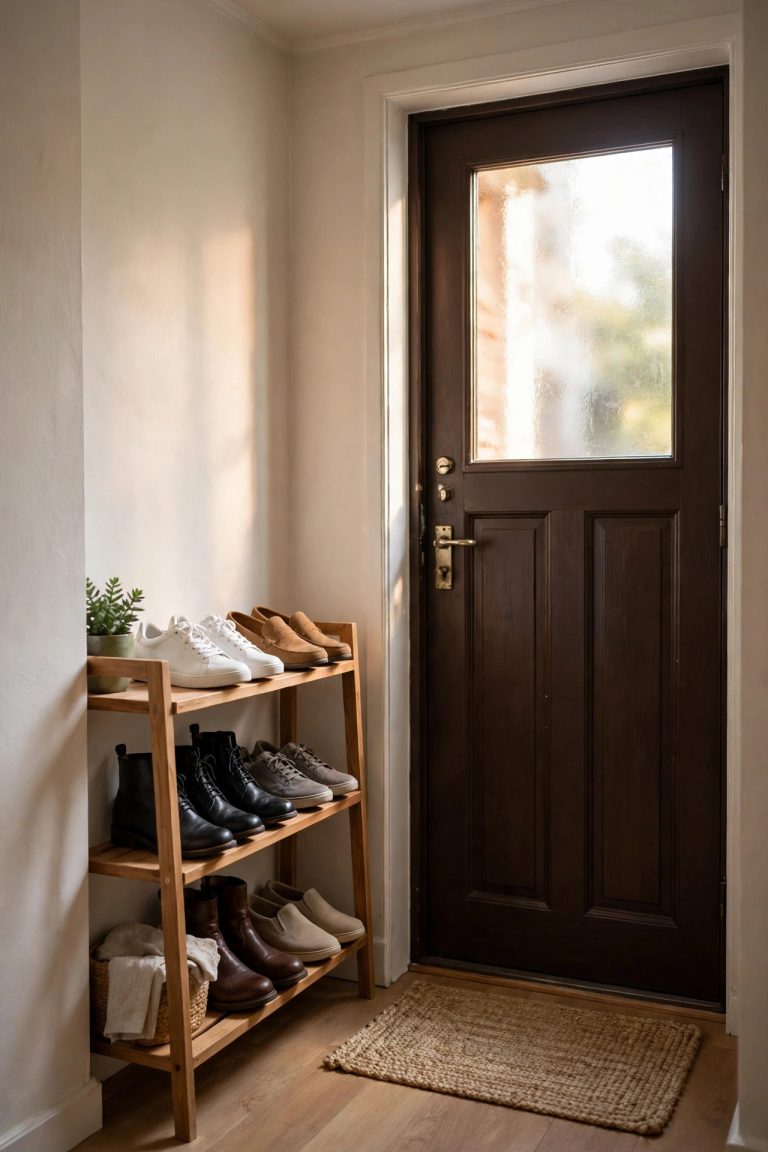
A low bench, 15 to 18 inches tall, with an open shelf or two underneath gives you seating and storage in one. Sit to put on shoes, and slide 4 to 6 pairs onto the shelf below. Choose one under 12 inches deep for a hallway. Honest trade-off: open shelves collect dust and look messy if shoes pile up, so this only works with the capacity rule in place.
4. Boot tray
Not storage, but the landing zone every setup needs. A tray around 30 by 15 inches by the door catches dirt and water from the day’s shoes without taking the footprint of a full rack. Use it under any of the options above in wet weather, or as the entire setup for a one- or two-pair household. Honest trade-off: it holds shoes off the floor but does nothing for visual clutter.
5. Over-the-door pocket organizer
Hangs on the entry door or a nearby closet door, using space nothing else can touch. Fine for flats, sandals, and kids’ shoes. Never overfill past the organizer’s weight capacity, or pockets sag, stitching tears, and it starts swinging when the door moves. Honest trade-off: bulkier shoes do not fit, and on the main entry door it rattles every time someone comes in.
Wet shoes and odor: the rules
This is the part most guides skip, and it is the part that ruins cabinets.
Never put damp or wet shoes straight into a sealed cabinet. Tilt-out cabinets and closed boxes trap moisture, and trapped moisture becomes odor and mildew within days. Wet shoes always air-dry first: on a boot tray, on a waterproof mat, or near a vent for a few hours. Only then do they go back into closed storage.

For rainy and snowy seasons, set up a dedicated wet-weather station: a boot tray plus a waterproof mat by the door, separate from the dry-shoe storage. The tray catches the mess, the mat protects the floor, and your cabinet stays dry and fresh. In winter, keep boots out of the cabinet entirely and let them live on the tray.
For odor, the unglamorous truth works best: rotate shoes so no pair is worn two days in a row, let each pair dry fully between wears, and keep a cheap odor absorber or baking soda sachet in closed compartments. No spray replaces airflow.
Frequently asked questions
How do you store shoes in a small entryway with no closet?
Start with the capacity rule: keep only 2 to 3 daily pairs per person at the door and rotate the rest elsewhere. Then pick storage to match your entry shape. A slim tilt-out shoe cabinet about 6.75 inches deep fits narrow hallways, a floating shelf with hooks uses zero floor space on a wall by the door, and renters can use a leaning ladder shelf or over-the-door organizer with no drilling.
How many pairs of shoes should you keep by the front door?
Two to 3 pairs per person is the sweet spot: the shoes you actually wore this week. A two-adult household keeps 4 to 6 pairs at the door, and everything else lives in under-bed bins or bedroom storage. If shoes pile up beyond that, the problem is the number of pairs, not the size of the rack.
Are wall-mounted shoe cabinets sturdy enough?
Yes, when mounted into studs or with proper wall anchors, slim tilt-out cabinets hold a full load of shoes without issue. They only wobble when installed with flimsy hardware or overloaded past the design, so use the anchors the unit ships with and do not stack more tiers than the instructions allow.
Where do wet shoes go in a small entryway?
Wet shoes should never go straight into a sealed cabinet. Let them air-dry first on a boot tray or waterproof mat by the door, then move them into closed storage once dry. In rainy or snowy seasons, give boots a permanent spot on the tray so your cabinet stays dry and odor-free.
What is the slimmest shoe storage for a narrow hallway?
A slim tilt-out shoe cabinet at about 6.75 inches deep is the slimmest closed storage option, and it fits hallways where a standard 12-inch-deep rack would block the walkway. For zero depth, wall-mounted shoe hooks about 12 inches above the floor keep shoes off the ground entirely.