How to Choose a Lampshade: Size, Shape and Fit
Learning how to choose a lampshade starts with the lamp you already own. A shade can look right in a shop and still sit too high, project into a walkway, or leave the bulb in your line of sight when you sit down. The attachment, dimensions and light all need to work together.
Before browsing colors, write down what you want to change. Is the old shade damaged but otherwise comfortable to use? Keep its successful dimensions as a reference. Is the lamp glaring beside your chair? Copying the old shade exactly may bring the same problem home.
This guide focuses on replacement shades for table lamps. A pendant, reflector-bowl lamp or other specialist design may need a shade made specifically for that fixture.
On this page:
Match the Fitting Before You Choose the Fabric
Unplug the lamp and let the bulb cool before inspecting the attachment. Photograph the existing shade from underneath and the support on the lamp. Keep the lamp’s model details if you have them; these are more useful to a seller than a picture of the room alone.
The Lamps Plus measuring and fitting guide describes three common attachments:
| Fitter | How it attaches | What to check |
|---|---|---|
| Spider | Rests on a harp around the bulb, commonly secured by a finial. | Confirm the support and mounting position suit your lamp. |
| UNO | Attaches at the socket rather than resting on a harp. | Ask the seller to confirm the exact socket attachment and opening. |
| Clip-on | Clips directly onto the bulb. | Confirm the specified bulb shape and compatibility with that shade. |
Treat the fitter name as a starting point, not proof that two products are interchangeable. If the listing does not show the attachment clearly, send your photographs and measurements to the seller before ordering. This matters especially when buying a shade from a different market or replacing one on an older lamp.
A shade that needs forcing onto the lamp is not a successful fit. Ask about a compatible replacement or manufacturer-approved fitting instead of bending the frame to make it stay in place.
How to Choose a Lampshade Size Without Relying on One Ratio
Record the old shade’s top width, bottom width, straight vertical height and sloping side length. On a tapered shade, the slant and vertical height are different measurements. For an oval or rectangular shade, record both width and depth; one diameter cannot describe its footprint.
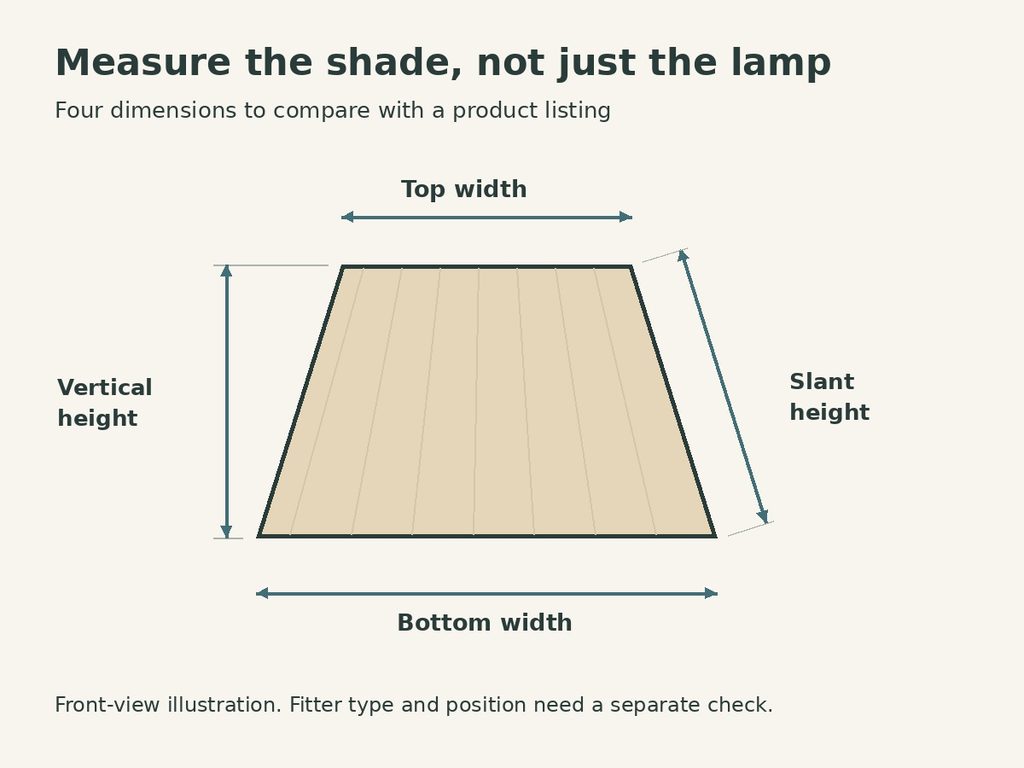
Label your notes rather than writing an unexplained sequence of numbers. Match each dimension to the seller’s drawing, and check the fitter’s position too. Two shades with similar outer dimensions can sit differently on the same lamp.
For a bare lamp, a proportion guideline can help you shortlist sizes. Pooky suggests a shade’s bottom diameter close to the lamp base’s height, with adjustments for particularly slender or broad bases. Treat this as a visual starting point rather than a compatibility rule.
The surface underneath provides a second check. Consider this illustrative example: a round shade measuring 16 inches across, centered over an 18-inch-wide table, leaves only 1 inch between its projected edge and each side of the tabletop. A 14-inch shade leaves 2 inches. Neither result automatically makes the lamp safe or comfortable, but the calculation shows why a small change can matter beside a busy seat.
That example checks width only. The table’s depth, the lamp’s actual position and the route beside it still matter. A narrower oval shade might solve a front-to-back projection problem without looking unusually small from the front, provided the fitting and bulb clearance are suitable.
Use a tape measure above the tabletop to compare candidate widths before buying. Keep the lamp unplugged while checking. Look from the doorway, then sit in the chair or on the bed: a proportion that looks balanced from across the room can still put the bulb directly in view.
Choose the Shape and the Light Together
A drum shade has a relatively straight-sided outline; an empire shade narrows toward the top. An oval or rectangular shade changes the footprint as well as the silhouette. Choose between them by looking at the lamp from the side, not only from the front.
You do not need to repeat every shape in the room. A simple shade can let a sculptural base stand out, while a patterned shade can provide the main detail on a plain lamp. Start with the part you want to notice, then avoid making both compete equally for attention.
Check how the shade behaves when illuminated. Ballard Designs distinguishes translucent shades, which let light through their sides, from opaque shades that direct it mainly through their openings. The lining and construction matter alongside the exterior fabric.
For a reading corner, ask to see the shade lit with a suitable bulb. Look at the page and your seated view, not just the glowing fabric. A shade that creates an attractive pool of light on a wall may not give you the light you want where you read.
If the real problem is that the entire room feels dark, a replacement shade may only address part of it. Our guide to bedroom lighting without a ceiling light explains how to give different lights separate jobs.
Try It Where the Lamp Will Actually Live
Before removing return packaging, confirm that the new shade sits securely and level. Follow the lamp, shade and bulb instructions, including bulb type, maximum wattage and required clearances. A proportion guide cannot replace those product requirements.
Then use the lamp during an ordinary evening. Sit where you normally sit, reach for its switch, open the nearby drawer and walk past it. Notice whether you move your head away from glare or angle your arm around the shade. Those small adjustments can reveal a poor fit more clearly than a photograph.
If the size looks right but the shade sits too high or low, ask a lighting retailer to check the mounting arrangement before buying a different shade. On a harp-mounted lamp, the support and shade need to work as a pair; changing the shade’s height alone may not solve its position.
Keep the replacement when it does three things together: fits the lamp securely, leaves the surrounding space comfortable to use, and gives you the light you wanted. A slightly different silhouette is worth considering if it meets those needs better than the first one you imagined.