Where to Put a Floor Lamp in a Small Living Room
A floor lamp is the easiest way to fix a dark corner in a small living room, but put it in the wrong spot and it eats floor space, blocks a walkway, or shines straight into your eyes while you watch TV. The right placement gives you reading light where you sit, soft evening light across the room, and a clear path through it.
Here are the five placements that actually work in small rooms, ranked from best to worst, plus the exact heights, clearances, and arc-lamp reach math so you can place yours with confidence.
On this page
- Beside the sofa at the reading end
- In the darkest corner, aimed at the wall
- Behind or beside the TV as bias lighting
- Beside a console or entry table
- Arc lamps: the reach math before you buy
- Choose a slim profile that fits the gap
- The one-lamp-per-100-square-feet rule
- Use warm bulbs, 2700K to 3000K
- When NOT to use a floor lamp
1. Beside the sofa at the reading end
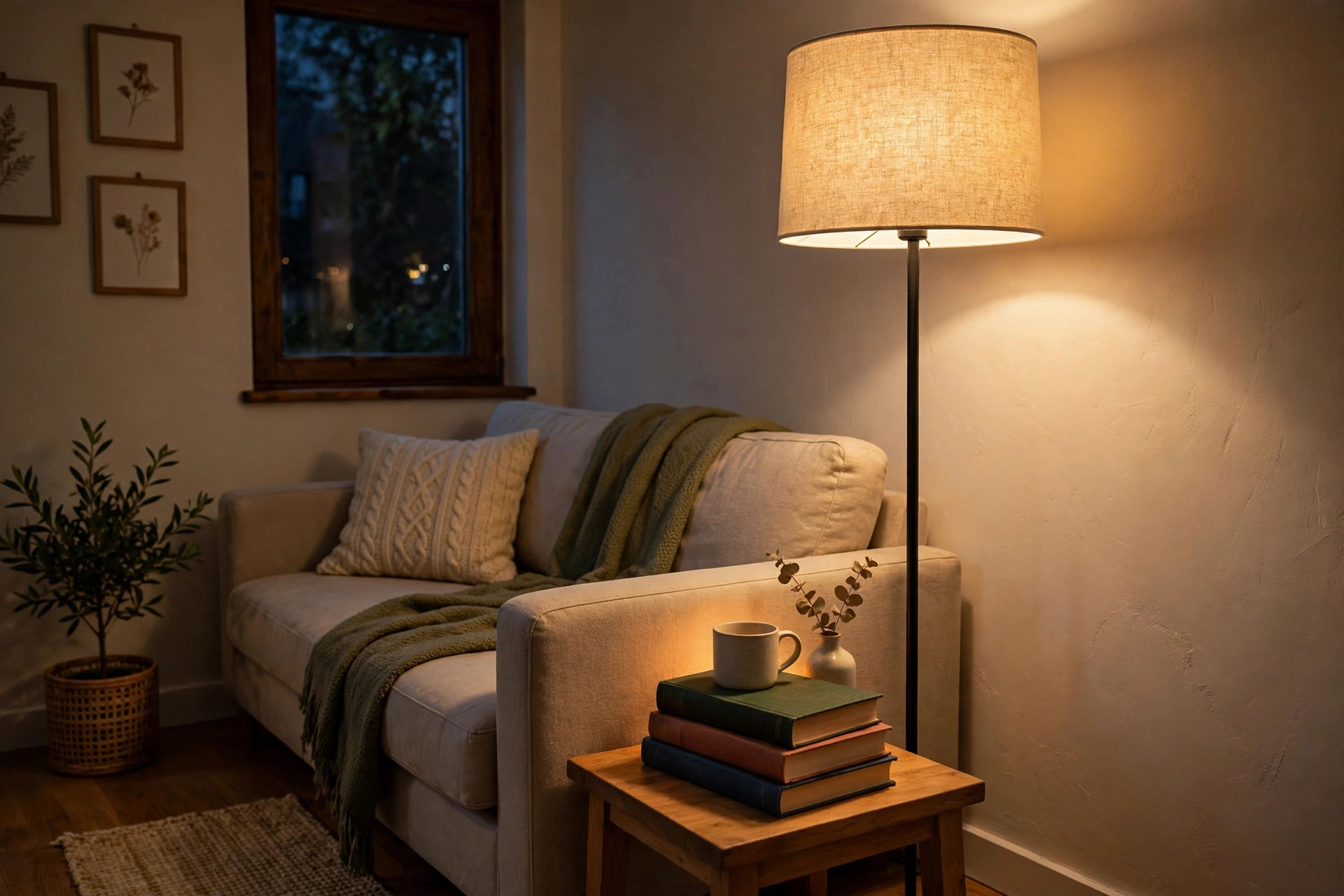
This is the best spot in most small living rooms. Put the lamp at the end of the sofa where you read, just behind or beside the armrest, so the shade sits over your shoulder and lights your book without glaring into your eyes.
Leave 2 to 4 inches between the lamp base and the sofa so the base does not stick out into the walkway, and keep the shade 6 to 12 inches away from the sofa fabric so heat and light do not wash one side of the cushion. If you have a side table there, the lamp goes behind the table, not in front of it, so you can still reach the table surface.
Get the height right: the bottom of the shade should sit at about shoulder height when you are seated, roughly 48 to 56 inches off the floor for a standard sofa. Too low and the light pools on the cushion; too high and the bulb glares over the top of the shade.
For more on arranging the seating around it, see small living room ideas and the sofa placement guide.
2. In the darkest corner, aimed at the wall
If your room has one corner that stays dark in the evening, that is the second-best spot. Place the lamp 6 to 12 inches out from the corner, aimed so the light washes the two walls. Bounced light makes the corner feel wider and the whole room brighter, without a harsh pool of light in the middle of the floor.
Keep the lamp out of the main walkway. In a small room, a corner lamp that forces you to step around it every time you cross the room is worse than a dark corner.
3. Behind or beside the TV as bias lighting
A floor lamp behind or beside the TV, aimed at the wall, works as bias lighting: it softens the contrast between a bright screen and a dark room, which reduces eye strain during evening viewing. Use a warm, dimmable bulb and keep the lamp itself out of your line of sight to the screen so the shade does not become a second bright spot.
Do not put an unshaded or upward-facing lamp directly behind the TV where it throws a bright halo onto the wall; the halo competes with the screen. A shaded lamp to one side of the TV, washing the wall beside it, is the safer version. See small living room layout with TV for the full arrangement.
4. Beside a console or entry table
If your living room opens onto an entry or hallway, a floor lamp beside a console table marks the transition and gives you a landing light when you walk in. Keep the base flush against the table leg so it reads as one unit, and choose a shade that matches the table height: the lamp should clear the tabletop by at least 12 inches so it does not look squat.
This spot also works beside a narrow bookcase or a plant stand, anywhere a vertical accent breaks up a long empty wall. The rule is the same: the lamp belongs next to something, not floating alone in open floor.
5. Arc lamps: the reach math before you buy
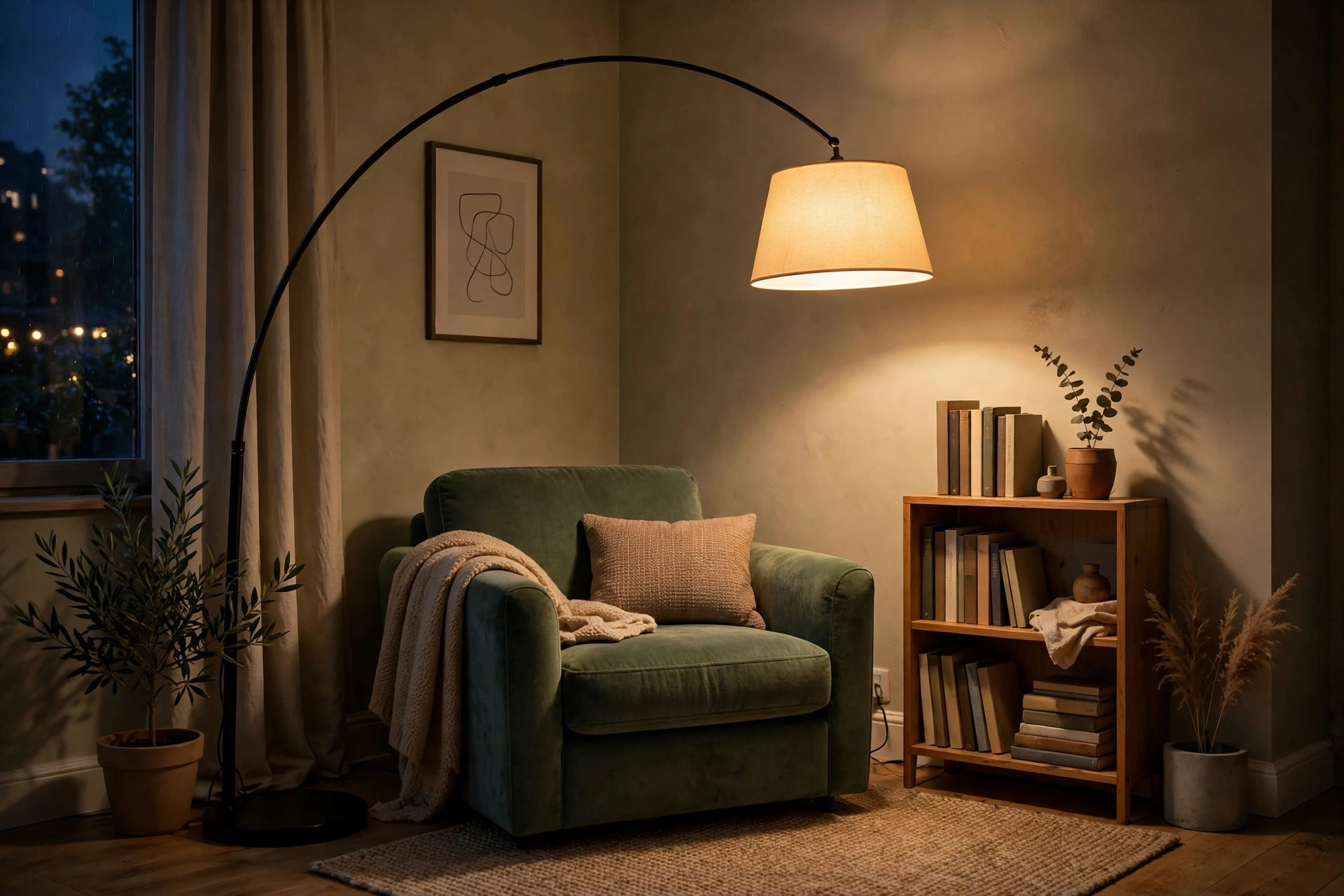
Arc lamps look dramatic, but in a small room the arc is the whole problem: the base sits in one place and the light lands somewhere else. Before you buy, measure two numbers. First, the horizontal reach from the base to where the shade will hang, usually 36 to 60 inches. Second, the clearance under the arc at its lowest point, which must clear the top of your sofa or chair by at least 6 inches.
A quick test: stand where the base would go, hold a tape measure out to your chair, and check that the shade would hang over the seat, not over the walkway. If the shade lands in the path you walk through, the arc is too long for the room, no matter how good it looks in the store.
Choose a slim profile that fits the gap
Floor lamp bases run from about 9 inches across for slim models to 14 inches or more for heavy tripod styles. In a small room, a slim base matters more than a slim shade: the base is what eats floor space and trips feet. Measure the gap where the lamp will go, then subtract 2 inches on each side for clearance. If the gap is 12 inches wide, you need a base no wider than 10 inches.
Tripod and multi-arm lamps look great in photos, but each leg extends the footprint. One straight pole with a single drum or cone shade is the safest profile for rooms under 150 square feet.
The one-lamp-per-100-square-feet rule
One floor lamp covers about 100 square feet of living room for ambient evening light, assuming a standard 60-watt-equivalent bulb and light-colored walls. A 120-square-foot room needs one floor lamp plus a table lamp or wall light, not two floor lamps. Two floor lamps in a small room crowd the floor and create competing bright spots.
Layer instead: one floor lamp for the reading corner, one small table lamp on a side table or console, and the ceiling light on a dimmer if you have one. Three small sources beat one bright source every time.
Use warm bulbs, 2700K to 3000K
Color temperature changes how a small room feels more than brightness does. A 2700K to 3000K warm white bulb makes the room feel cozy and makes wood and fabric look richer; a 4000K or higher daylight bulb makes the same room feel clinical. Use warm bulbs in every living room floor lamp, and make them dimmable so the same lamp works for reading and for winding down.
If your lamp sits near artwork, warm light also flatters the colors instead of washing them out. For hanging height rules on the wall above the sofa, see wall art above a sofa and choose a rug for a small living room.
When NOT to use a floor lamp
Skip the floor lamp if every wall in the room is already occupied by furniture and the only open spot is in the middle of a walkway. A lamp in a walkway is a tripping hazard and it will get bumped, knocked, or unplugged within a week. In that case, use a wall-mounted light, a table lamp on existing furniture, or a clip-on reading light instead.
Also skip it if the room is under 80 square feet and already has two other light sources. Small rooms get bright fast, and one more lamp pushes the room from cozy to glaring.
Frequently Asked Questions
Where is the best place to put a floor lamp in a small living room?
Beside the sofa at the reading end, just behind or beside the armrest, with the bottom of the shade at about shoulder height when seated (48 to 56 inches). This lights your book without glaring into your eyes or blocking the walkway.
How tall should a floor lamp be next to a sofa?
The bottom of the shade should sit at about shoulder height when you are seated, roughly 48 to 56 inches off the floor for a standard sofa. Standard floor lamps are 58 to 64 inches tall overall, which puts most shades in the right zone.
How much space does a floor lamp need?
Measure the gap where the lamp will go and subtract 2 inches on each side for clearance. A slim base is 9 to 10 inches across; leave 2 to 4 inches between the base and the sofa and 6 to 12 inches between the shade and the sofa fabric.
Can you put a floor lamp behind a TV?
Yes, as bias lighting: a shaded lamp behind or beside the TV, aimed at the wall, softens the contrast between a bright screen and a dark room. Keep the lamp out of your line of sight to the screen and use a warm, dimmable bulb.
When should you not use a floor lamp?
Skip it if the only open spot is in the middle of a walkway, or if the room is under 80 square feet and already has two other light sources. Use a wall-mounted light or a table lamp on existing furniture instead.