Dining Chairs With Arms vs Without: Which Fits Your Table?
Choosing dining chairs with arms vs without is partly about comfort, but the deciding detail may be underneath your table. An armchair can feel inviting until its arms hit the frame and stop you moving close enough to eat. An armless chair avoids that particular problem, yet it can still be too wide for the space between the table legs.
Start with armless chairs when side access and compact storage matter most. Consider arms when you enjoy resting your forearms during conversation and the chair fits both your body and the table. A mixed set can work well, provided the end seats receive the same measurement checks as the side seats.
On this page
- Dining chairs with arms vs without: the trade-offs
- Check the fit in three directions
- Try the chair as you would use it at home
- When to mix armchairs and side chairs
- What to confirm before ordering
Dining Chairs With Arms vs Without: The Trade-Offs
| What matters | With arms | Without arms |
|---|---|---|
| Resting during conversation | Provides a place for forearms if the height suits you. | Leaves the sides open; comfort depends on the seat and back. |
| Moving into the seat | May need to pull farther back before sitting. | Allows a sideways approach when the surrounding space permits. |
| Tucking under the table | Arm height and shape must clear the table frame. | No arm collision, but the seat, back or base may still limit insertion. |
| Seating several people | Compare overall width and room inside the arms. | Often available in narrow styles; check actual dimensions. |
| Visual effect | Can give end seats more presence. | Open sides can keep a closely spaced arrangement visually lighter. |
Do not use the label alone to judge size. A slim wooden armchair may occupy less floor space than a broad upholstered side chair. Likewise, removing arms does not create extra places if diners already lack room for their shoulders, elbows and meal settings.
Check the Fit in Three Directions
Take measurements at the position where each chair will actually sit. A rectangular table may offer different clearance at its ends, while a pedestal or trestle can interrupt the space farther underneath. If you are choosing the table too, compare round vs rectangular dining tables before settling on a full chair set.
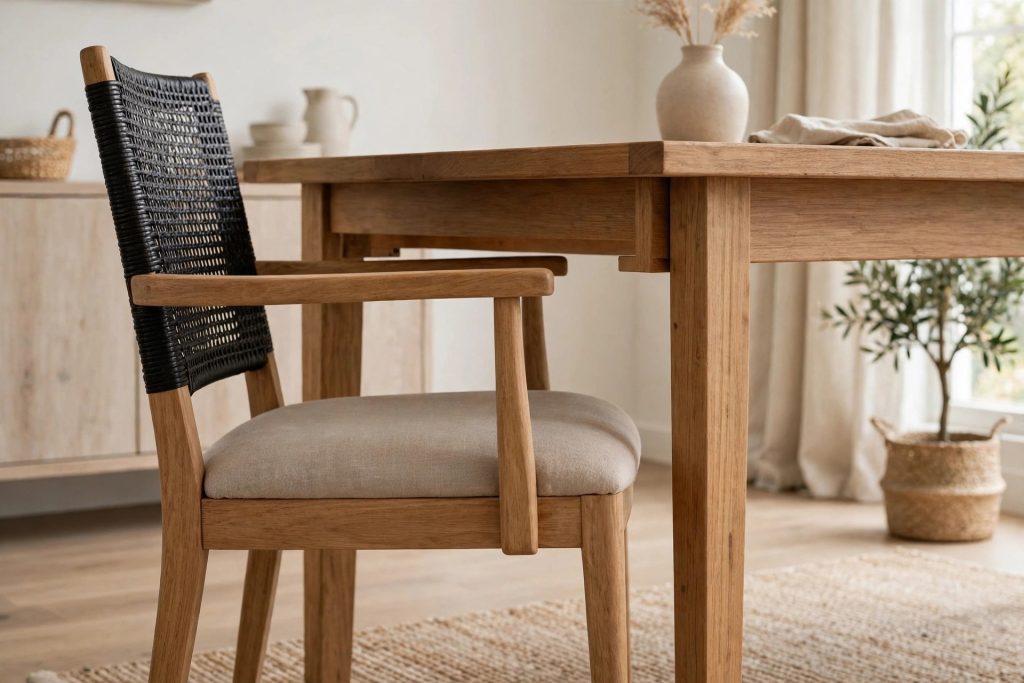
Height: measure below the tabletop
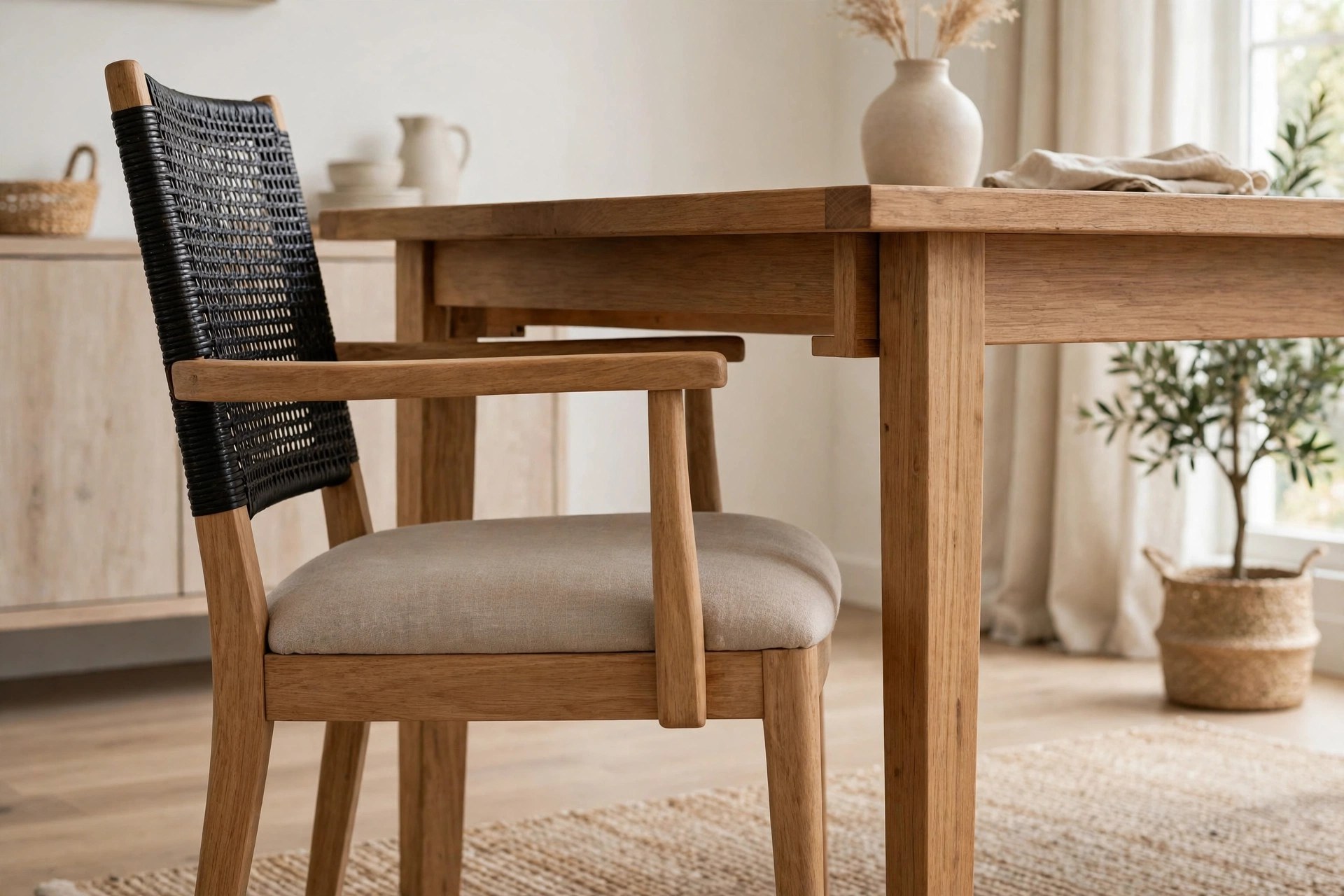
The apron is the rail or frame below some tabletops. Measure from the floor to its lowest relevant edge, then compare that with the chair’s arm height measured from the floor. Cuckooland’s dining-chair guide also distinguishes apron clearance from the tabletop measurement and advises checking arm height for chairs you want to tuck in.
Worked example: suppose the tabletop is 30 inches high, but the bottom of its apron is only 26 inches above the floor. A candidate chair has arms 27 inches high. The relevant calculation is 26 − 27 = −1 inch: those arms cannot pass beneath that apron. Comparing the arms with the top surface would misleadingly suggest 3 inches of room.
A second chair with 24½-inch arms would have 1½ inches of vertical clearance in the same example. That passes this one check, not the entire fit test. The arms might rise toward the back, the table could have a lower bracket farther in, or the chair base could meet a table leg. These are illustrative measurements, not a universal clearance recommendation.
Keep seat height separate from arm height. Sit at the table to check thigh space beneath the apron and whether your shoulders stay relaxed when using the surface. A chair can slide neatly underneath when empty and still put its occupant too high or too low.
Width: use the opening between the legs
Measure the clear opening rather than dividing the full tabletop length by the number of chairs. Include the chair’s widest parts: arms, back, upholstery or legs. Room & Board’s chair-sizing advice specifically calls attention to the distance between table legs.
For an illustrative 52-inch opening, two chairs each 23 inches wide leave 52 − (2 × 23) = 6 inches in total. That remainder must cover the gap between the chairs and the gaps beside both table legs. It is not 6 inches between the chairs plus extra space at the ends.
Two 20-inch chairs leave 12 inches in the same opening. The narrower option gives you more room to distribute, but neither calculation establishes comfortable seating. Try two people sitting next to each other and check that their normal movements do not depend on keeping their elbows tucked in.
Depth: check the chair while someone uses it
Test three positions: pushed in, occupied and pulled back for getting up. A chair that looks compact in a product photograph may project well into the room when someone is seated. Arms that stop at the apron can increase that projection further.
Open nearby drawers and doors during the test. Walk the actual route to the kitchen with a chair occupied. If there is a rug, pull the chair out normally and check whether its feet catch at the edge. A clear route with every chair empty does not tell you how dinner will feel.
Try the Chair as You Would Use It at Home
Sit back, move forward toward an imaginary plate and turn to speak to someone beside you. Notice whether the arms support your forearms comfortably or make you lift your shoulders. Check the usable seat width between the arms as well as the outside width used for the layout.
Then stand up and move the chair back into place. The weight, grip and floor contact matter when you repeat this several times a day. A chair you can move easily in a showroom may behave differently on a thick rug, so include your floor surface in the decision.
For longer meals, spend more than a quick moment in the seat. Does the front edge press behind your knees? Can you rest against the back without sliding forward? Does the cushion leave you sitting noticeably lower than expected? Arms alone cannot compensate for a seat that does not suit you.
Ask the household member who will use a particular chair to try it. Some people prefer an open side for access; others prefer having arms. Where someone relies on the arms when sitting or standing, confirm that the chair is suitable for that use rather than judging by appearance.
When to Mix Armchairs and Side Chairs
Armchairs at the ends of a rectangle and armless chairs along its sides can give you two different seating experiences. Check the end openings first: a short overhang or awkwardly placed support can make the apparent position of honor the least comfortable seat.

Pay particular attention to corners. An end chair and the nearest side chair may each fit separately but collide when both diners pull in. Try the complete arrangement before deciding how many seats the table can use comfortably.
For a coordinated appearance, repeat one visible detail, such as oak frames or blue upholstery. Let the arm shape provide the difference. Compare seat heights as well: a mixed set can look harmonious while making one diner sit much lower than everyone else.
A round table does not require a matching set or an all-armless arrangement. You can use arms at every place if the actual chairs, neighboring seats and base work together. Equally, one preferred armchair can be enough; there is no need to buy a second simply for symmetry.
What to Confirm Before Ordering
Keep a short note with your table measurements and candidate chair dimensions. If a product listing gives only overall height, width and depth, ask for the missing arm height, seat height and inside seat width before making the comparison.
- Under the table: arms, thighs and chair parts clear the apron, brackets and base where needed.
- Along the table: chairs fit between the legs with usable room for neighboring diners.
- Behind the chair: sitting down, getting up and passing nearby work in the real room.
- For daily use: the seat feels comfortable, the chair is manageable to move, and its care instructions suit your household.
If both styles pass these checks, choose according to how you like to sit. If only one works, let the fit settle the decision. A chair you can comfortably use every day is a better match than one that needs to be angled around the table frame at every meal.
Frequently Asked Questions
Can dining chairs with arms fit under a standard table?
Only if the arm height clears the apron, the rail below the tabletop. Measure from the floor to the apron’s lowest edge and compare with the chair’s arm height from the floor. In this guide’s example, 26-inch apron clearance minus 27-inch arms means they cannot pass underneath.
Are armchairs or armless chairs better for a small dining room?
Armless chairs suit side access and compact storage; arms suit lingering over conversation. Do not judge by the label alone: a slim wooden armchair may occupy less floor space than a broad upholstered side chair.
Can you mix armchairs and armless chairs at one table?
Yes. Armchairs at the ends of a rectangle with armless chairs along the sides give two seating experiences. Check the end openings first and try the complete arrangement, since an end chair and the nearest side chair may collide when both diners pull in.
How much space should there be between dining chairs?
Measure the clear opening between table legs rather than dividing the tabletop length. For example, two 23-inch chairs in a 52-inch opening leave 6 inches total to cover the gap between chairs and beside both legs. Then test with two people sitting to check elbows and movement.
What should I check before ordering dining chairs online?
Confirm arm height, seat height and inside seat width (listings often give only overall dimensions), check the chairs fit between the table legs, and confirm return conditions for the exact upholstery and configuration.