Where to Store Spices in a Small Kitchen (Without Losing Counter Space)
Spices are small, but they take over a small kitchen fast. A dozen jars on the counter costs you a full prep zone, and a cabinet full of loose jars costs you ten minutes every time you cook. The fix is not a bigger rack. It is choosing the spot that matches what you actually have: an empty drawer, a blank wall, a magnetic fridge side, or the inside of a cabinet door. This guide gives you seven spots that use zero counter space, with the measurements that decide whether each one fits your jars, plus the freshness rules that keep spices tasting like spices.
Measure Your Jars First
Measure your tallest jar, including the lid. Most standard spice jars are 4 to 4.5 inches tall, and many racks cap out at 4 inches. A shallow drawer needs at least 3 inches of clearance for jars lying flat, and angled inserts need about 12 by 12 inches to hold 12 to 16 jars. Measure the inside width of the cabinet door if you are planning a door rack, and check that the door still closes. A typical small kitchen holds 15 to 25 jars comfortably with a vertical solution. If you have more than 25, retire spices you have not used in a year and move backups out of the daily zone.
1. The Drawer Insert
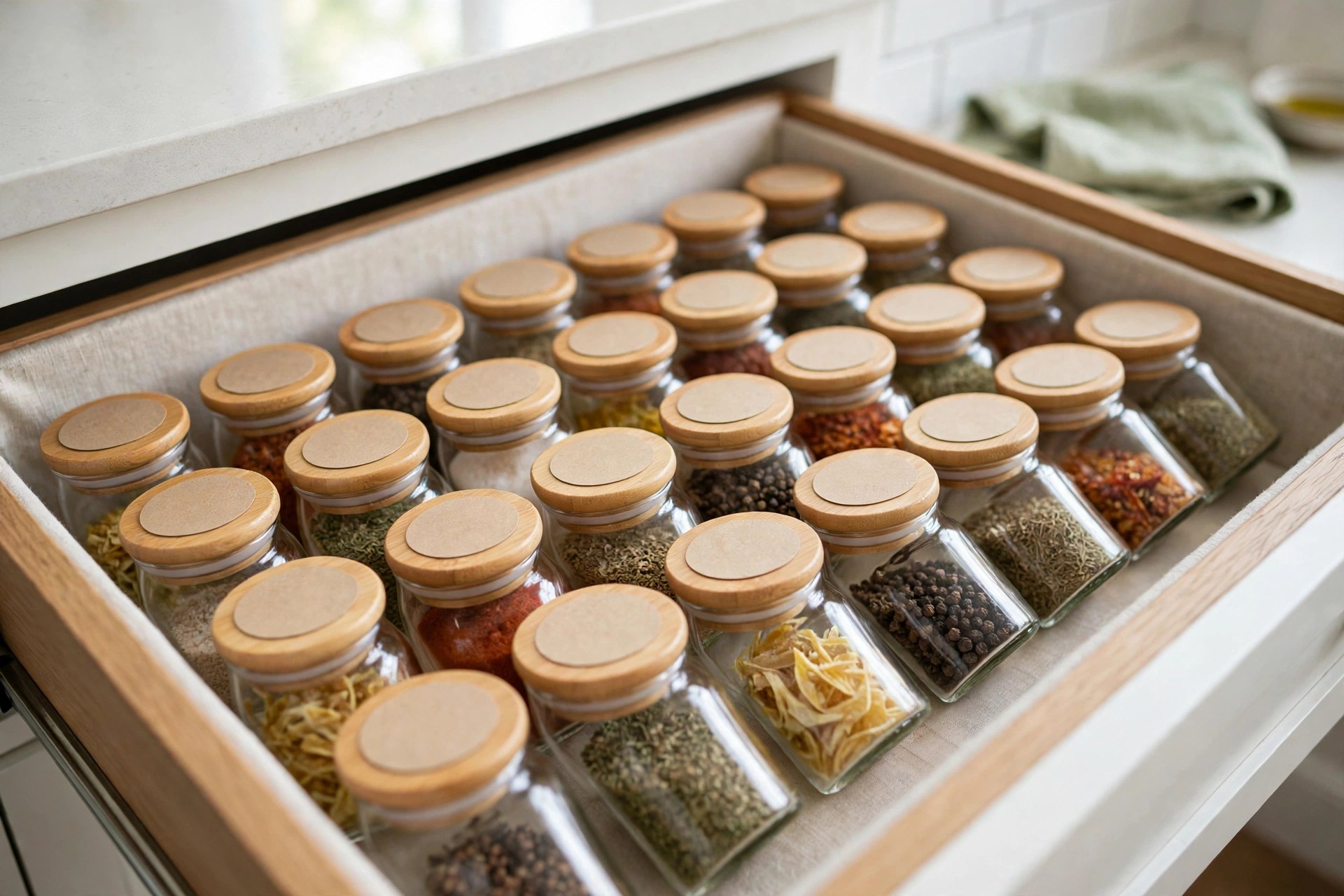
The drawer insert is best if you have even one shallow drawer to spare. Jars lie flat in angled rows, labels facing up, so you can read every jar at a glance. It uses existing storage, adds nothing to the wall, and keeps spices away from light and heat. It is best for 12 to 16 jars. The trade-off is that it costs a drawer, and it only works if that drawer’s contents can move elsewhere. It is the most rental-friendly option, since nothing is drilled or stuck. If the drawer is deep rather than shallow, use a tiered insert so the back row sits higher than the front row. For more everyday ideas, see these 13 small kitchen storage ideas for everyday essentials.
2. Inside the Cabinet Door
The inside of a cabinet door is dead space that is perfect for spice jars. A door-mounted rack holds 6 to 10 jars, usually with a height limit around 4 inches, so measure first. It keeps jars hidden, off the counter, and close to the stove without sitting in the heat. The trade-off is weight: a door full of glass jars stresses the hinges, so favor lighter jars or plastic tins, and check the hinges after a month. It is the best second spot if the drawer is taken, and it pairs well: daily spices on the door, the full collection in the drawer.

3. Magnetic Jars on the Fridge or a Strip
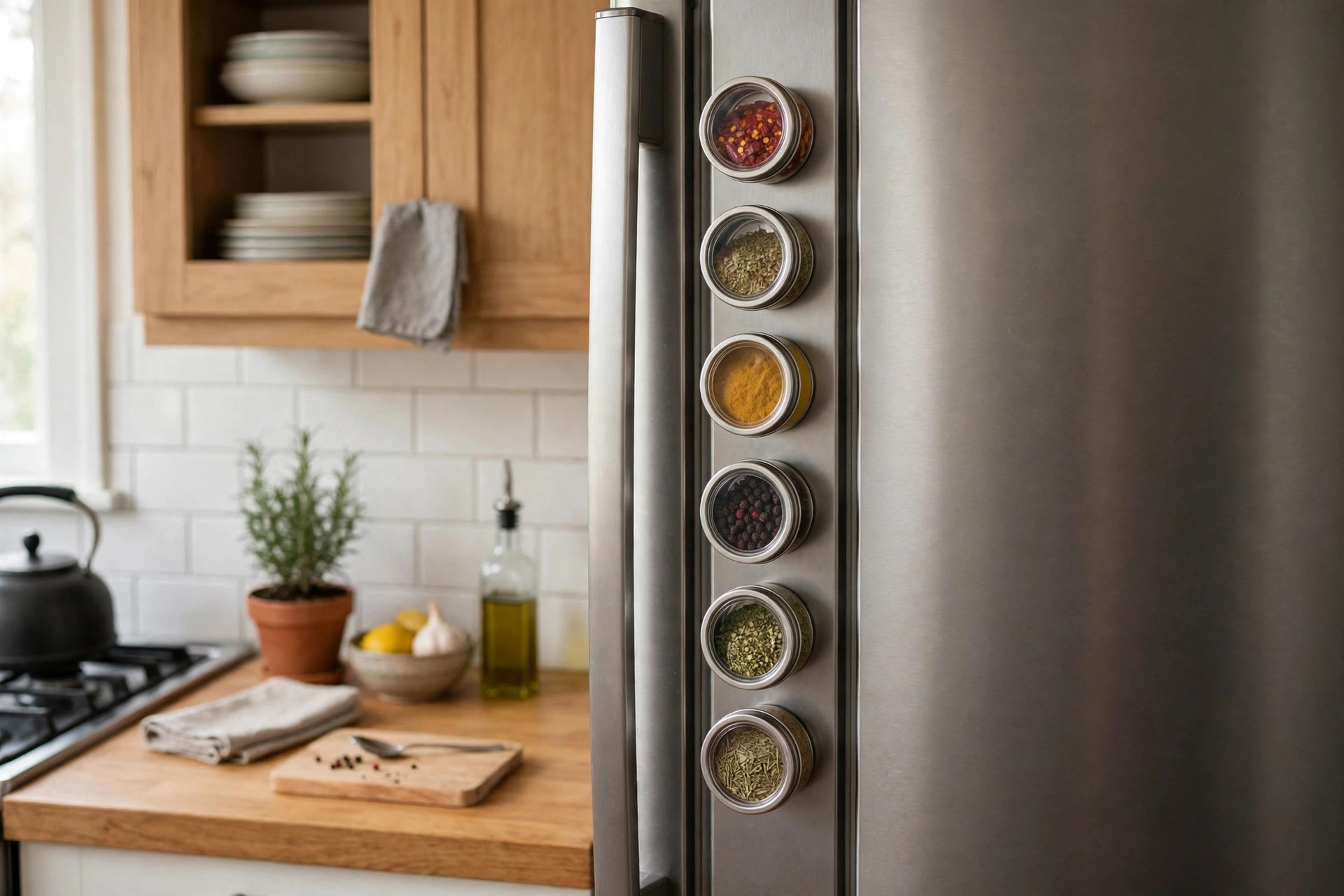
Magnetic tins stick to the side of the fridge, a magnetic strip on the backsplash, or a metal board on the wall, and they use zero counter and zero cabinet space. A single 12-inch strip holds 6 to 8 tins, and a fridge side can hold 16 or more in a vertical column. This is best if you have no free drawer and no free door. Test that the fridge side is actually magnetic first, because many stainless finishes are not. Keep the tins away from direct steam and heat, since moisture clumps ground spices and heat fades flavor. Label the lids, not the sides, and refill over the counter, not over the board. If appliances crowd your counter, see where to put a kettle in a small kitchen.
4. A Wall Rail by the Prep Zone
A wall-mounted rail or tiered rack beside the stove puts daily spices at eye level. A rack about 24 inches wide holds roughly two rows of standard jars, covering the spices most home cooks use every week. This is best if you own your home or your landlord allows small screws, and you have a blank wall near the prep zone. The trade-off is light and heat exposure: do not mount it directly beside the stove or in direct sun, since ground spices lose flavor faster in light and heat. Use tins with tight lids and keep the rack on a wall away from the cooking zone, even if that means one extra step.
5. A Tiered Shelf Inside a Cabinet
A tiered shelf is the cheapest fix if your spices are already in a cabinet but you cannot find anything. A tiered step shelf raises the back row so every label is visible, and it fits a standard cabinet shelf without installation. It holds 8 to 10 jars. The trade-off is that it still uses cabinet space, so it is a visibility fix, not a space saver. It works best as a companion: daily spices on a step shelf in the cabinet nearest the stove, backups elsewhere. If the cabinet shelf is deep, pull the step shelf forward so the back row is still reachable. For another appliance that eats counter space, see where to put a microwave in a small kitchen.
6. The Pantry Zone for Backups
Backup jars, bulk bags, and spices used less than once a month belong in a separate pantry zone: a high shelf, a bin on top of the cabinets, or a box in a nearby closet. Keep backups airtight, labeled with the purchase date, and refill your daily jars from them. Whole spices last 2 to 3 years and ground spices last 1 to 2 years when stored cool, dark, and dry. Check aroma and color once a year and replace anything dull or weak. Buying in bulk only saves money if you use it before it fades.
What Not to Do
Do not store spices directly beside the stove, above the dishwasher, or on top of the fridge near a heat vent: heat and steam are the fastest way to kill flavor. Do not store spices in clear jars on a sunny windowsill, since light fades ground spices in weeks. Do not buy a carousel that eats an 8-inch circle of counter: that is prep zone you cannot afford to lose. Do not transfer every spice to matching jars if your collection is mostly standard jars already: matching jars help only when bottle shapes are wildly different, and transferring costs time and risks mislabeling. Pick the spot that fits your jars, not jars that fit a photo.
Where is the best place to store spices in a small kitchen?
In a drawer insert if you have a spare drawer, or on the inside of a cabinet door if you do not. Both use zero counter space and keep spices away from light and heat.
How do I store spices with no wall space?
Use a drawer insert or the inside of a cabinet door. If neither is free, magnetic tins on a fridge side or a tiered shelf inside an existing cabinet both work without wall space.
Can I use a magnetic spice rack on a refrigerator?
Yes, if the fridge side is actually magnetic. Test it first, because many stainless finishes are not magnetic. Keep the tins away from steam and heat.
How long do spices last?
Whole spices last about 2 to 3 years and ground spices about 1 to 2 years when stored cool, dark, and dry in airtight jars. Replace anything that smells dull or looks faded.
Should I transfer spices to uniform jars?
Only if your bottle shapes are very different. Uniform jars help magnetic and tiered systems, but if your jars are already standard sizes, keep them and choose a rack that fits.