How to Organize a Small Shower Without Shelves
A small shower without shelves needs a place for the products you use while washing, without putting bottles underfoot or crowding the controls. Start with one modest caddy that fits the enclosure and its surfaces. If there is no suitable place to mount one, a portable basket may work better than forcing a fitting onto the wrong wall.
The useful question is not how many shelves you can add. It is whether you can reach your shampoo, turn around and open the shower door without moving things. Work through the products, mounting options and clearances before choosing an organizer.
Start With What a Small Shower Without Shelves Needs to Hold
Take the bottles out and separate current products from replacements. Keep the shampoo, conditioner, body wash or soap you actually use in the shower. An unopened refill does not need the same convenient position as the bottle already in use.
In a shared bathroom, group the collection by person before deciding how much space is needed. Shared products can occupy one section, with a small area for anything individual. The aim is to avoid buying a large rack for duplicates that could live elsewhere.
Place the selected bottles together on a dry surface. Notice their shape as well as their number: one tall pump bottle can require more usable height than several short tubes. Include a draining soap dish if you use a bar, and leave room to lift items out without catching the others.
If replacements need a new home, our guide to organizing under a small bathroom sink covers removable containers and working around plumbing. Keep the everyday shower set separate so refilling does not turn into another search through the cupboard.
Choose Storage That Fits the Surface and Enclosure
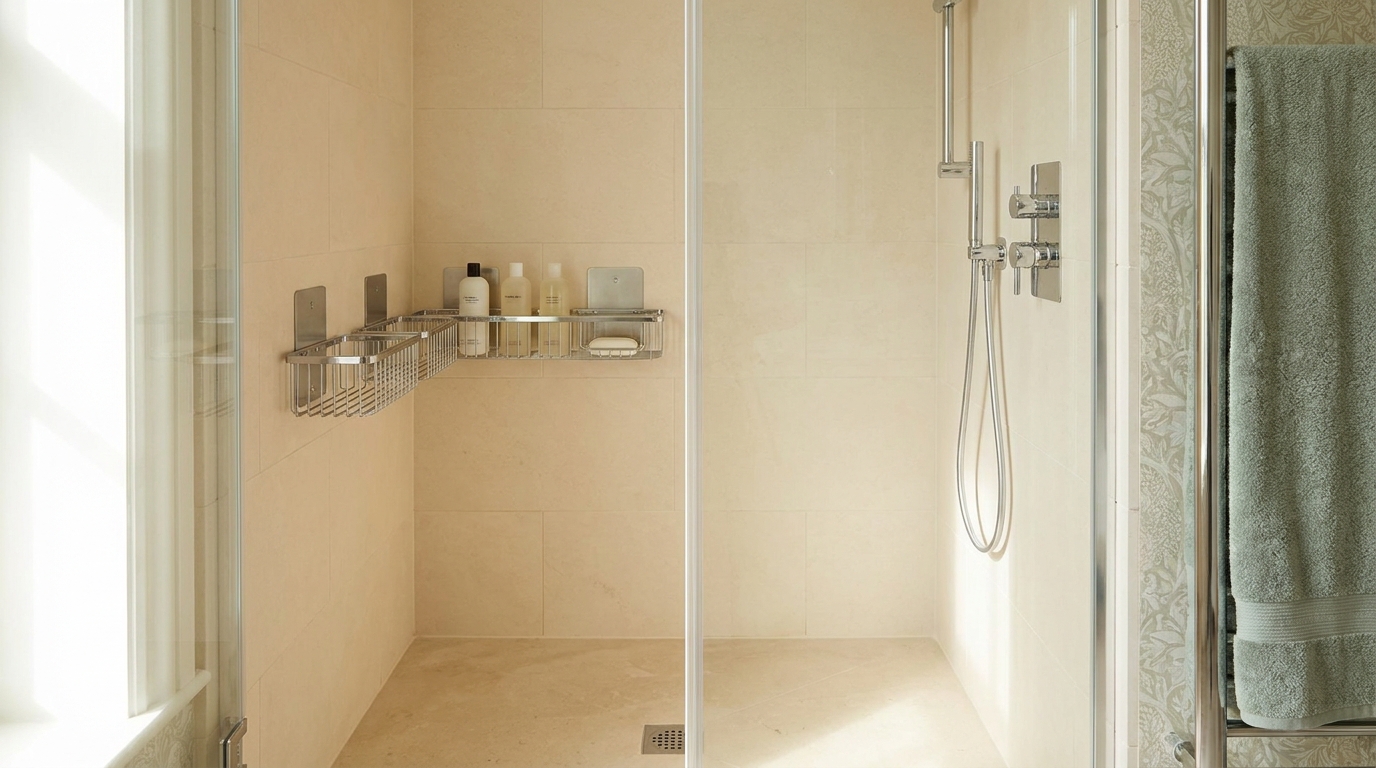
A wall basket for a compatible surface
A shallow basket attached to the wall keeps bottles off the floor and can be positioned around your reach. Adhesive and suction versions have different requirements, so choose the fitting method before settling on a color or shape.
For suction, a smooth surface matters. For example, OXO’s StrongHold corner basket guidance specifies smooth glazed surfaces, mirrors or glass, and advises against textured or porous surfaces. A shower being tiled does not automatically make every tile suitable.
For adhesive storage, choose a product intended for the shower environment and follow its own instructions for surface preparation, strip placement, waiting time and removal. Keep mounting pads off grout where the manufacturer requires it. Do not substitute ordinary hooks or extra generic tape for the specified fittings.
Check the tile area behind the mounting pads, not only the space occupied by the basket. Small tiles and closely spaced grout lines can leave too little uninterrupted surface for a particular model. In a rental, confirm that the intended mounting and removal method is permitted.
A hanging caddy for a suitable enclosure
A caddy made to hang over an enclosure can be useful when the walls are unsuitable for suction or adhesive. Check the exact support it is designed for, including glass or frame thickness and any protective pads. The enclosure manufacturer’s restrictions matter as well as the caddy’s instructions.
Test the door’s full movement before loading the caddy. The frame, hooks and bottles must clear nearby walls and fittings, and the door must close normally. An organizer intended for one enclosure type should not be forced onto another.
A shower-head caddy is another product category, but do not assume every shower arm can support one. Use only an arrangement compatible with the shower fitting and the caddy instructions. A hose, control, grab bar or curtain rail is not a substitute mounting point unless explicitly designed for that use.
A tension caddy where the height and footprint fit
A floor-to-ceiling tension caddy can offer several baskets without wall adhesive. Check the measured distance against the product’s supported range, along with the required contact surfaces and installation method. Do not improvise extensions or wedge the pole against a surface it is not designed to use.
Look beyond the pole itself: each basket projects into the shower. This option makes more sense when the corner is outside your normal standing and turning space. If only three bottles need storage, a tall multi-basket unit may use more room than the problem warrants.
A portable basket when fixed storage is unsuitable
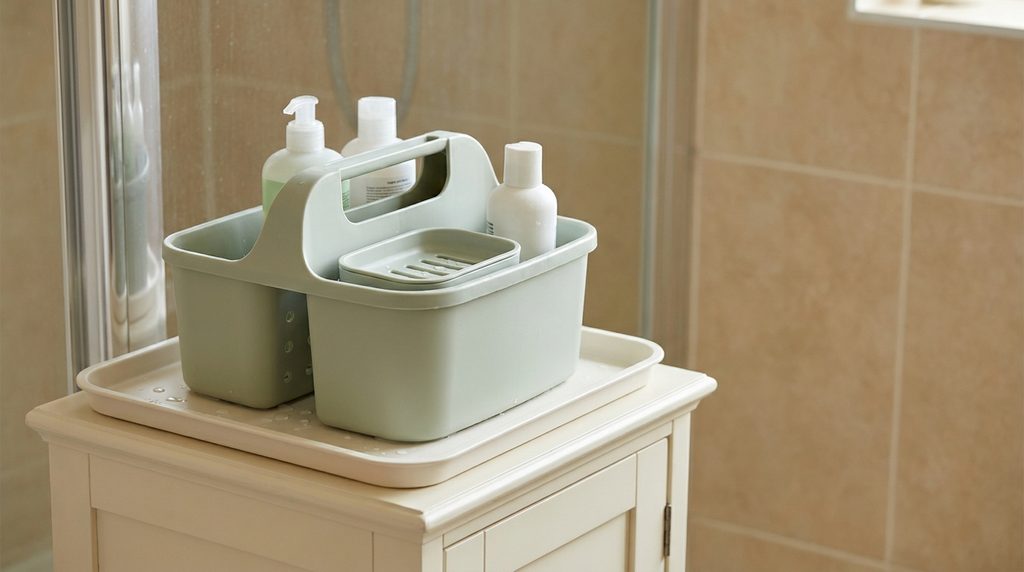
A small handled basket lets you bring your own toiletries to the shower and remove them afterward. It can suit a shared bathroom or an enclosure with difficult surfaces, but it still needs a stable place during use and a draining spot afterward.
Plan that spot before choosing the basket. It should not sit at the entrance, cover the drain or force you to step around it. If there is no usable position inside the enclosure, a portable caddy alone will not solve the access problem; reconsider the layout or a compatible mounted option.
After use, allow the basket to drain before returning it to storage. A washable tray outside the enclosure can contain drips, provided it is emptied and dried rather than left holding water.
Place the Caddy Around How You Move
Choose a position you can reach from your normal stance, without stretching across the water controls. There is no single correct mounting height for every household. Check the reach of the people who use the shower, including anyone who sits to wash.
Before fitting anything, stand in the dry enclosure and rehearse ordinary movements: raising your arms, turning, reaching the controls and opening the door. Consider the loaded basket’s depth and any bottle pumps that project beyond it. A corner that looks empty from outside may be exactly where your elbow moves.
Keep access to controls, grab bars and the shower hose clear. Where the layout permits, place the caddy away from the strongest spray so it is not constantly catching water. Do not gain storage by obstructing the way in or out.
In a curtained shower, check the shower curtain length and liner position too, so the caddy does not catch the material or push it outside the wet area.
Check Bottle Height, Access and Loaded Weight
Measure your tallest bottle with its pump unlocked or cap open, and allow room for the action you use to remove it. A bottle can fit between two shelves yet still be difficult to lift over the basket’s front rail.
Check the base of smaller items against the rack openings. A narrow tube that tips through widely spaced wires may need a suitable small holder rather than a deeper basket. Soap needs a place that drains without sliding out when you reach for another product.
Assess capacity with full bottles. Use the manufacturer’s stated load limit and instructions about what that limit includes; counting bottles is not a reliable weight check. If the basket is not designed for downward pump pressure, lift the bottle out before dispensing instead of pressing hard on the mounted rack.
Avoid reorganizing solely for matching containers. Keeping products in their original packaging preserves their names and directions and removes a refilling task. A tidy arrangement can still contain different bottle colors and sizes.
Keep Water Moving and Spare Products Elsewhere
Look for drainage openings you can reach to clean, and avoid crowding the basket so tightly that bottles are difficult to remove. Rinse away product residue and clean the caddy according to its material and care instructions. Lift out removable parts when cleaning the shower so you can reach the surface behind them.
For adhesive fittings, keep the removal instructions and any required release area accessible. Command’s bathroom installation and removal guidance illustrates why the fitting method matters; use the directions supplied with your particular caddy rather than assuming every adhesive system works the same way.
If a fitting loosens, shifts or shows damage, unload it and resolve the cause before using it again. Adding another strip at random or loading a neighboring hook can conceal the same compatibility problem.
Give the collection a quick reset when a bottle runs out: replace it, remove the empty one and return spare stock to its cupboard. For the rest of the room, our small bathroom storage ideas cover towels, counter space and everyday supplies. Keep shower storage focused on what needs to be within reach while you wash.