How to Choose a Bathroom Mirror: Size, Shape and Placement
To choose a bathroom mirror, start with the space above the sink and the people who will use it. The right mirror needs to fit between the fittings, give you a comfortable view and work with your lighting. A shape that looks lovely in a product photograph can still feel awkward if its frame crowds the tap or its reflection ends too low.
Before shopping, measure the available wall area, mark out a possible mirror and check it from your normal position at the basin. That small exercise can help you decide between a simple wall mirror, a taller shape and a cabinet that also holds everyday toiletries.
On this page
- Measure before shopping
- Choose a bathroom mirror shape
- Set the height and position
- Decide between a mirror and a cabinet
- Check lighting, finish and cleaning
- Make the final fit check
Measure the Available Space Before Shopping
Write down the width of the vanity or basin, then measure the wall area above it. Include obstacles that a product photo will not show: a projecting light shade, a tall tap, a nearby cabinet, a sloping ceiling or a tile border you want to leave visible.
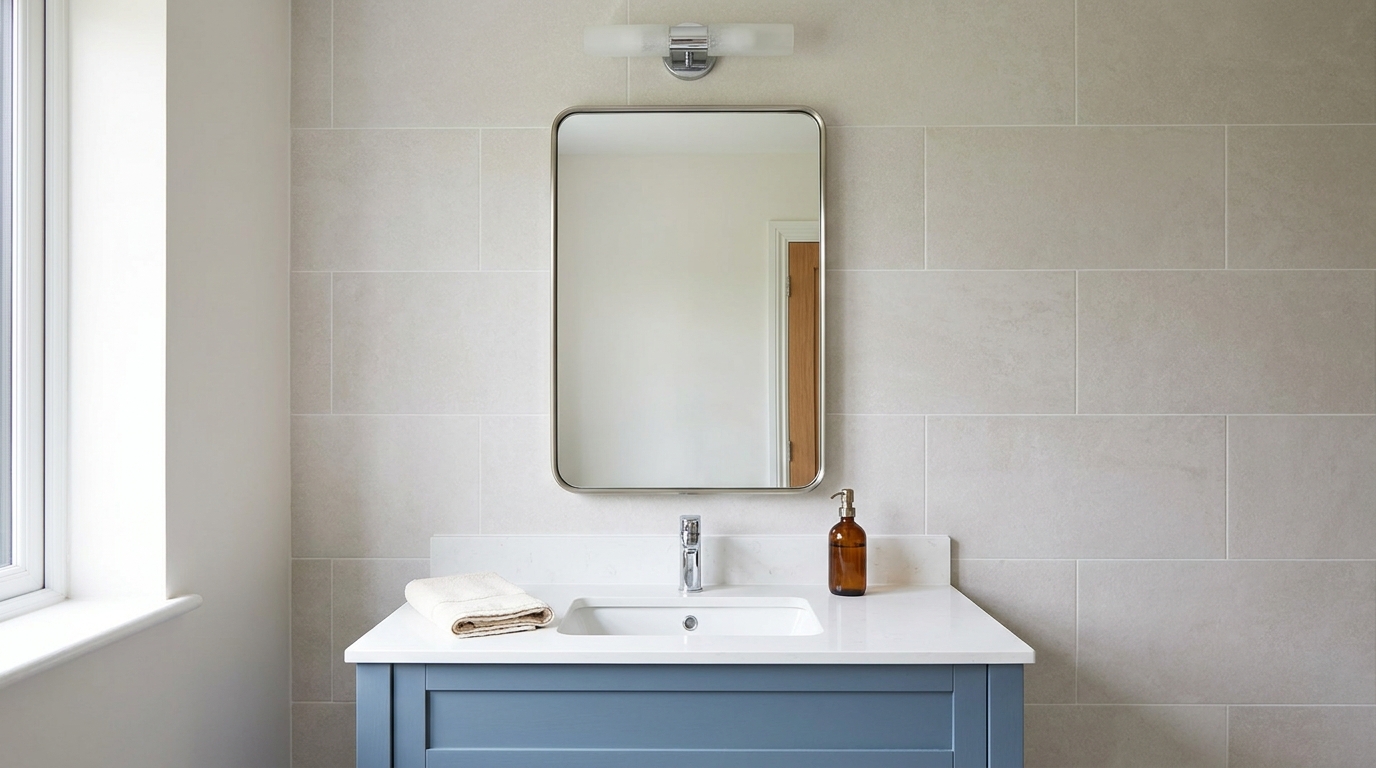
Kohler’s mirror buying guide suggests starting with a mirror no wider than the vanity and allowing space for surrounding fittings. Treat this as a starting point for an individual mirror, rather than a rule that every wall-to-wall installation must follow.
Measure the outside of the frame, not just the glass. Check the product drawing too: a listed measurement may describe the overall item, while a separate figure describes the reflective area. A broad frame can use a surprising amount of the available width.
A simple width example
Imagine a 36-inch-wide vanity with a centered basin. You are comparing mirrors with outside widths of 28 and 32 inches. When centered over that vanity, the 28-inch option leaves 4 inches of vanity width on either side; the 32-inch option leaves 2 inches. The calculation is (vanity width − mirror width) ÷ 2.
Those are visual margins, not required installation clearances. If side lights or another fitting occupy that space, measure their actual position and projection before choosing. The smaller mirror may fit comfortably, or both options may need to change. These dimensions are an illustrative comparison, not a shopping recommendation for every 36-inch vanity.
Choose a Bathroom Mirror Shape Around the View You Need
Compare shapes inside the wall area you actually have. A circle’s quoted width is also its height, while a rectangular mirror can be narrow and tall. This matters when there is generous vertical space but very little room between side fittings.
| Shape | A useful reason to choose it | What to check |
|---|---|---|
| Rectangle | Provides reflection across its full width from top to bottom. | Whether a vertical or horizontal orientation suits the users and wall. |
| Round | Introduces a curved outline above a boxy vanity. | The glass narrows above and below the middle; test the view at your face height. |
| Oval or capsule | Offers a tall outline with curved ends. | The actual glass width where you need to see your face and shoulders. |
| Arch | Adds a curved top while keeping a straight lower edge. | The top’s relationship to the light above and any tile border. |
For a fair comparison, note both height and width. A 24-inch circle and a 24-by-36-inch rectangle share a width but occupy quite different wall areas. Neither is automatically better: the question is whether the visible glass falls where you need it.
Set the Height for the People Using the Basin
A standard hanging height cannot account for every household. Before choosing the final position, have the shortest and tallest regular users stand where they normally wash or get ready. Include a seated user if that is how the bathroom is used. You are checking the reflective glass, not whether everyone’s eyes line up with the decorative frame’s center.
Start with a paper outline of the outside dimensions, then mark the glass area inside it. This checks the fit and approximate sightlines; it cannot show the actual reflection. Where possible, compare the proposed edges with an existing, securely mounted mirror, or examine a display model before ordering.
If a round mirror’s lower curve leaves too little width for a shorter user, try a taller shape before simply lowering the whole mirror toward the tap. Keep the fitting clearances specified for the products involved.
What if the basin is off-center?
Mark the basin’s center and the vanity’s center separately. For a mirror used mainly at one basin, begin by testing alignment with that basin. Then step back to the doorway and judge the whole arrangement. A wide mirror may bridge the difference; a narrow one placed over the cabinet’s center could leave the user standing near its edge.
With two basins, compare one broad mirror with two separate mirrors. Two mirrors create distinct stations, but their spacing must work with the basin centers and lights. One broad mirror can offer a continuous view without asking each person to stand in a narrow spot.
Choose a Mirrored Cabinet Only If the Storage Works
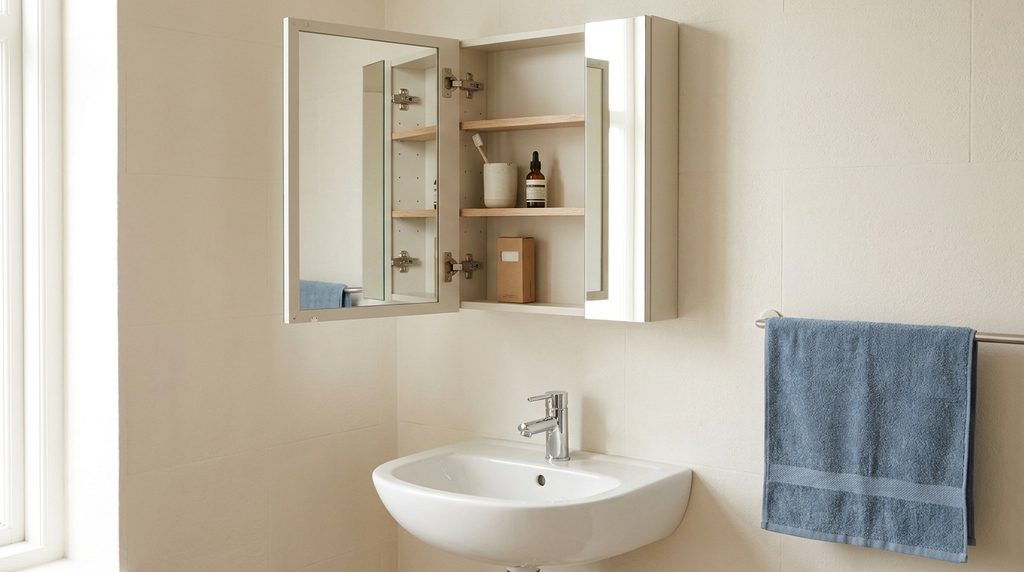
List the items you would actually keep behind the mirror. Measure the tallest bottle and check the internal shelf depth, not just the cabinet’s outside dimensions. Storage is less useful if the everyday items still have to stay on the basin because they do not fit inside.
Also check the open door. Can it swing past a side light or adjacent wall? Can you reach the contents without standing awkwardly around the basin? A surface-mounted cabinet projects into the room; a recessed model needs a suitable wall cavity and an installation assessment. Do not assume an existing wall can accept one just because its face is wide enough.
For a pedestal or wall-hung basin, mirrored storage may solve one part of the problem, but towels and larger supplies still need a home. These ideas for a small bathroom without a vanity can help you plan those items separately.
Check the Light and Frame Before Paying for Extras
Look at your current mirror with the lights you normally use after dark. Is your face easy to see, or does a bright reflection make you move to one side? A new frame will not necessarily solve an awkward lighting position. Consider the mirror and fittings together before ordering either.
If you are repainting the surrounding wall, compare bathroom paint finishes under the same lights before choosing the final sheen.
For an illuminated model, check what the lighting is intended to do. Do not assume a glow behind the mirror will provide the same view as light directed toward your face. Ask to see it operating, check its controls and review the manufacturer’s installation requirements. Confirm bathroom suitability and any electrical work with a qualified installer before buying.
Choose a finish by looking at the fittings already beside it. Repeating the tap’s finish is one option; a simple contrasting frame is another. Compare a finish sample in the room if available, because a bright product photograph may hide differences in sheen or color.
Check care instructions as well. Deep grooves and a projecting lower frame create more edges to wipe. If you like a timber frame, confirm that the particular product is intended for bathroom conditions rather than assuming every decorative mirror is suitable.
Make the Final Fit Check Before You Order
Use a paper template or small pieces of low-tack tape that are suitable for the wall finish; test an inconspicuous spot first. Mark the outside edges and any cabinet projection. Keep the product drawing beside your measurements.
- At the basin: check where each regular user stands and whether the glass area suits that position.
- Around the edges: confirm space for the tap, lights, nearby doors and cleaning access.
- From the doorway: check the outline against the vanity, tile borders and the rest of the wall.
- Before installation: confirm the mirror’s weight, approved mounting method, wall suitability and product-specific clearances with the installer.
Keep a note of the final outside dimensions and glass dimensions when shopping. That gives you a useful shortlist: mirrors that fit your bathroom and daily routine, with shape and finish chosen within those limits.