Off-Center Window Behind a Bed: Make the Wall Feel Balanced
You center the bed on the wall, step back, and the window makes everything look slightly wrong. Move the bed underneath the window and the bedside space becomes uneven. An off-center window behind a bed creates two different problems: where the furniture works best, and how the wall looks once the furniture is there.
Start with the usable bed position. Then decide whether to align with the window, soften the whole wall with curtains, or leave the window visible and balance the empty side. The best choice is the one that still works when the curtains are open and someone needs to get around the bed.
Explore the options
An Off-Center Window Behind a Bed: Separate the Layout From the Look
Imagine a bedroom with a window to the left of the wall’s center. The bed currently sits in the middle, with a practical route down each side. This is an illustrative room, not a makeover we have carried out; it lets us compare what changes and what stays fixed.
The temptation is to slide the bed until its center meets the window’s center. Before doing that, mark the new bed-frame position on the floor and open the nearby doors and drawers. The full frame matters, including any projecting footboard or upholstered sides.
A simple example: if the window center is 18 inches left of the bed center, aligning them means moving the bed 18 inches left. A 32-inch gap on that side would shrink to 14 inches. Those are hypothetical measurements, not clearance recommendations, but they show why a prettier wall can produce a less usable room.
Also check whether this is a suitable bed wall at all. You need to operate the window and its covering, and preserve any escape route it provides. NFPA’s escape-planning guidance calls for identifying two ways out of each room. If the bed would obstruct an escape window, use another position. Keep furniture and fabric clear of heaters and follow the appliance’s required clearances.
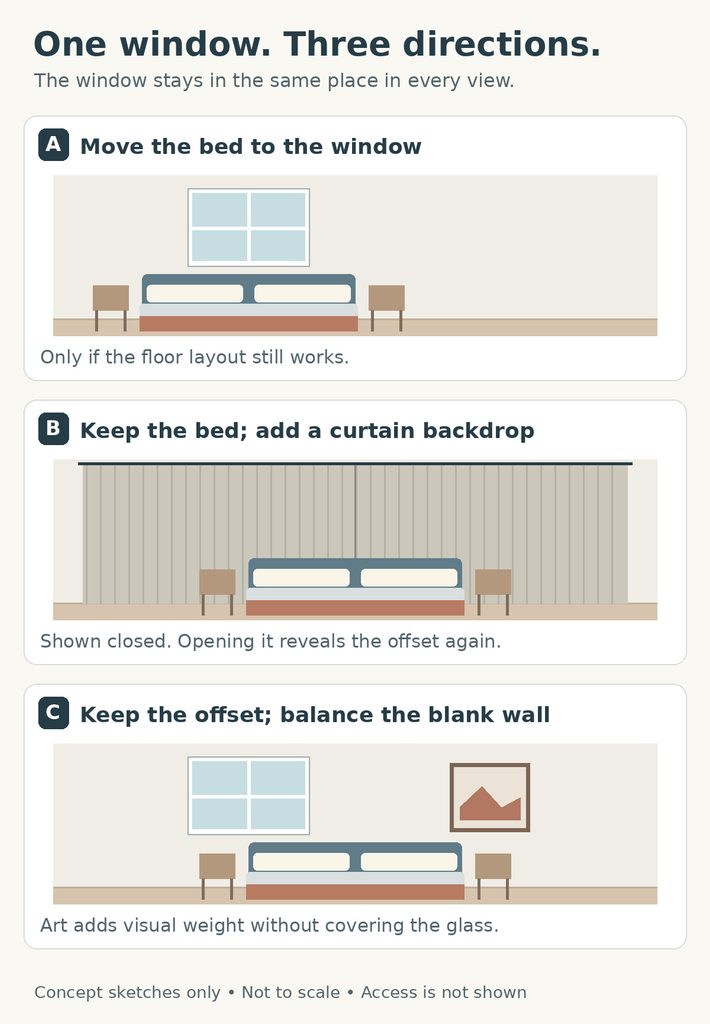
Three front-view concepts for the same window position. These sketches explain the visual choices; they are not floor plans, clearance diagrams or installation instructions.
Three Ways the Same Wall Can Work
Move the bed when the window offers a better center
This is worth trying when there is enough room to shift the bed without pinching a route or blocking storage. Move the bed and its bedside furniture as a group, rather than leaving the tables behind to preserve their old positions. The window becomes the center of the sleeping area even though that area is no longer centered on the entire wall.
In a bedroom layout project by Chris Loves Julia, centering the bed between two windows would have put a nightstand in conflict with a closet door. Their solution was to align the bed with one window instead. The useful lesson is to test the surrounding furniture, not just the bed-to-window relationship.
An unequal amount of wall on each side is not necessarily a fault. Leave the larger side open if the room needs that space. Do not buy a chair or cabinet merely to make the empty area look occupied.
Where this approach breaks down: the bed looks aligned in a photograph, but one person has to squeeze past it, a drawer cannot open, or the foot of the bed lands in the entrance route. In that case, restore the workable position and change the backdrop instead.
Keep the bed where it works and create a curtain backdrop
A broad run of curtains can give the bed a continuous background. The fabric becomes the feature, so the eye is less concerned with the exact position of the window behind it. Jennifer Rizzo’s off-center window projects show how extending window treatments across a wider area can change the apparent balance of a bed wall.
Decide what the curtains need to look like in two states. Closed panels may create a centered backdrop at night. Open panels can reveal the original offset in daylight. That is acceptable, but it means a wall of fabric does not permanently turn an off-center window into a centered one.
There is a further limit to the “fake a wider window” trick: an opening between the panels must actually contain glass if you want it to read as a window. A centered gap that reveals mostly blank wall can make the arrangement look more confusing. Do not cover most of your only window simply to preserve a symmetrical opening.
Before buying the wider rod or track, picture where the gathered fabric will sit. It must move without catching behind the headboard or tangling with bedside lamps. Check that you can reach the controls and open the window normally. Our guide to choosing curtains for a small bedroom covers fabric, privacy and measuring once the layout is settled.
Leave the window visible and balance the blank side
If moving the bed makes the floor plan worse and more curtains would steal light, let the wall stay asymmetrical. A window on one side and a deliberate piece of art on the other can form a complete composition without pretending to be matching objects.
Arlyn Hernandez explores this approach in her off-center bedroom window design study on Emily Henderson’s site. The useful distinction is visual balance: the two sides can feel considered without having identical shapes.
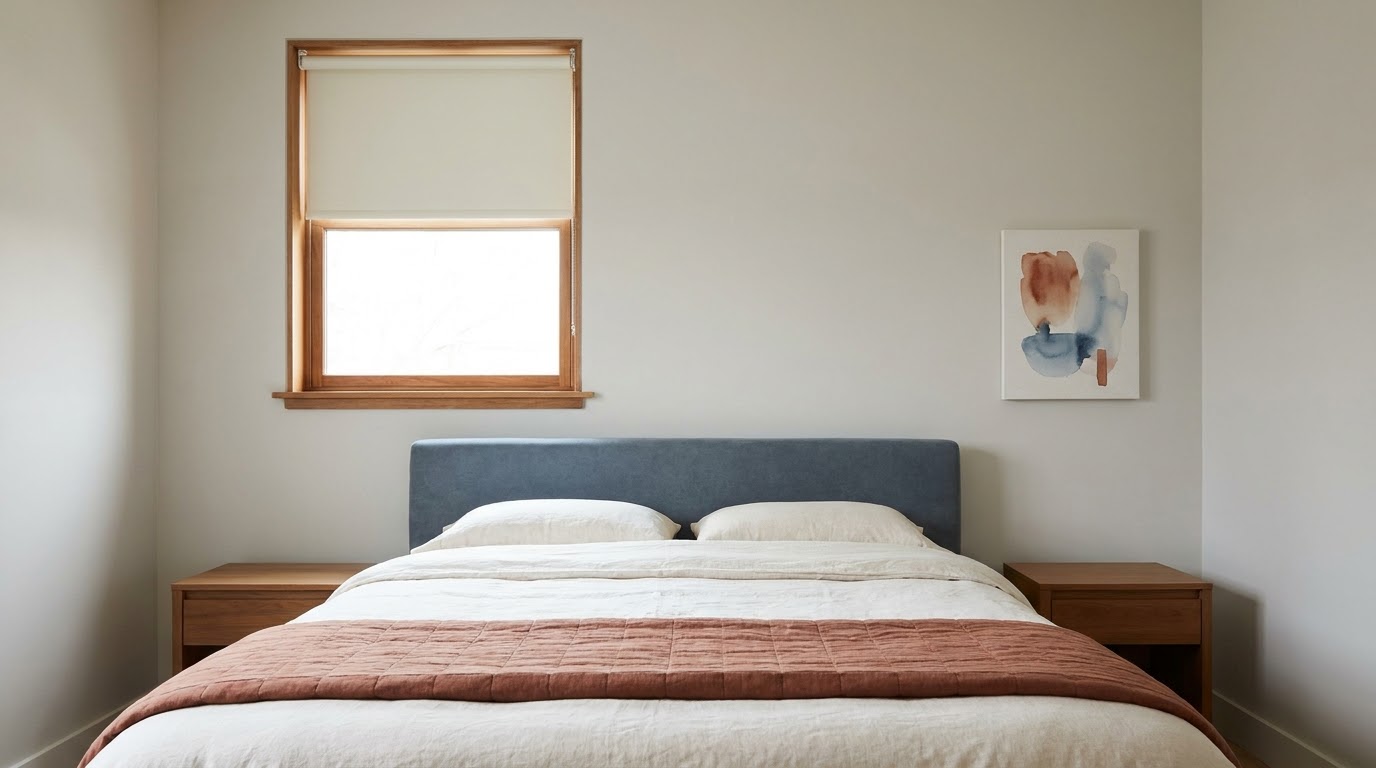
For our example, keep the blue headboard centered on the wall. Leave the left-hand window plainly visible and try a single rust-and-blue canvas on the blank area to the right, preferably beside the sleeping area. Repeat a small amount of rust in the bedding so the artwork belongs to the room rather than looking like a patch for the window.
Judge the artwork by how much attention it draws, not just its dimensions. A small dark print may compete more strongly than a larger pale canvas. Start with one piece rather than spreading several small frames across every gap. The goal is a second point of interest, not an exact copy of the window.
You can make this gentler by choosing a window covering close to the wall color. Avoid adding a heavy mirror or shelf above the pillows just to fill the empty side; artwork can sit beside the bed, and any wall-mounted item needs appropriate secure fixing.
Try the Wall in Daylight Before You Commit
Take a straight-on photograph from the foot of the bed and another from the doorway. Use copies to sketch the bed shift, a curtain rectangle and an art rectangle. These rough mockups help you compare the composition without ordering three different solutions.
Next, test the strongest idea in the room. Mark the proposed frame position on the floor or use a safely attached paper template for the artwork, removing it after the test. Look at it with the window covering open, then closed. A scheme that only works with the daylight hidden may not be the one you want to live with.
Return to the ordinary movements: getting into bed, opening a drawer and using the window. If those still work, decide whether the room feels settled from the doorway. You do not need to erase the offset. You need a bed position that works and a wall that looks deliberately arranged around it.