Where to Put a Cutting Board in a Small Kitchen (So It Stops Living on the Counter)
A cutting board is the most-used surface in a small kitchen, and often the worst-stored one. Left flat on the counter, it eats the only prep space you have. Stacked in a cupboard, it slides out in an avalanche every time you open the door. Shoved in a drawer, it jams the drawer shut.
The fix is not a bigger kitchen. It is matching the spot to the board. A thin board and a thick butcher block do not belong in the same place, and a board you use twice a day should not live in the same spot as one you use twice a year. Measure your board and your storage first, then pick from the spots below.
Measure First: Board, Gap, and Drawer
Before you buy any holder, measure three things. First, your board: length, width, and thickness. A daily board for one or two people is usually around 12 by 8 inches, while a board for big-batch cooking is closer to 15 by 10 or 18 by 12 inches. Second, the gap you plan to use: the inside depth of the cabinet, the space beside the fridge, or the inside height of a drawer. Third, the clearance: a divider slot needs about an inch more than the board thickness, and a wall hook needs enough room to lift the board off without hitting the shelf above.
Write the numbers down before you shop. Most cutting board storage fails because the holder fits the idea of the board, not the board itself.
1. Vertical Dividers Inside a Cabinet
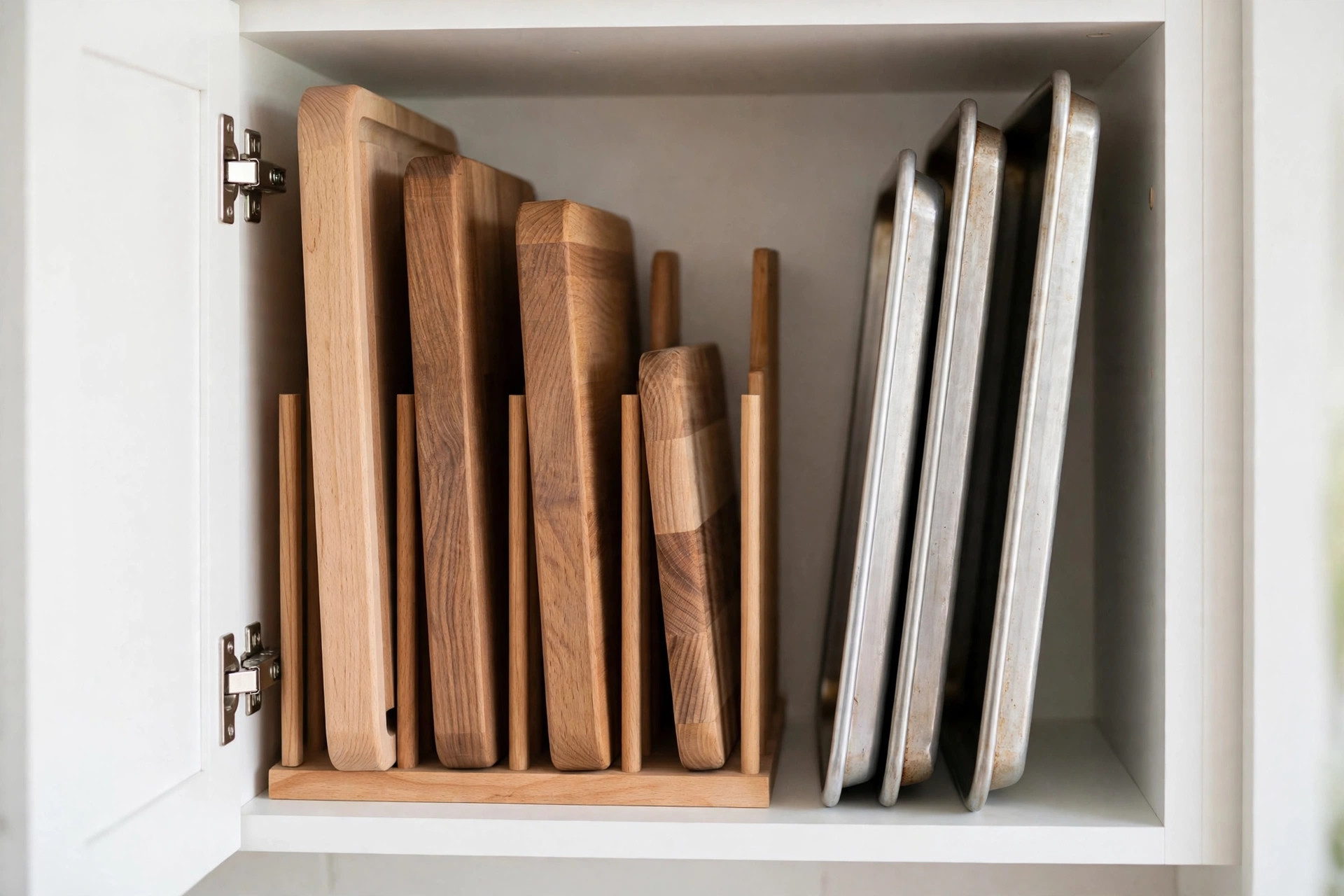
This is the best spot for most small kitchens, because it uses a cabinet you already have and keeps boards upright, separated, and easy to grab. Slide vertical dividers, tension rods, or a file organizer into a deep cabinet, and store boards upright like books, beside baking sheets. Pull one board out without moving the rest.
This works best for thin to medium boards, up to about 1 inch thick. A heavy butcher block belongs lower down, not on a high shelf, because lifting a heavy board overhead is awkward and risky. If your cabinet is shallow, measure the board length against the cabinet depth first, because a board longer than the cabinet will not close the door.
2. A Slim Rack on the Counter
If you use your board twice a day, keeping it on the counter is reasonable, as long as it stands upright in a slim rack instead of lying flat. A vertical rack takes a strip of counter about 2 to 3 inches deep, while a flat board takes its whole footprint, so upright storage can return most of your prep space.
This is the right choice for one beautiful daily board, not for a collection. If you own four boards, only the daily one earns counter space. The rest go in a cabinet, a drawer, or on the wall.
3. On a Wall Hook or Rail
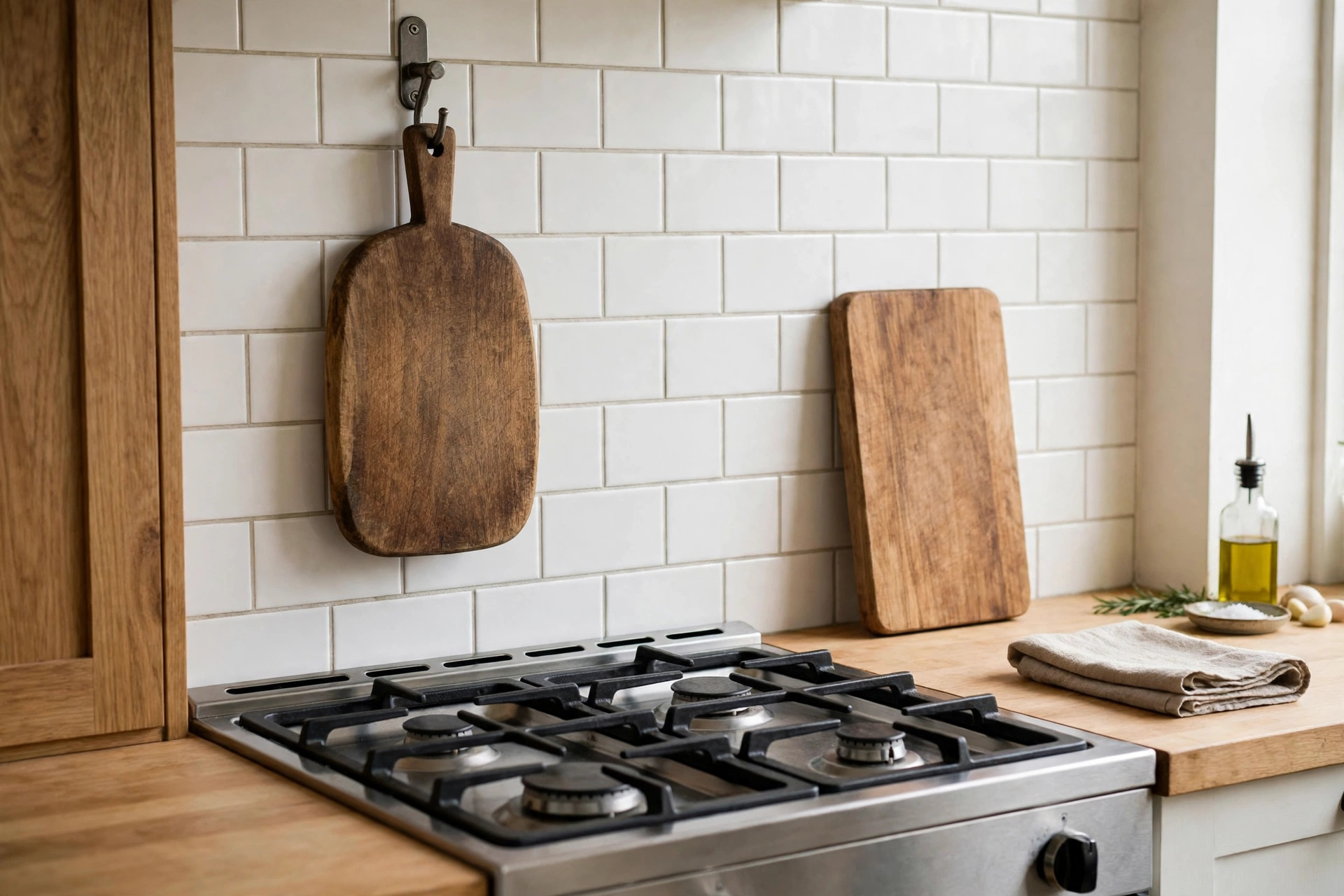
A board with a hanging hole or handle can live on a wall hook, a rail, or a row of sturdy hooks beside the stove or sink. This costs zero counter and zero cabinet space, and the board is in reach the moment you start cooking. Use a proper wall anchor, not just a nail in plain drywall, because a heavy wooden board will pull a weak hook out over time.
Skip this spot if you are renting and cannot put anchors in the wall, or if the only free wall is above the stove, where heat and steam will damage a wooden board. A hook inside a pantry door is the renter-friendly version of the same idea.
4. Inside a Cabinet Door
An over-door rack or a slim rack screwed inside a cabinet door turns wasted space into board storage. It suits thin and medium boards, and it keeps them hidden but instantly reachable when you open the door. Check two measurements: the door must still close with the board in place, and the rack must clear the shelf inside when the door swings shut.
This spot does not suit thick boards or boards wider than the door itself. If the rack bows or the door will not close fully, the board is too big for it, and the cabinet divider is the better choice.
5. Flat in a Drawer
A drawer works for boards that are too awkward to store upright, such as a large board or a set of thin boards stacked together. Lay boards flat, put a thin mat or tea towel between them so they do not slip or scratch, and keep the drawer for boards only, not boards plus gadgets. A drawer shared with utensils becomes a jammed drawer.
Measure the drawer interior, not just the drawer front. A board that is 12 inches long needs a drawer interior at least 12.5 inches deep, and a thick board needs a drawer tall enough to close without pressing on it.
6. The Fridge Gap and Over the Sink
Two overlooked spots suit slim boards. The gap beside the fridge, often 2 to 3 inches wide, holds a thin board upright and out of the way, as long as the board is dry and the gap is clean. An over-sink board, or a board stored across the sink when not in use, doubles as extra counter space during prep, though it should not live there permanently, because it blocks the sink.
Never store a board in a damp gap or against a wet wall. Boards need air, and a board wedged into a damp space will smell before it dries.
The Drying Rule That Protects Every Board
Whatever spot you choose, one rule matters more than the holder: never store a wet board in a closed space. Wooden boards stored wet will warp, crack, or smell, and plastic boards stored wet will trap moisture against the surface they touch. After washing, stand the board upright on a dish rack or lean it against the backsplash until both sides are fully dry, then put it away.
This is also why vertical storage beats stacking. Boards stored upright dry faster, stay separated, and do not trap moisture between layers. If your board is still damp at bedtime, leave it out overnight and store it in the morning. One night on the rack beats a week in a damp cabinet.
Which Spot Fits Your Kitchen
If you have a deep cabinet, use vertical dividers. If you cook daily and own one good board, use a slim countertop rack. If you have free wall space and a board with a hole, use a hook. If you rent, use an inside-door rack or a drawer. And if you own more boards than you use, move the spares to deeper storage and keep only the daily board within reach.
A cutting board that has a real home gets used, cleaned, and put away without thinking. A board with no home ends up back on the counter, taking the prep space it was meant to create. Measure the board, pick the spot that fits it, and let the counter go back to being a counter.
Where should I store a cutting board in a small kitchen?
Upright in a cabinet with vertical dividers is best for most kitchens. It keeps boards separated, dry, and easy to grab without using counter space.
Is it better to store cutting boards vertically or flat?
Vertically, whenever the board fits. Upright boards dry faster, do not trap moisture between layers, and let you pull one board out without moving the rest.
Can I store a cutting board in a drawer?
Yes, if the drawer interior is longer than the board and tall enough to close without pressing on it. Put a mat between stacked boards so they do not slip.
How do I store a cutting board with no cabinet space?
Hang it on a wall hook or rail if it has a hole or handle, or slide a slim board upright into the gap beside the fridge, as long as the spot is dry.
Should I store a cutting board wet?
No. Always let both sides dry fully before storing it, or a wooden board can warp and smell. Stand it upright on a dish rack until it is completely dry.