Where to Put a Kettle in a Small Kitchen
A kettle is the smallest appliance that causes the biggest daily argument in a small kitchen. It needs an outlet, it needs steam room, and it needs to be reachable before you have had your first cup of tea. Left on the main counter, it eats the one stretch of prep space you actually use. Shoved in a high cabinet, it never comes out, and you end up boiling water in a saucepan instead.
The fix is not a bigger kitchen. It is giving the kettle a home that respects three things: steam, power, and reach. This guide ranks the six best spots for a kettle in a small kitchen, with the exact clearances and outlet rules that decide whether a spot works or slowly damages your cabinets.
The Best Spot First: a Dedicated Kettle Zone
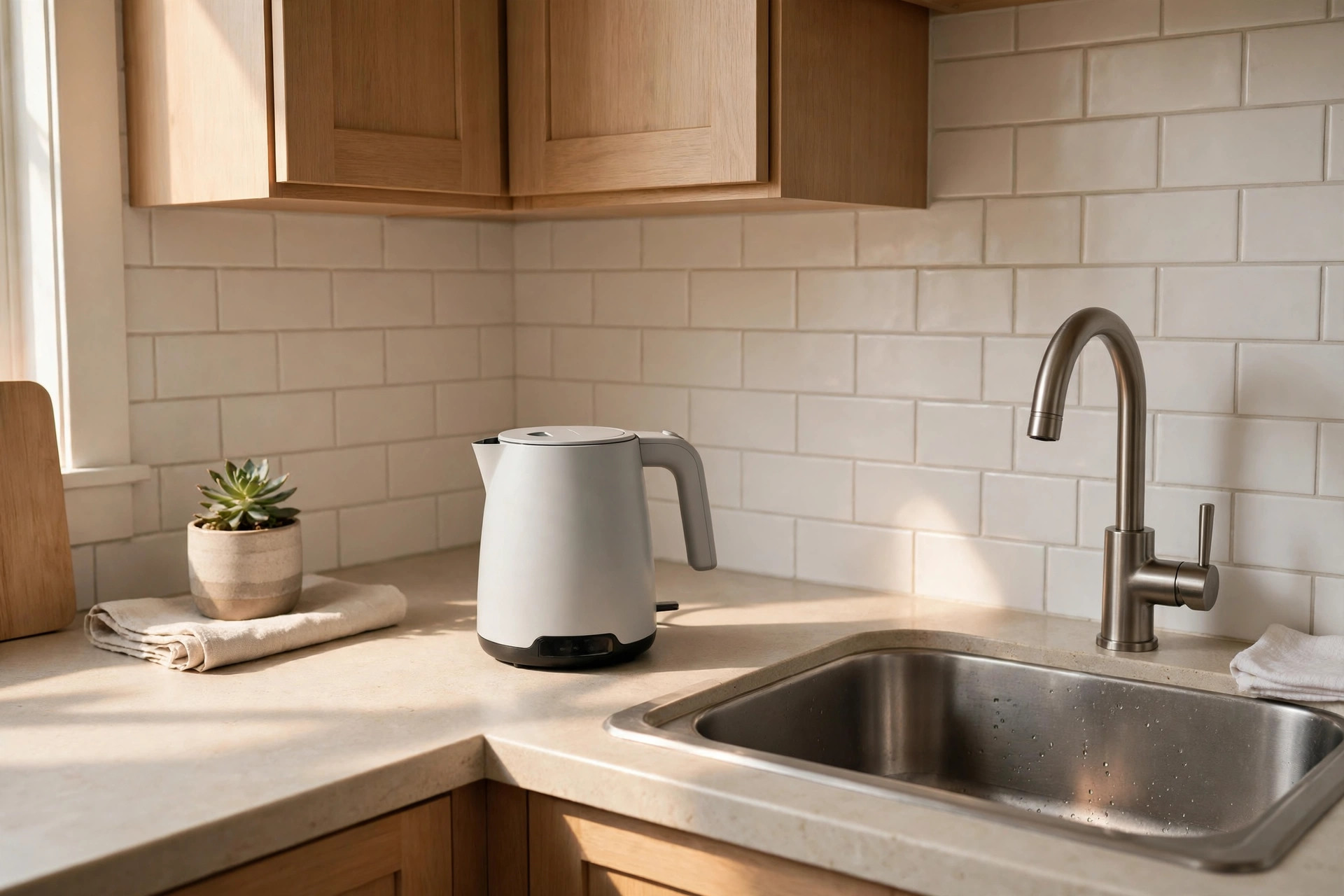
Stop looking for a spare inch and start looking for a zone. A kettle zone is a patch about 12 inches wide and 12 inches deep, near an outlet, where the kettle lives permanently with its mugs and tea or coffee beside it. The zone can be a corner of the counter, one shelf of a cart, or one shelf inside a cabinet. What matters is that it is always the kettle’s place, so you never have to clear prep space to use it or hunt for it in the morning.
Measure your kettle before you choose. Most electric kettles are 8 to 9 inches tall and 6 to 8 inches across at the base, and they need another 4 to 6 inches of lift room to fill from the tap or to lift off the base. If your chosen spot cannot fit the kettle plus that lift room, it is not a spot, it is a storage sentence.
The Steam Rule Most Guides Skip
A kettle is a steam machine. Every boil sends a plume of hot steam straight up, and steam is what warps cabinet bottoms, peels laminate, and leaves damp patches on the underside of upper cabinets over months. This is the single most common kettle placement mistake in small kitchens, where the temptation is to tuck the kettle directly under a wall cabinet to save counter space.
The rule is simple: never boil a kettle directly under a closed cabinet with less than 12 inches of open space above it. If the only space under your cabinets is tight, slide the kettle forward to the front edge of the counter while it boils, then push it back when it cools. Better still, pick a spot with open air above it, like a cart shelf or an open wall shelf, where steam rises and disperses instead of collecting under wood.
One more steam check: keep the kettle at least 6 inches from the side of a fridge or a wooden pantry door. Repeated steam on one side of a surface causes the same slow damage as steam from above, just in a place you check less often.
The Outlet Rule: Never Share With a Microwave
Kettles draw a lot of power, typically 1200 to 1500 watts. A microwave draws a similar amount. Plug both into the same outlet, or the same power strip, and you are asking for tripped breakers, especially in older apartments where one circuit serves the whole kitchen counter run.
Follow these two rules and you will never trip a breaker over a cup of tea. First, give the kettle its own wall outlet, not a shared power strip, and never run it on the same strip as a microwave, toaster, or air fryer. Second, keep the cord short and unstressed: the kettle base should sit within easy reach of the outlet so the cord does not dangle across a walkway or pull the base toward the counter edge. If the only free outlet is far from every sensible spot, that spot is wrong, no matter how tidy it looks. Move the zone to the outlet, not the other way around.
Spot 1: The Coffee Station Corner
Footprint: about 12 by 12 inches of counter.
If you already have a coffee maker, this is the easiest win. Group the kettle, the coffee maker, mugs, and tea or coffee supplies into one corner of the counter, ideally the corner farthest from the sink and the stove. Corralled into a defined zone, the kettle stops looking like clutter and starts looking like a station, and you reclaim the rest of the counter for prep.
This spot works best when the corner has open space above it, or when you can slide the kettle to the front edge while it boils. It pairs naturally with the coffee maker placement covered in our guide to where to put a coffee maker with no counter space, and it keeps all your hot-drink gear in one trip instead of three.
Spot 2: A Slim Rolling Cart
Footprint: about 12 to 16 inches wide, and it moves out of the way.
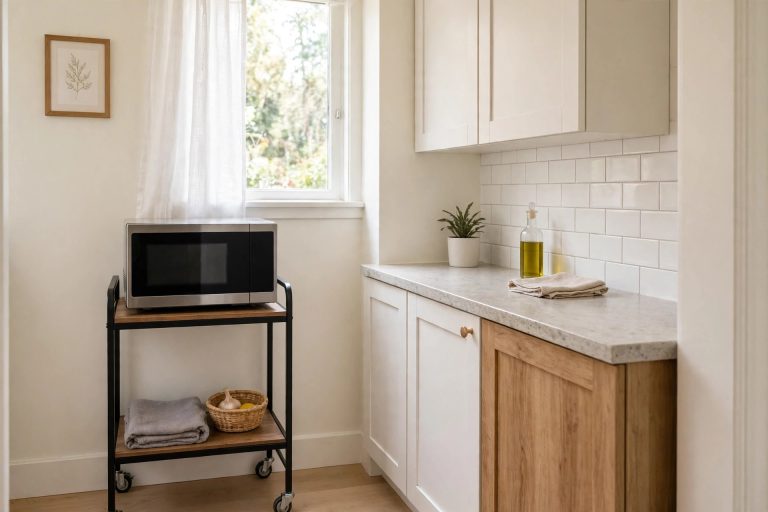
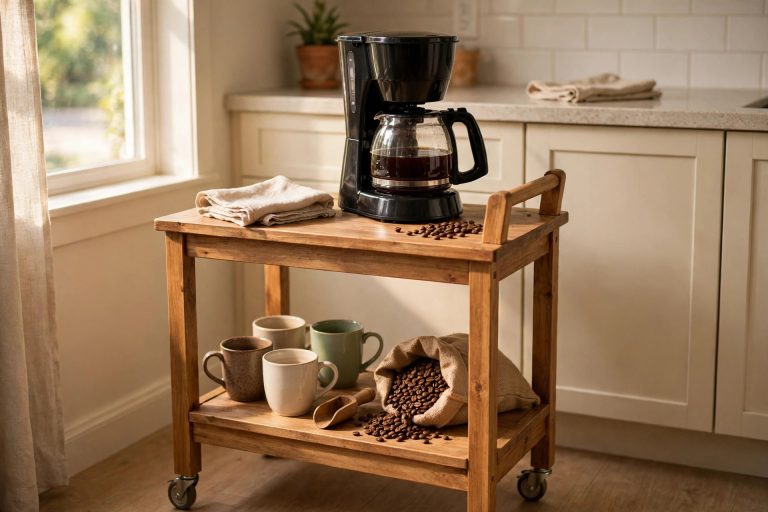
A slim rolling cart is the best kettle home for kitchens with almost no counter at all. Put the kettle on the top shelf, mugs and tea on the middle shelf, and backup supplies below. Roll it next to the counter when you boil, roll it against a wall or into a pantry gap when you cook. Because the top shelf is open, steam rises freely, which solves the steam problem completely.
Choose a cart with locking wheels, so it does not roll when you lift a full kettle, and check the top shelf height: you need enough room above it to lift the kettle off its base. A cart also solves the outlet problem if you park it near a free outlet and keep its position fixed for boiling, moving it only when it has cooled.

Spot 3: Inside a Cabinet on a Pull-Out Shelf
Footprint: zero counter space, but only if the cabinet is the right one.
A lower cabinet with a pull-out shelf turns dead cabinet depth into a kettle garage. Slide the shelf out, boil with the shelf extended and steam in open air, slide it back when cool. This only works if you always boil with the shelf pulled out: boiling inside a closed cabinet traps steam and heat, which is exactly the damage you are trying to avoid.
This spot suits kettles you use once or twice a day rather than every hour, because the pull-out step adds friction. It is also the best option if your counter is genuinely full and you refuse to give up prep space. Our small appliance placement guide covers the same pull-out logic for other heat-making appliances, and the same steam warning applies to all of them.
Spot 4: A Sturdy Wall Shelf Above Counter Height
Footprint: zero counter space, and the kettle stays visible and reachable.
A wall shelf mounted at a height where you can lift the kettle straight off without stretching works well for lightweight kettles, especially in kitchens where the counter is a single short run. The shelf must be rated for the kettle’s weight plus a full kettle of water, and it must sit near an outlet so the cord does not cross the room.
Skip this spot if you are renting and cannot drill, or if the shelf would sit above head height. A kettle that requires a step stool is a kettle that will fall one day. For rentals, a freestanding cart beats a wall shelf every time.
Spots to Avoid
Three spots look clever and cause trouble. First, directly under upper cabinets with tight clearance, for the steam reason above. Second, on top of the fridge: it is too high to lift safely, the cord rarely reaches an outlet cleanly, and fridge tops collect heat and dust. Third, beside the stove: splashes, heat, and a cord near burners are a bad combination, and the kettle competes with cooking for the same small stretch of counter.
Also avoid the windowsill. It looks charming and it blocks light, collects condensation, and puts a hot appliance where curtains or blinds can brush against it.
The 60-Second Placement Test
Before you commit to a spot, run this test. Put the kettle there, fill it, and boil it once. While it boils, check four things: steam has open air above it, the cord reaches its own outlet without stretching, you can lift the kettle off its base without hitting anything, and you can set a mug down beside it without moving something else. If all four pass, you have found the kettle’s home. If any one fails, try the next spot on this list before you rearrange the whole kitchen around a bad one.
Can I put my kettle under my upper cabinets?
Only if there are at least 12 inches of open space above it, and even then, slide it to the front edge of the counter while it boils. Steam trapped under a cabinet warps wood and peels laminate over time.
How much clearance does a kettle need?
Allow at least 12 inches of open air above the kettle for steam, 6 inches clear on the steam side, and enough lift room to take the kettle off its base without hitting a shelf.
Can a kettle share an outlet with a microwave?
No. Both draw 1200 to 1500 watts, and sharing an outlet or power strip is the most common cause of tripped kitchen breakers. Give the kettle its own wall outlet.
Where should a kettle go in a rental with no drilling?
A slim rolling cart is the best rental option. It needs no drilling, it gives steam open air, and it parks against a wall or in a pantry gap when you need the floor space.
Is it safe to store a kettle inside a cabinet?
Yes, if you only boil with the shelf or door open and the kettle pulled into open air. Never boil inside a closed cabinet, where steam and heat have nowhere to go.