Mixing Wood Tones in a Living Room Without Matching Everything
Mixing wood tones in a living room often starts with furniture you already own: a floor you are keeping, a cabinet you love, and a coffee table bought at a different time. These pieces do not need identical finishes. The more useful question is whether their differences look comfortable together from the places where you actually use the room.
Before replacing anything, identify the combination that bothers you. Is a table almost the same color as the floor, but slightly pinker? Does one dark cabinet feel isolated? Or are several strongly patterned surfaces competing for attention? Each problem calls for a different adjustment.
Read the Finishes You Already Have
Look at the visible finish rather than relying on a label such as “oak,” “walnut” or “natural.” Those names alone do not tell you exactly how two finished pieces will look together.
Compare three separate qualities: how light or dark the surface looks, the color you notice within the brown, and how prominent the grain appears. A pale golden table and a deep brown cabinet may be very different in darkness while still feeling related. Two medium-brown pieces can look less comfortable together if one appears rosy and the other grayish.
You do not need to assign every piece a perfect undertone label. Describe what you can see: “more golden than the floor,” “darker and less orange,” or “a much busier grain.” Those comparisons are more useful than deciding that every piece of a particular wood species must belong to the same color family.
Room & Board’s guide to mixing wood tones suggests shared undertones as one way to connect different finishes. Treat that as a starting point for comparison, rather than a reason to discard a piece you enjoy.
Choose What Leads When Mixing Wood Tones
Start with the wood surface that has the strongest presence and is least likely to change. That may be an exposed floor, built-in shelving or a substantial cabinet. A floor mostly covered by a rug may contribute less to the view than a tall bookcase directly opposite the sofa.
Stand in the doorway, then sit in your usual seat. Notice which wooden surfaces you see together. A side table hidden behind a sofa arm does not need the same attention as a coffee table sitting directly in front of a large media cabinet.
Use that main surface as your reference when considering another piece. You can repeat some of its warmth, introduce a clearly lighter or darker finish, or choose a different material where another wood surface feels unnecessary.
There is no need to buy a matching set to settle the room. If your existing pieces are comfortable and useful, first try changing their placement or the surfaces around them. Our guide to refreshing your home with what you have offers ways to test a change before turning it into a shopping project.
A Worked Example: A Honey-Colored Floor and a Dark Cabinet
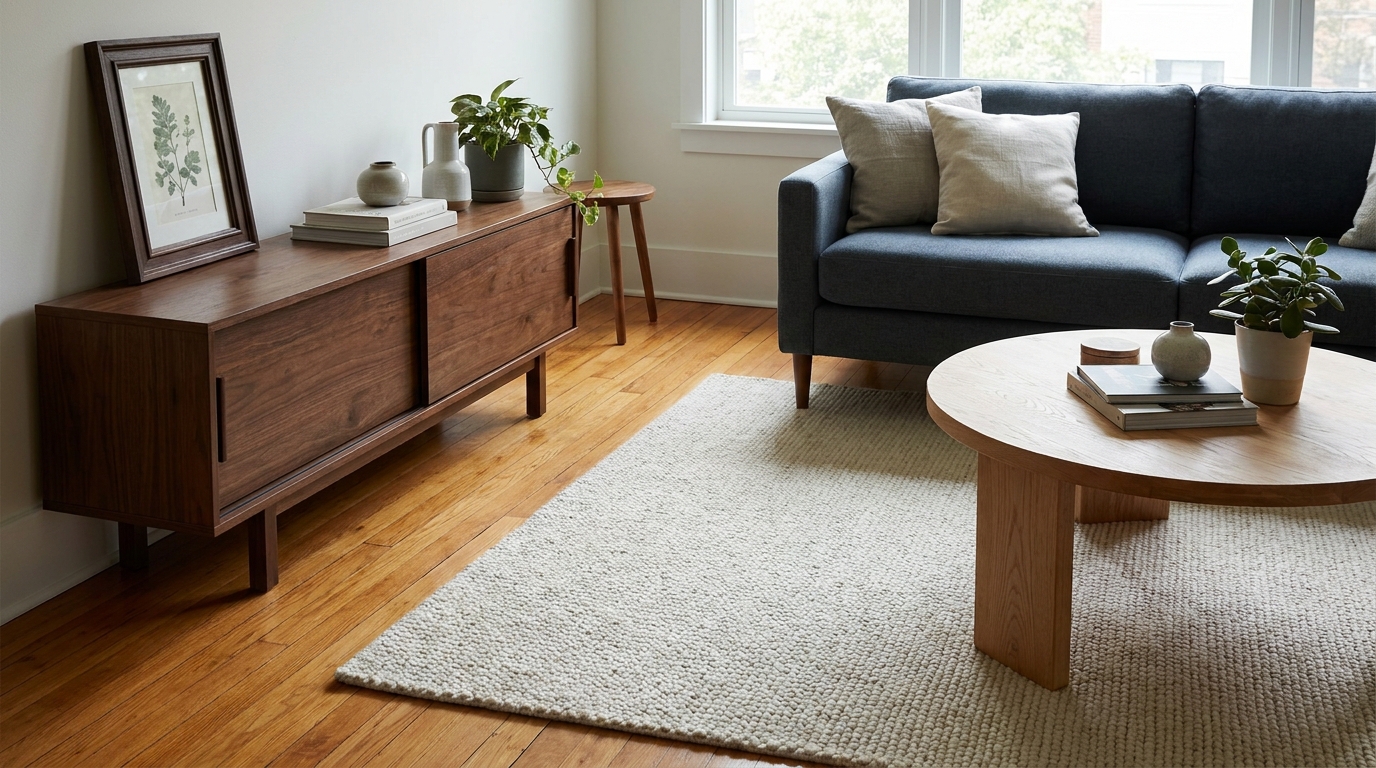
Imagine a living room with honey-colored flooring, a dark brown cabinet, a pale wood coffee table and a charcoal-blue sofa. This is an illustrative arrangement, not a photographed makeover or a tested result.
The floor supplies most of the visible wood color. Keep it as the starting point. The dark cabinet can remain a deliberate contrast instead of becoming something the coffee table must copy.
Next, look at the pale table against the floor. If its outline gets lost, try an existing rug beneath the seating area. The purpose is to see whether separating the two wood surfaces improves the view. A rug cannot change the table’s finish, but it changes what sits immediately around it. Check the rug’s size and furniture placement as well as its color.
If the cabinet still feels isolated, temporarily move a dark wooden frame you already own into the same view. Keep it only if you prefer the result. Repeating a color can connect the arrangement, but the room does not need extra ornaments simply to satisfy a matching rule.
Finally, judge the whole group from the sofa. You may decide the pale table works well once the floor is partly separated from it. If it still looks pink beside the golden floor, that specific pairing deserves attention; the cabinet does not automatically need replacing too.
Use Contrast Where a Near-Match Looks Accidental
Trying to find a finish that is almost identical to an older piece can make small differences more noticeable. Before pursuing the closest possible match, compare it with an option that is clearly lighter or darker.
For example, beside a medium-brown cabinet, compare both a similar medium-brown sample and a noticeably lighter one. The lighter finish may create a distinction you prefer. That does not make the near-match wrong; it gives you another direction to assess before committing.
Also separate color from visual texture. A strongly figured table beside a heavily grained cabinet may feel busy even if their colors relate. Try removing patterned accessories from that view before assuming the wood colors are the problem.
If you already have several prominent wood surfaces, the next useful piece could be upholstered, painted or metal. Choose it for its job and its relationship to the room, rather than adding another finish to complete an imagined collection.
Troubleshoot the Combination That Bothers You
Change one thing at a time. These are small visual experiments you can try before buying furniture or altering an existing finish.
| What you notice | What to try first | What to check afterward |
|---|---|---|
| The coffee table disappears against the floor. | Test an existing rug beneath the seating group. | Can you now distinguish the table without making the room feel crowded? |
| One dark cabinet looks disconnected. | Try a dark frame or another existing dark accent elsewhere in the same view. | Does the repetition help, or does it simply add clutter? |
| Two neighboring finishes almost match but look uncomfortable together. | Separate the pieces temporarily, or compare a clearly contrasting sample. | Is the problem the pairing rather than either piece alone? |
| The room feels busy despite similar wood colors. | Temporarily remove patterned accessories around the strongest grain. | Was pattern competing with pattern more than color with color? |
| A new finish looks different from its online photograph. | Compare a physical sample in its intended position. | Do you like it beside your actual furniture under the lighting you use? |
Compare Real Samples Before Changing a Good Piece
When samples are available, bring them into the room together. Studio McGee describes comparing material samples in its Oaks Project, rather than judging each finish separately.
Place a tabletop sample horizontally near the existing table or floor. Hold a cabinet-finish sample vertically where the cabinet would stand. Look in daylight and again with your usual evening lights. Include a small area of the sofa fabric or rug in the comparison so you are judging the room’s materials together.
For an open living-and-dining space, compare round vs rectangular dining tables for fit before choosing a wood finish.

A sample is a comparison aid, not a promise that an entire piece will have exactly the same pattern. Ask the seller about the finish, expected variation and return conditions before ordering an expensive item.
Before making a final choice, write down what the change should improve: “make the table distinct from the floor,” “connect the dark cabinet to the seating area,” or “reduce the number of competing patterns.” If you cannot name the problem, keep the furniture for now. Mixing wood tones should help you enjoy useful pieces together, not create a reason to replace a room that already works.